
The master guide to building a data strategy for digital transformation that connects enterprise data to faster decisions, stronger agility, and measurable business outcomes.
Over the past few years, organizations have invested heavily in digital transformation initiatives. From expanding cloud platforms and adopting advanced analytics tools to integrating AI into daily operations, enterprises have spent millions trying to modernize how they operate and make decisions.
Yet despite all that, many leadership teams still struggle with a frustrating reality: decision-making often feels just as slow as before the transformation began.
According to Backlinko’s 2026 Digital Transformation Statistics Report, only about one-third of digital transformation initiatives achieve their intended outcomes. That gap usually has less to do with technology itself and far more to do with how organizations manage and use their data across the business.
Many enterprises continue focusing on systems, pipelines, and platform deployments without fully connecting those investments to operational goals and business performance.
Data, therefore, remains fragmented across departments, reporting stays inconsistent, and teams spend more time searching for insight than acting on it.
However, digital transformation moves differently when data becomes part of the business strategy instead of sitting quietly in the background as a technical function.
A clear data strategy for digital transformation helps organizations align enterprise data with operational priorities, business outcomes, and long-term growth objectives.
Continue reading to explore how data strategy supports digital transformation, how enterprises design an effective enterprise data and analytics strategy, and how organizations can turn common roadblocks into long-term operational capabilities.
The Strategic Engine: What Role Does Data Strategy Play in Digital Transformation?
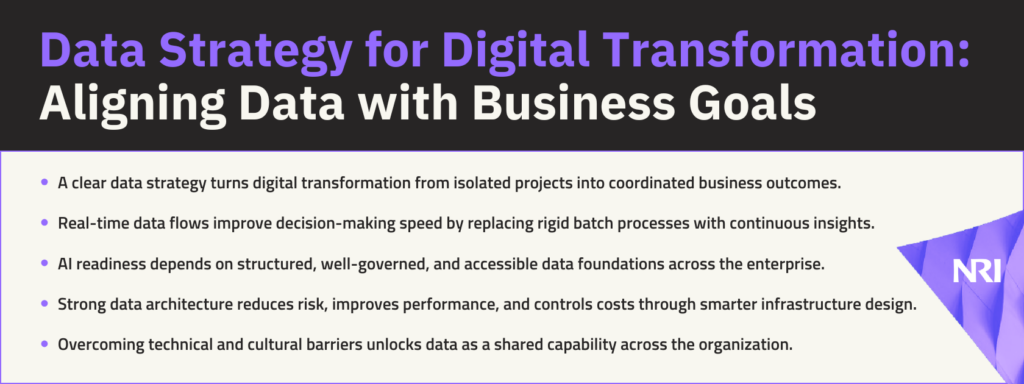
A data strategy keeps digital transformation aligned with business goals. It connects data, systems, and decision-making in ways that help organizations move faster, improve visibility, and create measurable business outcomes across the enterprise.
Here are the core ways data strategy supports digital transformation.
- Enterprise alignment across initiatives
The right data strategy for digital transformation helps teams operate from shared data standards, priorities, and business definitions. As a result, information flows more consistently across systems, and departments avoid building disconnected solutions that create duplication and operational friction later.
Organizations therefore achieve better alignment across transformation initiatives because teams work toward shared business outcomes. Not isolated technical goals. In addition, leadership teams gain clearer visibility into how transformation investments support enterprise performance.
- Modernization of data as an enterprise asset
Many organizations still rely on fragmented systems that make data difficult to access across the business. A strong enterprise data and analytics strategy replaces that fragmentation with integrated structures that improve accessibility, support real-time insight, and help teams make faster operational decisions.
- Built-in security and governance
A powerful data strategy builds security and governance directly into modernization efforts from the beginning. Compliance requirements, security controls, and risk policies become part of the system design, helping organizations maintain trust, reduce operational risk, and support transformation with greater confidence.
Designing an Enterprise Data and Analytics Strategy
Designing an enterprise data and analytics strategy requires more than selecting tools or platforms. It requires a clear structure that connects data movement, intelligence readiness, and infrastructure design into one coordinated system.
A clear data strategy for digital transformation also ensures data supports both immediate operational needs and long-term innovation goals. The focus shifts toward building capabilities that scale with business growth and evolving technology demands.
Below are the key areas that shape a modern enterprise’s data and analytics strategy.
- Real-time data flow enablement
Many organizations still rely on batch processes that delay insight and slow decision-making. A modern approach focuses on continuous data movement, enabling systems to reflect what is happening across the business in real time, helping teams respond faster and make more accurate operational decisions.
Real-time flows also reduce the delays caused by scheduled updates and disconnected reporting cycles. Data becomes immediately usable across analytics platforms, enabling organizations to respond faster to changing business conditions.
- AI-ready data foundations
AI success depends heavily on data quality, structure, and accessibility. Organizations that prepare early create systems that keep data governed, organized, and accessible for model training, analytics, and inference.
Preparation also reduces operational friction that often slows AI adoption later. Teams can test and deploy models faster because the underlying data systems already support advanced analytics and machine learning workloads.
- Optimized cloud architecture
Cloud adjacency keeps data and computing resources closer together, improving performance and reducing unnecessary data movement across systems. Organizations therefore gain faster processing, lower latency, and more efficient infrastructure usage over time.
Better architectural decisions also help control costs tied to excessive data transfer and fragmented infrastructure design. In addition, approaches like cloud-adjacent data management support scalability while helping organizations balance performance, compliance, and operational efficiency.
Flipping Roadblocks into Capabilities
Digital transformation efforts often slow down when organizations run into long-standing technical and cultural barriers. However, a clear data strategy helps turn those barriers into opportunities that support more scalable and adaptable operations.
Navigating Technical Debt
Many organizations still rely on difficult-to-replace legacy systems. Fear of major disruption often accompanies the notion of replacing these. A layered data approach allows teams to modernize gradually on top of existing systems, which keeps operations stable while introducing new capabilities over time.
That approach also reduces operational risk because core systems remain intact while data access, visibility, and usability continue improving. In addition, organizations gain more flexibility to modernize architecture without relying on constant infrastructure overhauls.
Overcoming Cultural Inertia
Data often remains isolated within IT teams, slowing how quickly business units can act on insights. A more distributed ownership model encourages collaboration and gives teams greater responsibility for how they use, interpret, and apply data across operations.
As a result, accountability improves, and decision-making becomes faster across the organization. Not only that, but data also becomes part of daily business operations. No longer is it locked inside a centralized technical function.
Accelerate Digital Transformation Outcomes with NRI
Digital transformation is a continuous evolution, and a clear data strategy keeps that momentum moving in the right direction. Organizations that treat data as a strategic asset often outperform those that still rely on fragmented systems and disconnected modernization efforts.
If your organization is looking to close the gap between data ambition and execution, partnering with NRI North America can help you get there with confidence. We help enterprises design scalable data strategies, strengthen governance, modernize analytics capabilities, and prepare enterprise data systems for AI-driven growth.
Ready to align your data strategy with real business outcomes? Schedule a data strategy workshop with NRI to explore how your organization can move from disconnected systems to a more integrated, insight-driven enterprise.
Ready to align your data strategy with real business outcomes? Schedule a data strategy workshop with our team to explore how your organization can move from disconnected systems to a fully integrated, insight-driven enterprise.