
Don’t just choose a digital transformation framework based on hype; align your approach to strategy, governance, and execution to drive real transformation outcomes.
Most organizations don’t struggle with a lack of digital transformation frameworks. They struggle with choosing the right one.
What initially seems like a straightforward decision becomes more complicated once you start comparing the many “proven” models that all promise faster ROI and smoother execution. The challenge is not the number of options available, but the difficulty in determining which framework actually aligns with how your organization operates and what you are trying to achieve.
From agile-led approaches to enterprise architecture-driven models, each framework requires a different level of commitment, investment, and organizational change. With so many directions to choose from, decision-making can slow down, and progress stalls as teams spend more time evaluating options rather than moving forward. Analysis paralysis sets in, delaying meaningful transformation.
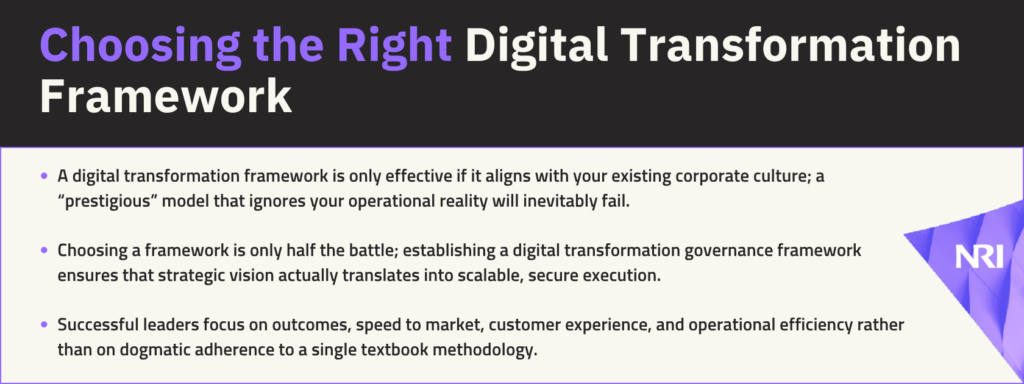
View a digital transformation framework as a structured approach that supports your broader strategy, rather than something to adopt for its own sake. Its effectiveness depends on how well it fits your organization’s structure, culture, and priorities, and the feasibility of implementation across teams.
When you shift your focus from identifying the “best” framework to selecting the right digital transformation framework for your specific environment, the decision becomes clearer and more practical. This shift allows you to move forward with confidence and avoid getting stuck in continuous comparison without action.
This guide will help you cut through the noise, evaluate frameworks with a practical perspective, and choose an approach that supports execution and measurable outcomes.
The Taxonomy of Choice: Categorizing the Big Three
Evaluating every digital transformation framework individually is not necessary to make a confident decision. Most frameworks follow a few clear patterns in how they approach transformation, and understanding those patterns makes it much easier to narrow the field.
At a high level, most frameworks fall into three categories based on what they prioritize: strategy, execution, or people. Each category addresses a different challenge, and identifying the primary constraint within the organization helps bring focus to the decision.
- Strategic or conceptual frameworks
These frameworks establish clarity at the highest level. They focus on long-term direction, business model evolution, and how technology supports enterprise-wide objectives.
This approach is most relevant when leadership alignment is lacking or when there is still uncertainty around what transformation should achieve. Frameworks from institutions like MIT Sloan are often used in this context because they provide structure around vision, value creation, and competitive positioning.
They are valuable for setting direction, but they do not, on their own, drive execution. Their role is to ensure that what follows is grounded in a clear and shared strategy.
- Execution-led frameworks
Execution-led frameworks center on delivery. Their purpose is to help organizations move faster, reduce friction, and translate strategy into consistent, repeatable outcomes.
Approaches like Scaled Agile Framework or McKinsey’s Digital Factory model introduce structured workflows that prioritize speed, iteration, and continuous delivery. These frameworks are often adopted when the strategy is defined but execution remains inconsistent or slow.
They are effective at building momentum and improving time-to-market, but they require coordination and discipline across teams. Without that structure, increased speed can quickly lead to misalignment.
- Culture-first frameworks
This category focuses on the often underestimated human side of transformation. It addresses leadership behavior, team dynamics, and the introduction and sustainment of new ways of working.
Culture-first frameworks become especially important when resistance, low engagement, or internal silos slow progress. Even well-defined strategies and delivery models struggle to succeed if adoption does not follow.
These frameworks help create the conditions for transformation to take hold and scale by ensuring the team aligns with the implementation of change.
Decision Matrix For The C-Suite
Choosing the right digital transformation framework becomes more practical when the focus shifts from external trends to how the organization actually operates. Every organization has its own structure, constraints, priorities, and ways of working, and those factors should carry more weight than any widely adopted model.
- Legacy vs. digital-native environments
Organizations operating in legacy environments tend to prioritize stability, compliance, and integration with existing systems. In these cases, frameworks that support structured change and gradual modernization are more effective than those built for rapid disruption.
Digital-native environments operate differently. Speed, experimentation, and adaptability are often built into how teams work, making execution-led frameworks a more natural fit, as they support rapid iteration and continuous delivery without the added complexity of legacy constraints.
- Assessing time to value
Time-to-value is another critical consideration. Some frameworks are designed for long-term transformation, where results take time to materialize but lead to deeper, sustained change. Others focus on delivering quick wins that create momentum and demonstrate progress early.
The right choice depends on what the organization can realistically support. When leadership expectations center on near-term results, execution-led approaches can help build confidence and show measurable progress. When the priority is long-term reinvention, strategic frameworks provide the structure needed to rethink business models and guide sustained transformation.
Balancing immediate impact with long-term readiness is essential. Overemphasizing speed can lead to short-term gains without lasting value, while focusing only on long-term change can delay visible results.
The Role of a Digital Transformation Governance Framework
Even the most well-designed framework will struggle without a governance layer. You need a structure that manages cross-functional dependencies, aligns priorities, and ensures teams are not working at odds with each other.
Without governance, execution becomes fragmented and inconsistent. One team may follow an agile model, while another sticks to traditional processes, creating friction and slowing overall progress.
Governance provides visibility and coordination across the transformation effort. It helps align initiatives, manage risks, and ensure decisions support shared business outcomes rather than isolated team goals.
Standardizing how success is measured is equally important. A unified KPI dashboard allows you to track performance consistently, regardless of the framework or methodology different teams use.
When teams operate from the same set of metrics, alignment improves across leadership and execution, making it easier to track progress and adjust direction as needed.
FAQ / Key Questions
- Can you mix and match elements from multiple frameworks?
Yes, and in most cases, you should. No single framework covers every need, so combining elements lets you tailor your approach to your organization’s structure, goals, and maturity level.
- How do you pivot if a chosen framework is not gaining traction?
You need to assess where the breakdown is happening, whether in adoption, execution, or alignment. From there, you can adjust specific components without abandoning the entire approach, which allows you to stay flexible while keeping your transformation on track.
Align Your Digital Transformation Framework with NRI Advisory Support
Complexity is the enemy of execution. When transformation efforts become overloaded with frameworks, models, and competing priorities, progress stalls, and teams struggle to move from strategy to action.
The best digital transformation framework is not the most sophisticated one. It is the one your organization can adopt and sustain without constant friction.
NRI takes a practical, execution-focused approach to help align strategy, governance, and delivery into a clear path forward. We support you in selecting and adapting frameworks that fit your environment and can be implemented effectively.
Talk with an NRI transformation advisor today to simplify your approach and accelerate meaningful results.