
Most organizations have more data than ever, but still struggle to turn it into reliable insight. Here’s how to build an enterprise data and analytics strategy that connects architecture, governance, and outcomes to scale AI with confidence.
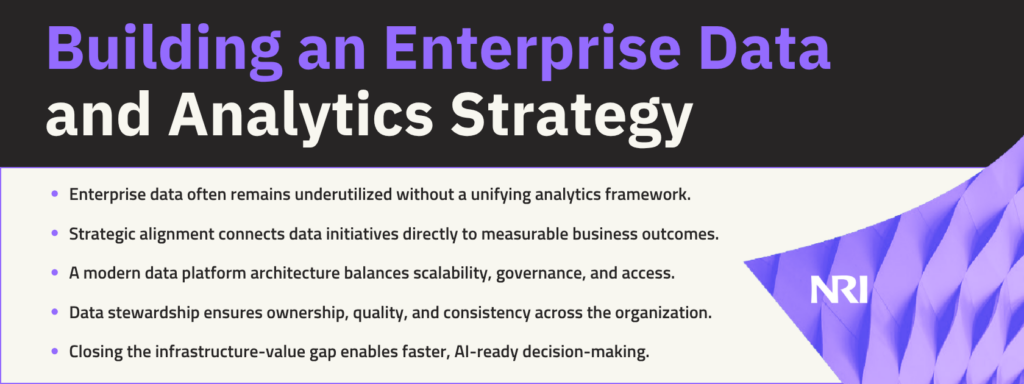
According to Merkle research, 68% of enterprise data goes unused. The challenge isn’t the availability of data, but how disconnected it remains across platforms, teams, and processes.
When scattered across systems and tools, more data does not automatically lead to better decisions. Without a unifying structure, analytics efforts tend to fall back on reactive reporting, offering visibility into what has already happened but little direction on what should happen next.
Closing this gap requires a shift from reactive reporting to a more proactive, AI-ready approach. Instead of simply explaining past performance, this approach focuses on integrating, governing, and activating data to support faster, forward-looking decisions continuously.
This guide explores the key components of an enterprise data and analytics strategy, how to design the supporting enterprise data platform architecture, and how to turn common challenges into opportunities for scalable growth.
The blueprint: what should an enterprise analytics strategy include?
An effective enterprise analytics strategy provides structure for how data is collected, managed, and used to inform decisions that support business outcomes. Without that structure, data initiatives often operate in isolation and struggle to deliver measurable impact.
A few core components comprise a strong strategy. These work together to ensure data creates consistent value across the organization:
- Strategic alignment
Strategic alignment connects data and analytics initiatives directly to business goals. It ensures that data efforts support measurable outcomes, particularly those tied to revenue, cost, and profitability.
When alignment is clear, data stops being a support function and becomes a driver of business performance.
- The architectural foundation
The component focuses on balancing centralized governance with decentralized access. Consistent standards for data quality, security, and compliance are maintained, while teams still have the flexibility to access and use data quickly for their specific needs.
A well-designed enterprise data platform architecture enables this balance, making it easier to scale analytics without losing control.
- Data stewardship
Data stewardship establishes clear ownership for maintaining the quality, consistency, and reliability of enterprise data. It defines who is responsible for accuracy, governance, and lifecycle management across the organization.
These elements create a cohesive framework that turns enterprise data from a technical asset into a strategic driver of performance.
The engine room: enterprise data platform architecture
Enterprise data platform architecture serves as the engine room of your analytics strategy. It defines how data moves, where it resides, and how quickly it can be turned into insights that support decision-making across the business.
It directly impacts speed, reliability, and scalability. When it is well designed, teams can access and act on data with confidence. When it is not, delays and inconsistencies begin to affect outcomes.
Modernizing the data stack involves moving beyond legacy data warehouses that limit flexibility and slow access to insights. More agile environments support real-time processing, diverse data types, and evolving analytics requirements, making it easier to keep pace with changing business needs.
Cloud adjacency plays a key role in this case. Keeping data closer to where it is generated and used reduces latency and improves performance. At the same time, it supports data sovereignty and compliance requirements while enabling faster, more responsive decision-making.
Navigating the roadblocks: from obstacle to opportunity
While enterprise data challenges often appear as constraints, they can strengthen your analytics foundation when addressed early. Left unresolved, these issues compound over time, making it harder to scale analytics and AI effectively.
Here are two of the most common challenges and how to turn them into opportunities for improvement:
- Addressing data debt
Data debt builds up when legacy systems, redundant pipelines, and inconsistent data models are left unresolved. It often results from prioritizing speed over structure, with new tools layered on top of existing systems without addressing underlying inefficiencies.
Addressing data debt starts with identifying where these issues create the most friction. Modernization then happens in phases, beginning with the systems that have the greatest impact on reporting and decision-making. This approach improves data quality and scalability while maintaining operational continuity.
- Closing the trust gap
The trust gap emerges when decision-makers lose confidence in data and AI insights. This often happens when definitions are inconsistent, data quality is uneven, or reports conflict across systems.
Closing this gap requires enforcing consistent data standards and applying automated quality checks throughout the data lifecycle. Aligning teams around shared definitions and governed datasets ensures that decisions are based on a single, trusted version of the truth.
Addressing these roadblocks proactively can transform operational constraints into long-term advantages, improving data reliability and decision-making speed.
How do you measure the ROI of a multi-year data transformation?
ROI is measured by linking data capabilities directly to business outcomes such as revenue growth, cost reduction, and operational efficiency. Rather than focusing only on infrastructure outputs, the focus shifts to how improvements in data access, quality, and speed lead to faster decisions, reduced manual effort, and stronger financial performance over time.
Who should own the “Golden Record”—IT or the business units?
Ownership of the “Golden Record” should be shared but clearly governed. IT manages the infrastructure and data integrity, while business units define what accurate data means in context. This model ensures data remains both technically reliable and operationally relevant, with accountability aligned to usage.
Unlock scalable data built for the future with NRI
An enterprise data and analytics strategy is not a static endpoint. It evolves alongside your business, data maturity, and technology landscape, adapting to new demands and priorities over time.
NRI helps organizations turn strategy into a scalable, future-ready foundation. Its services include aligning data initiatives with business outcomes, modernizing enterprise data platform architecture, and strengthening governance to ensure data remains reliable and actionable.
Support also extends to accelerating AI readiness by structuring data environments for speed, scale, and consistency.
If you are ready to close the gap between data and decisions, schedule an Enterprise Data Strategy Assessment with NRI.