
Avoid tool sprawl and reactive firefighting by adopting a cybersecurity governance framework that provides structure for your security program and enables strategic resilience.
Cyber threats are no longer isolated incidents that security teams can handle on a case-by-case basis. They are continuous, adaptive, and increasingly driven by automation, which makes traditional defensive approaches harder to sustain over time.
According to the CrowdStrike 2026 Global Threat Report, cyber-attacks driven by AI-enabled adversaries have increased by 89%. This surge highlights how quickly attackers are scaling their capabilities, often outpacing traditional security approaches.
In response, many organizations invest in more tools to keep up with evolving threats. While this can strengthen specific areas of defense, it often introduces new challenges. Additional solutions can create blind spots, fragment data, and lead to inconsistent policies across the environment.
More technology alone does not solve the problem. What is often missing is structure, a way to align decisions, define accountability, and ensure every control supports a shared objective.
This is where a cybersecurity governance framework becomes critical. It provides the structure needed to connect business priorities with security operations, enabling consistent, risk-informed decision-making across the organization.
Keep reading to explore key cybersecurity frameworks, understand how to build a unified enterprise cybersecurity strategy, and learn how to overcome common implementation challenges.
What Cybersecurity Frameworks Exist?
A cybersecurity governance framework provides the structure needed for rapid, compliant decision-making. It defines how threats are identified, how systems are protected, and how incidents are detected, responded to, and recovered from consistently.
Instead of relying on scattered tools and ad hoc decisions, a framework aligns security activities with business priorities. It also creates a shared understanding across teams, so expectations around security are clear and consistent in practice.
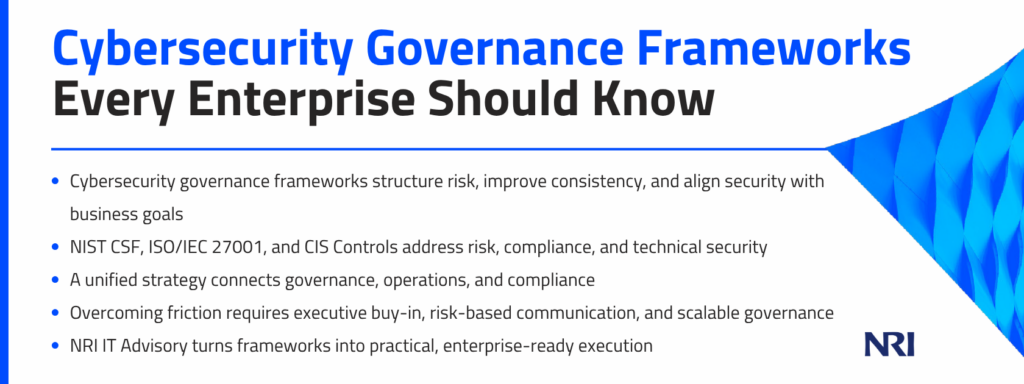
With that foundation in place, the next step is understanding the cybersecurity frameworks most widely used in enterprise environments. Each offers a different approach depending on your risk profile, regulatory needs, and operational priorities.
- NIST cybersecurity framework
The NIST cybersecurity framework is widely recognized as a leading model for risk-based security management. It organizes security efforts around five core functions: identify, protect, detect, respond, and recover.
This framework is especially useful when flexibility is required, as it allows organizations to align security practices with business risk rather than follow rigid compliance structures.
- ISO/IEC 27001
ISO/IEC 27001 is an international standard for establishing an Information Security Management System. It provides a structured approach to managing sensitive data through defined policies, controls, and continuous improvement.
It is often used when organizations need globally recognized assurance for customers, partners, and regulators.
- CIS controls
CIS Controls offer a prioritized set of technical best practices for quickly reducing risk. They emphasize practical actions such as asset inventory, secure configuration, and access control.
This approach is particularly valuable when immediate improvements in security hygiene are needed without adding unnecessary complexity.
How to Build a Unified Enterprise Cybersecurity Strategy
A unified enterprise cybersecurity strategy connects governance, risk, and compliance into a single, coherent approach. It ensures security efforts remain consistent, measurable, and aligned with business priorities, rather than being spread across disconnected initiatives.
Here are the key steps you should focus on:
- Align with regulatory requirements
Map your cybersecurity frameworks to the specific regulations that apply to your organization, such as HIPAA, PCI DSS, or GDPR. Mapping ensures controls are both effective and compliant with legal and industry expectations, while reducing audit pressure by embedding compliance into your security design.
- Move beyond check-the-box compliance
Compliance alone does not protect against modern threats. The focus should shift toward operational security that strengthens real-world resilience rather than meeting minimum requirements. This approach helps address actual security gaps instead of simply passing audits.
- Leverage IT advisory consulting
Bridging the gap between policy and execution often requires external support. IT advisory consulting helps translate governance requirements into practical controls that teams can implement effectively, ensuring the strategy is both well-designed and executable.
When compliance, operations, and execution are aligned, security efforts become more structured and resilient, supporting a unified enterprise cybersecurity strategy that holds up under pressure.
From Roadblock to Opportunity: Overcoming Implementation Friction
When cybersecurity priorities do not align with business outcomes, implementation friction often arises. Strong technical plans alone are not enough if they cannot be translated into risk and value that leadership understands.
Securing board-level support depends on quantifying cyber risk in business terms. Translating threats into financial exposure, operational downtime, and reputational impact makes governance more tangible and strengthens the case for investment.
With alignment established, the next challenge is scale. Governance must extend across hybrid and multi-cloud environments where visibility is fragmented, and control is distributed. Consistent policies, centralized oversight, and adaptable controls that remain effective across platforms are required.
An effective enterprise cybersecurity strategy moves from reactive fixes to proactive, architected resilience. Governance becomes a driver of both stability and agility across the organization.
FAQ / Key Questions
How do we choose between NIST and ISO for an international organization?
Consider how the organization operates across regions and the level of regulatory alignment required. NIST CSF offers flexibility for risk-based security programs, while ISO/IEC 27001 supports formal certification and global regulatory recognition. Many organizations use both together, combining operational flexibility with external assurance.
How often should a governance framework be audited for efficacy?
A cybersecurity governance framework should be reviewed at least annually to stay aligned with evolving risks and business priorities. In highly regulated or high-risk environments, more frequent reviews such as quarterly assessments may be necessary. Continuous monitoring also helps identify and address gaps in real time.
Move from Framework to Execution with NRI IT Advisory
True agility in cybersecurity comes from structure, not speed alone. When your cybersecurity governance framework is clear and consistent, your organization can respond to change without losing control or increasing risk.
Strong governance ensures security investments protect the organization’s most critical business assets. It gives security teams the confidence to support new initiatives, adopt new technologies, and enable growth without compromising security.
Turning strategy into execution requires more than defined policies. It requires alignment between governance frameworks and day-to-day operations.
Here, IT advisory consulting plays a critical role. NRI helps bridge the gap between policy and practice by aligning cybersecurity governance frameworks with real-world execution, enabling security programs to operate effectively at scale.
If you are ready to strengthen your security structure and move from complexity to clarity, contact our IT Advisory team for a tailored framework assessment.