
Close the gap between data growth and business value by building an enterprise data management strategy that aligns data with measurable outcomes and better decisions.
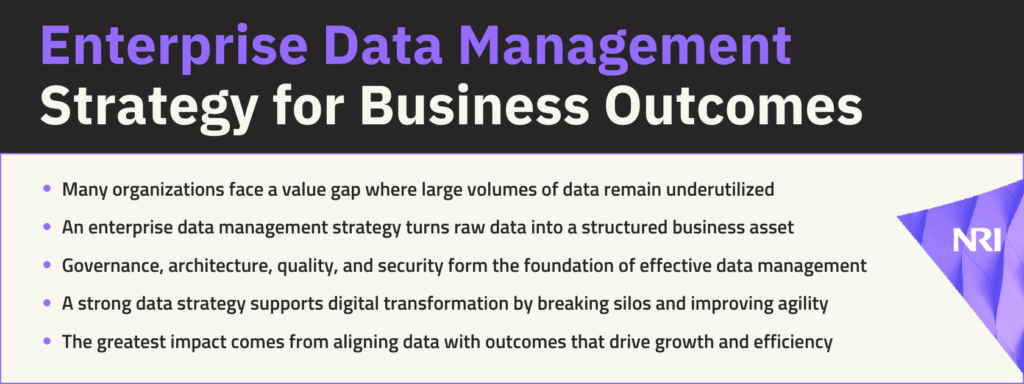
Have you ever asked why growing data still fails to deliver better business outcomes? Many organizations continue to collect and store increasing volumes of data, yet struggle to turn it into meaningful insight, creating a gap between what data promises and what it actually delivers.
It is easy to assume that more data will naturally lead to better decisions, but in practice, that only happens when the right structure is in place. Research from IBM shows that organizations leave between 60% and 73% of their enterprise data unused for analytics, which highlights that the issue is not availability but how data is managed, governed, and aligned with business priorities.
Closing this gap requires a shift in perspective from treating data as something to store toward treating it as something to use with purpose. An enterprise data management strategy provides the structure needed to connect data to outcomes by aligning governance, architecture, quality, and security with business goals, ensuring that data supports decisions and delivers measurable value.
Continue reading to understand what an enterprise data management strategy involves, how it supports digital transformation, and how to turn common roadblocks into opportunities for real business impact.
What is an enterprise data management strategy?
An enterprise data management strategy is the framework for managing data as a business asset rather than an isolated IT resource. It defines how data is collected, organized, governed, protected, and used so it consistently supports business goals and decision-making across the organization.
At its core, the strategy brings structure to how data flows through the enterprise by connecting technology, processes, and people. That structure ensures data remains accurate, secure, and usable throughout its lifecycle, allowing teams to rely on it with confidence.
A strong strategy typically rests on four key pillars:
- Architecture: Designing and integrating data systems so information moves efficiently across the organization
- Governance: Defining ownership, rules, and accountability for how data is used
- Data quality: Ensuring data remains accurate, consistent, and reliable
- Security: Protecting data and maintaining compliance with regulatory requirements
With these foundations in place, the approach shifts from a defensive focus on compliance and risk avoidance toward a more offensive, outcome-driven mindset. Data becomes a driver of growth, supporting new opportunities, improving customer experiences, and enabling faster, more informed decisions.
Connecting that foundation to business impact is what turns strategy into value. Outcome-centric alignment ensures data initiatives tie to measurable results rather than technical milestones.
A well-defined data strategy for digital transformation acts as the engine that converts raw information into actionable intelligence. At the same time, strong data integrity provides the foundation of trust needed to scale AI and analytics reliably.
Building an enterprise data management strategy with that level of alignment and discipline moves data beyond a background function and turns it into a consistent driver of business outcomes.
The catalyst: how data strategy supports digital transformation
Digital transformation does not happen simply by introducing new tools. It takes a well-defined data strategy that connects systems, teams, and decisions to support real business outcomes.
One of the most important shifts is breaking down silos that fragment customer and operational data. A unified view enables organizations to understand customers better, improve operations, and make decisions with greater clarity and consistency.
A strong enterprise data management strategy also improves agility across the business. When data is governed and trusted, teams can test ideas faster and experiment with less risk because they are working with reliable information.
Scalability follows naturally from a strong foundation. Instead of remaining in isolated pilots, organizations can expand analytics and AI initiatives across the enterprise with confidence, knowing that data can deliver consistent, repeatable outcomes.
Turning roadblocks into opportunities
Challenges in data management are often seen as technical limitations, but they usually reflect deeper gaps in structure and alignment. Addressing them early creates opportunities to strengthen both the data foundation and the organization as a whole.
Legacy integration is one of the most common hurdles in enterprise environments. Rather than replacing systems all at once, data abstraction allows organizations to connect legacy platforms with modern environments, enabling gradual modernization without disrupting core operations.
Culture plays an equally important role. Treating data literacy as a core competency ensures that business leaders can interpret and use data effectively in their decision-making, which strengthens alignment between strategy and execution.
By addressing technology and people together, roadblocks become enablers. This approach supports a more adaptable, data-driven organization that can respond to change while continuing to evolve.
Operationalize your enterprise data management strategy with NRI
Collecting more data does not, on its own, create an advantage. Real impact comes when data is operationalized and embedded into the decisions, processes, and outcomes that drive the business forward.
As data becomes operational, it moves out of isolated systems and starts shaping how teams plan, execute, and improve performance. An enterprise data management strategy becomes a true differentiator when it connects data directly to measurable business value.
Achieving that level of alignment at scale often requires both technical depth and strategic direction. NRI works with organizations to design and implement enterprise data management strategies that support digital transformation and long-term growth, ensuring data consistently delivers trusted, actionable insights.
Are you ready to move from data collection to data-driven outcomes? Request a data strategy consultation and explore how your organization can turn data into a competitive advantage.