
Get past legacy systems that struggle with real-time analytics, AI workloads, and scalable processing by building an enterprise data platform architecture that delivers a flexible, high-performance data foundation.
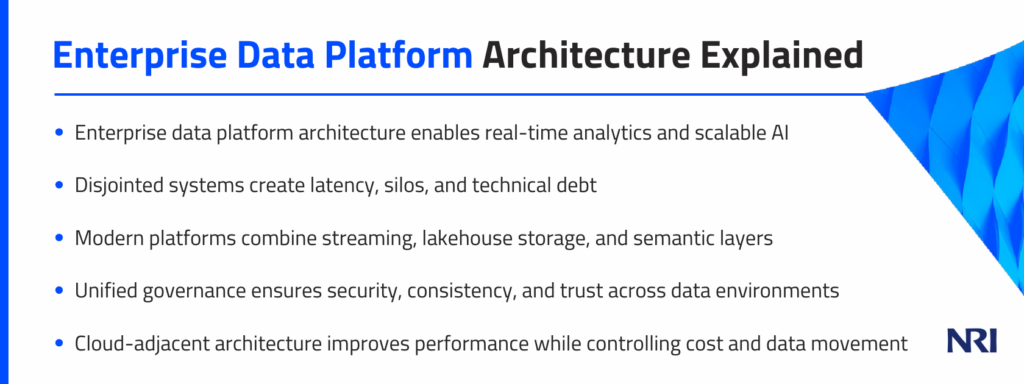
Many warehouse-based systems still rely on batch processing and rigid schemas, slowing data ingestion, processing, and analysis. Those delays make it harder to act on data when timing matters most.
As AI and real-time use cases expand, the gap becomes more visible. Continuous data flow and instant insights are no longer optional. Traditional architectures do not support them. The result is a growing disconnect between what the business needs and what the platform can deliver.
Research from DesignRush shows that 82% of organizations are investing in modern data platforms to close that gap. These platforms move beyond passive storage and use enterprise data platform architecture to turn data into active, real-time intelligence.
This guide outlines how to move away from legacy constraints and design an enterprise data platform architecture that supports speed, scalability, and AI-driven insight. It covers core components, deployment strategies, and practical ways to overcome latency challenges that limit performance.
Core components: what components are required?
Modern enterprise data platforms structure how data moves and scales. These systems ensure teams use information consistently across the organization. They support both real-time and batch workloads while ensuring data remains accessible, secure, and reliable for analytics and operations.
A well-designed enterprise data platform architecture relies on four core components:
- Ingestion layer
The ingestion layer manages how data enters the platform from multiple sources. It supports both batch processing and real-time streaming using technologies such as Kafka and Pulsar, enabling continuous data flow across systems.
- Storage and processing
Storage and processing define how data is handled at scale. Modern architectures like the data lakehouse, supported by technologies such as Delta Lake and Iceberg, allow organizations to store diverse data types while enabling efficient, large-scale analytics.
- Integration and semantic layer
The integration and semantic layer ensures data is consistent and usable across the enterprise. It standardizes definitions, organizes datasets, and makes data accessible to both business users and applications without confusion or duplication.
- Governance and security
Governance and security provide control across the platform. Centralized identity and access management ensures data protection, while governance policies enforce compliance, consistency, and accountability across all layers.
Together, these components create a unified architecture that turns fragmented data into reliable, real-time intelligence.
Strategic deployment: enterprise data platform strategy
Modern enterprise data strategies require more than selecting tools. They rely on deliberate architectural choices that align data ownership, scalability, and access patterns with business needs. The objective is to balance control with agility while enabling data to move efficiently across the organization.
A key decision involves choosing between decentralized and unified models. Data Mesh distributes ownership to domain teams, improving accountability and supporting scalability in large environments. Data Fabric takes a more integrated approach, using automation to connect systems and deliver consistent, real-time access to trusted data.
Another important consideration is cloud adjacency and how it addresses the “data gravity” challenge, where large data volumes become difficult to move efficiently. Processing data closer to where it resides reduces latency, lowers transfer costs, and improves performance for analytics and AI workloads.
Aligning compute resources with data location ensures faster access to large-scale datasets while maintaining efficiency. It also supports scalability by allowing workloads to expand without creating bottlenecks in data movement or system performance.
From roadblock to opportunity: solving the latency trap
Latency remains one of the most common barriers to scaling analytics and AI. Delays in data processing reduce the value of insights and limit how effectively organizations can act in real time.
Overcoming this challenge requires a focused approach across architecture, performance, and cost:
- Scale for AI workloads: Design architectures that support high concurrency and sustained throughput for demanding workloads such as large language model training. Systems must handle multiple processes simultaneously without performance degradation to ensure continuous data access.
- Optimize for performance: Reduce latency by minimizing bottlenecks in data movement and processing. Efficient data pipelines and distributed processing help deliver faster, more reliable insights.
- Control data movement costs:
- Limit unnecessary data transfer and optimize storage usage to reduce egress fees. Smarter data placement and access strategies improve both performance and cost efficiency.
- Balance performance and cost: Align infrastructure design with both technical and financial goals. Scalable architectures should support growth without introducing unsustainable operational costs.
When these elements are aligned, latency shifts from a constraint to an advantage, enabling faster insights, stronger AI performance, and more efficient use of enterprise data.
Engage NRI to transform data into AI-ready intelligence
Designing for infinite scale requires more than incremental improvement to existing systems. It demands an enterprise data platform architecture that can continuously adapt to rising data volumes, AI workloads, and real-time decision needs without compromising performance or governance.
Organizations that succeed in this shift treat data infrastructure as a living system rather than a static environment. They build for elasticity, intelligence, and long-term extensibility so that data becomes a foundation for innovation rather than a constraint.
If you need a partner to guide you through the complexity of building and evolving modern data platforms, NRI can work alongside you to translate ambition into scalable design. We can help you turn data challenges into a clear, scalable foundation that supports AI, real-time analytics, and long-term growth.
Contact us to schedule a talk with a data architecture expert and discuss how to design, optimize, and scale your data environment for evolving business and AI needs.