
With 84% of organizations struggling to manage cloud expenses, choosing the cheapest vendor isn’t always the smartest decision. Use NRI’s 10-criterion scorecard to evaluate costs, risks, and long-term business value.
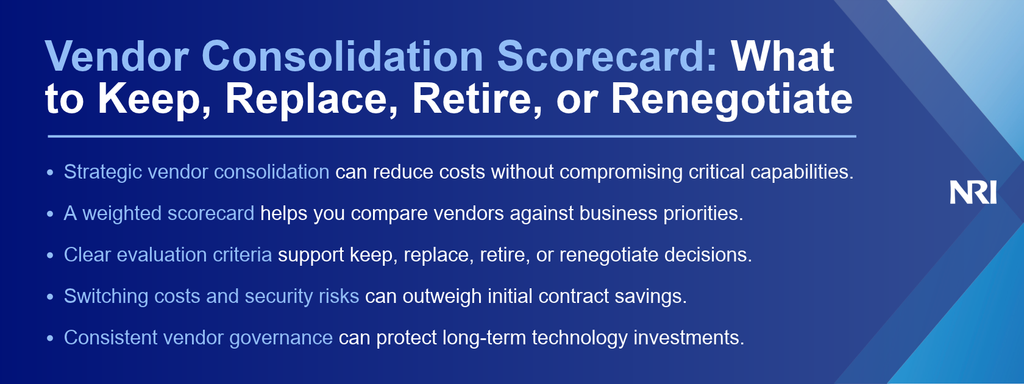
Your IT department may manage several vendors providing similar services, each with separate licenses, renewal dates, and support agreements. What started as individual purchasing decisions can gradually become a costly network of overlapping contracts.
Reducing your vendor count can lower costs and simplify management. But choosing which vendors to keep based on price alone can introduce migration costs, capability gaps, security exposure, and operational disruption.
Effective vendor consolidation requires more than comparing contract prices. IT leaders need to determine which vendors support critical business needs, which contracts should be renegotiated, which tools can be replaced, and which redundant services can be retired.
A weighted vendor scorecard provides the data-driven clarity needed to compare cost, capabilities, security, integration, resilience, and switching risk before deciding what to keep, replace, retire, or renegotiate.
The Weighted Vendor Consolidation Scorecard
Vendor consolidation involves reducing or reorganizing your supplier portfolio to eliminate duplication and simplify IT management. However, before changing contracts, you need a reliable way to compare each vendor’s contributions.
A weighted scorecard helps you evaluate providers against the same criteria, with greater emphasis on your organization’s most important requirements. For example, a regulated organization may give security and compliance more weight, while an organization modernizing a complex hybrid environment may prioritize integration, resilience, and switching costs.
10 Criteria Every Vendor Evaluation Should Cover
Use the following baseline model to assess supplier portfolios. While the below weightings total 100%, IT leaders should calibrate individual percentages to align with specific organizational priorities.
Weighted Vendor Consolidation Scorecard
| Evaluation Criteria | Weight | What to Assess |
| Business and Strategic Fit | 15% | Support for essential business requirements and strategic goals |
| Capability Overlap | 10% | Distinct value relative to capabilities already available elsewhere |
| Integration Health | 10% | Compatibility with current systems and applications |
| Security Posture | 15% | Security controls, compliance, and risk exposure |
| Service Quality | 10% | SLA performance, reliability, and support responsiveness |
| End-User Adoption | 10% | Actual usage and employee dependency |
| Contract and Renewal Timing | 5% | Renewal dates, termination clauses, and commitments |
| Switching Costs | 10% | Migration, retraining, and implementation expenses |
| Operational Resilience | 10% | Availability, disaster recovery, and business continuity |
| Strategic Flexibility | 5% | Scalability, portability, and future business needs |
| TOTAL | 100% | Overall vendor evaluation |
Table note: Score each vendor from 1 (poor) to 5 (excellent). Multiply each rating by its weight, divide by 5, and add the results for a score out of 100.
Calculating the Weighted Vendor Score
Not every criterion carries the same importance. For example, a healthcare organization may prioritize security, while a business with complex infrastructure may place greater weight on integration and resilience.
Score each vendor from 1 to 5 against every criterion, where 1 indicates poor performance, and 5 indicates excellent performance.
Calculate the result using:
Weighted score = Σ (rating ÷ 5 × criterion weight)
A vendor scoring 4 across all ten criteria would earn 80 out of 100 points.
However, don’t let a high overall score override a critical failure. Define non-negotiable requirements, such as necessary security controls, regulatory requirements, or essential business functions, before comparing weighted totals. A vendor that fails one of those requirements should not advance based on its overall score alone.
Use the score as a comparison tool, not an automatic decision rule. Review high-scoring vendors for retention or renegotiation, and investigate lower-scoring vendors for replacement or retirement. Then validate each decision against switching costs, dependencies, contract timing, and transition risk.
How to Decide Whether to Keep, Replace, Retire, or Renegotiate Vendors
Once you’ve evaluated your vendors, the next question is what to do with each relationship.
Your scorecard provides evidence, but the final decision should also consider operational dependencies and transition risks.
1. Retain Vendors Delivering Core Value
Some vendors support critical business systems, established integrations, or infrastructure that’s difficult to replace.
For example, replacing a platform that supports identity, security, collaboration, or network operations may create more cost and disruption than the consolidation would save.
Retain a vendor when:
- Its capabilities directly support important business operations.
- Its service and security performance meet your requirements.
- Replacing it would introduce unnecessary costs or disruption.
2. Replace Inefficient Vendors With Higher-Fit Solutions
You may have specialized applications that duplicate capabilities available through an existing enterprise platform.
Replacing them could simplify licensing, integration, and support, but only when the alternative meets your functional, integration, and security requirements.
Compare the full migration costs, dependencies, training needs, and transition risk before making the change.
3. Decommission Redundant or Deprecated Services
Unused software and legacy services can continue consuming a budget long after their original purpose disappears.
Review usage records and application dependencies before deciding which services to retire.
Before decommissioning, confirm data retention requirements, contractual obligations, and access removal procedures.
4. Renegotiate Contracts With Vendors You Want to Keep
Sometimes the vendor is right for your business, but its commercial terms aren’t.
Consolidated enterprise spend analytics empower commercial negotiations across key areas.
- Licensing: Remove unused seats and adjust subscription tiers.
- Pricing: Explore volume discounts and bundled services.
- SLAs: Match service commitments to operational needs.
- Contract flexibility: Review renewal terms and exit provisions.
NRI’s guide to IT cost reduction strategies explores additional opportunities to manage technology expenses without sacrificing essential services.
Hidden Costs and Strategic Risks in Vendor Rationalization
A cheaper contract doesn’t always mean lower overall costs. According to Flexera’s 2025 State of the Cloud Report, 84% of respondents identified managing cloud spending as a top challenge.
Before consolidating, consider expenses that may not appear in a vendor’s initial quote:
- Contract penalties: Early termination fees and minimum purchase commitments.
- Migration expenses: Data transfers, integrations, and system configuration.
- Retraining costs: Employee training and temporary productivity losses.
- Security exposure: Gaps in monitoring, access controls, or compliance coverage.
- Service disruption: Downtime or reduced resilience during transitions.
For example, consolidating network and security services under one provider may simplify support. However, losing independent recovery capabilities could increase the impact of a service outage.
Compare each option using a three-year total cost of ownership (TCO) that includes licensing, implementation, migration, integration, training, support, contract-exit costs, and ongoing operations.
Use the weighted score and TCO together. The score shows how well a vendor meets your requirements; the TCO shows what keeping or changing that relationship will actually cost.
Strategic IT Vendor Governance With NRI
Choosing which vendors to retain is only part of the challenge. You also need an architecture and governance model that keeps your technology portfolio manageable after consolidation.
NRI North America connects strategic guidance, engineering expertise, and managed operations through its integrated capabilities.
Our three service pillars can support your consolidation efforts:
1. Strategize and Advise: NRI can assess vendor relationships, technology investments, licensing commitments, and business priorities to identify duplication, dependencies, and consolidation opportunities.
2. Build and Transform: NRI can help simplify application and infrastructure environments, address integration dependencies, and plan migrations while protecting the systems the business still relies on.
3. Protect and Manage: NRI can help address cybersecurity, service continuity, and ongoing operational oversight so consolidation doesn’t introduce new gaps or unmanaged risk.
By connecting these capabilities, we help you approach vendor consolidation as an ongoing technology management priority rather than a one-time purchasing exercise.
Software licensing remains a significant management challenge. Josy’s 2026 research found that 75% of respondents struggled with software license issues. NRI provides independent guidance to help you assess platform licensing, identify redundant licenses, and negotiate terms that better match your actual usage and business needs.
Building an Enterprise-Ready Vendor Ecosystem With NRI
Reducing your vendor count without considering switching costs, security, and resilience can create expensive operational problems. A weighted scorecard helps you make consolidation decisions based on long-term value, not contract price alone.
If you’re ready to simplify your vendor ecosystem, NRI can help. Our advisory, engineering, and managed services capabilities can support portfolio assessment, technology consolidation, and ongoing governance.
Talk to NRI about a vendor and technology-stack rationalization workshop to identify redundancies, evaluate dependencies, and prioritize your next moves.