
Make a stronger security budget case by connecting cyber threats to business disruption, potential financial losses, and the cost of reducing exposure.
You’ve explained the vulnerability and presented the budget for the fix. Your CFO’s next question is harder: “What could this risk cost us, and why should we fund this fix before another priority?”
A list of critical findings won’t answer that on its own. Finance needs to understand the business interruption, potential losses, and choices behind the budget request.
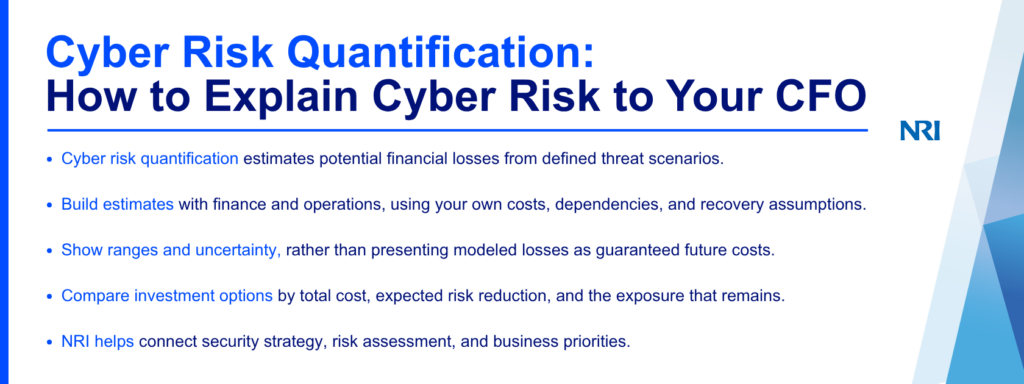
Cyber risk quantification gives that conversation a financial foundation. It estimates how often a defined loss event could occur and how much it could cost if it did.
For CISOs and IT leaders at enterprise and upper-middle-market organizations preparing security budget discussions with finance executives, the goal isn’t to predict the next breach to the dollar, but to make security investment decisions easier to compare with other business demands.
How to Quantify The Financial Impact of Your Cyber Risk
You need to understand not only your specific cyber risk but also its associated costs. Start with a business process and a specific loss scenario. For example, “Ransomware interrupts order fulfillment” gives you something more useful to analyze than the general problem of “high cyber risk.”
You need to understand not only your specific cyber risk but also its associated costs. Start with a business process and a specific loss scenario. This gives you something more useful to analyze than the general rating of “high cyber risk.” Then, work with finance, operations, and the process owner to identify what stops working, what recovery requires, and which costs follow.
- Identify Critical Business Processes
- Determine which business processes are essential for your operations.
- Prioritize these based on their impact on revenue and customer satisfaction.
- Define Specific Loss Scenarios
- Develop detailed scenarios that describe how cyber incidents could disrupt these processes.
- Use specific examples such as “Ransomware interrupts order fulfillment” to provide clarity.
- Collaborate with Key Stakeholders
- Engage with finance, operations, and process owners to gain a comprehensive understanding.
- Ensure all relevant departments are involved in the risk assessment operation.
- Assess Operational Impact
- Identify what parts of the business will stop functioning during a cyber incident.
- Determine the immediate and long-term operational impacts of the disruption.
- Evaluate Recovery Requirements
- Outline the necessary steps to recover from the incident.
- Consider the resources, time, and personnel needed for recovery efforts.
- Analyze Associated Costs
- Calculate the direct and indirect costs associated with the disruption.
- Include costs such as lost revenue, recovery expenses, and potential regulatory fines.
- Develop Mitigation Strategies
- Based on the analysis, create strategies to mitigate identified risks.
- Implement measures to reduce the likelihood and impact of these scenarios.
Include response and restoration costs, lost productivity, lost business, and potential legal or regulatory costs where relevant.
Here’s how:
- Identify critical assets: Map the applications, data, cloud services, and on-premises systems that support the process. Identify dependencies and recovery requirements.
- Define a threat scenario: Specify the event, affected process, and scope. A ransomware outage and a customer data breach may have different loss drivers.
- Estimate loss event frequency: Assess how often the scenario could produce a loss within a defined period. Use incident history, relevant industry evidence, and informed estimates.
- Estimate loss magnitude: Build a range for the cost of one event. Ask finance to validate revenue or margin assumptions and operations to validate downtime and recovery estimates.
- Model the range: Combine frequency and loss estimates. Monte Carlo simulation tests many combinations to show a distribution of potential losses, including less likely, costly outcomes.
How CISOs Should Explain Cyber Risk to the CFO
Once you’ve completed the above analysis, it’s time to take this back to your CFO in a way that influences their decision to invest. To bring the decision into focus, you’ll need to clearly explain the business process at risk, the estimated exposure, the investment requested, and the risk that would remain after implementation. Here are the four things your presentation must do:
Connect Your Technical Findings to Financial Health
Your CFO needs to know which business activities your findings could disrupt and the cost implications of itFor example, explain how an exposed system could interrupt billing, delay production, or prevent customers from placing orders. Share your loss estimate and show the evidence behind it.
Don’t attach a dollar figure to remediation unless you can explain the scenario, assumptions, and expected effect of the control.
Use a Financial Model to Evaluate Scenarios and Optimize Controls
Factor Analysis of Information Risk (FAIR) provides a structured model for analyzing cyber risk in financial terms. A full analysis should show a range of outcomes, the evidence supporting the inputs, and the possibility of losses that exceed the average. It also helps identify the frequency of loss events and the magnitude of those losses.
Why use FAIR methodology? FAIR bridges the gap between technical jargon and business communication by translating technical risks into understandable terms that resonate with board members and executives. It replaces subjective risk ratings with a more robust, data-driven method, and by calculating the Return on Security Investment (RoSI), security leaders can identify which controls or defenses most effectively minimize expected financial losses. FAIR also complements existing qualitative compliance and governance frameworks, such as NIST, ISO 27001, or COBIT, by adding a crucial quantitative measurement layer.
Annualized loss expectancy is the estimated average loss per year for a defined scenario, but keep in mind that an average alone can hide severe outcomes. Also, it isn’t a prediction of next year’s bill.
Consider a simplified illustration: 0.2 expected loss events per year at an average of $1 million per event produces $200,000 in expected annual loss.
If a control reduced the modeled frequency to 0.1 events per year, with severity unchanged, expected annual loss would fall to $100,000.
That’s a modeled $100,000 annual reduction in exposure, though it cannot be presented as guaranteed savings. You can then compare it with the control’s total cost and show how the result changes if the assumptions change.
Connect Security Controls to Business Outcomes
Explain what each proposed control changes about the risk scenario. For example, does it reduce the chance of a loss, limit its severity, or help the business recover faster?
Here are three examples of a security control and the business outcome of a potential mitigation:
- Data encryption: Explain which sensitive information it protects and how that could limit exposure. It won’t eliminate every breach cost or compliance obligation.
- DDoS mitigation: Connect availability protection to the affected customer channel. Use your own transaction volume and recovery assumptions to estimate the cost of an outage.
- Third-party risk management: Identify critical supplier dependencies, likely disruption costs, and the controls or contingency plans that could reduce them.
Present Investment Options and Their Trade-Offs
Now it’s time for you to present the costs to your CFO. It’s ideal to give them several viable options with varying scope and time horizons. Then, show implementation and operating costs, expected loss reduction, delivery timing, and remaining exposure for each:
- Baseline option: Address immediate priorities and explain which risks remain. Identify any mandatory requirements that this option must satisfy.
- Recommended option: Explain why the proposed controls offer the best fit for the organization’s risk tolerance, resources, and operational needs.
- Enhanced option: Show what additional spending could reduce, what it wouldn’t solve, and whether the extra benefit justifies the cost.
By translating technical risks into financial terms, it aligns cybersecurity initiatives with business priorities and makes it easier for CFOs to understand the impact on financial health. Using FAIR provides a clear, defensible basis for decision-making, moving beyond subjective assessments. This method also helps identify which security controls offer the best return on investment by quantifying potential loss reductions. Multiple investment options offer decision-making flexibility, ensuring the chosen strategy aligns with your organization’s risk tolerance and resources. Ultimately, this approach facilitates informed, strategic decisions that enhance both security posture and financial outcomes.
Close your presentation with a specific recommendation and decision deadline. Name the risk owner, explain the consequences of deferring action, and agree on when to revisit the estimates.
Bring a Decision to the Budget Conversation
A stronger security budget request explains what could happen, what it could cost, and how the proposed investment would change things.
Start with one meaningful scenario, validate the assumptions with the people who own the process, and present the trade-offs clearly.
How NRI Connects Security Priorities to Business Impact
If this feels overwhelming, we can help. We work with CISOs and IT leaders at enterprise and upper-middle-market organizations to assess risk, define a security strategy, and build a roadmap around business priorities.
Our cybersecurity services span strategy, architecture, protection, and response. Within Strategize & Advise, that includes risk assessments, roadmap development, and business impact analysis.
Our governance, risk, and compliance capabilities help connect security decisions with oversight and organizational requirements.
That gives your team a foundation for discussing priorities with finance, choosing the next action, and identifying where more analysis is needed.
Talk with an expert at NRI North America about your security priorities and the risk assessment or roadmap support needed to build a clearer business case.