
74% of healthcare organizations report cybersecurity staffing shortages, putting added pressure on internal IT teams. Here are six leading co-managed IT services providers helping health systems strengthen support without giving up control.
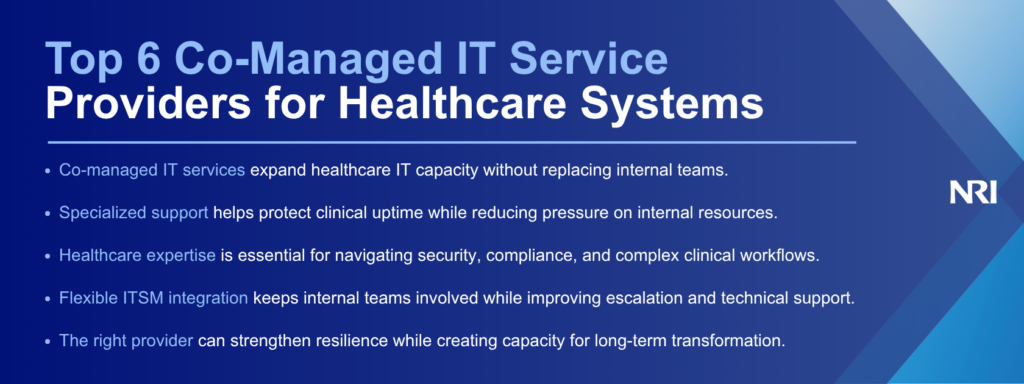
Healthcare IT has become a capacity equation that’s getting harder to balance. Every expansion in digital care brings new systems to manage, new risks to secure, and new demands on the same internal team. Yet staffing hasn’t always kept pace with that complexity.
According to HIMSS, 74% of healthcare organizations report they’re underequipped to meet cybersecurity needs with current staffing levels. Meanwhile, your IT team is still expected to protect patient data, maintain clinical uptime, support EHRs, and keep transformation projects moving.
And contrary to the common trend, completely outsourcing IT isn’t always the answer. Your internal team understands clinical workflows, EHR dependencies, users, and organizational priorities that an outside provider can’t simply replace.
That’s where co-managed IT services create a practical middle ground. You retain internal control while adding specialized engineering, 24/7 monitoring, escalation support, and additional capacity where your team needs it most.
Continue reading to see how co-managed IT services work, what healthcare leaders should look for in a partner, and how six leading providers compare for complex healthcare systems.
Understanding the Model: What Are Co-Managed IT Services?
Your healthcare IT team already knows your clinical systems, workflows, users, and priorities. Co-managed IT services build on that knowledge by adding external engineering expertise and capacity where your team needs additional support.
Unlike fully managed IT, co-management doesn’t require you to hand over your entire technology environment. Instead, you decide which responsibilities stay in-house and which move to your provider. A shared responsibility model can cover infrastructure monitoring, security operations, technical support, cloud management, or complex escalations.
Besides, both teams can work within shared ticketing and escalation processes. Your internal staff maintains visibility and control, while specialized experts step in when an issue requires additional capacity or deeper technical expertise.
Strategic Value: How Healthcare Managed IT Services Support Internal Teams
Healthcare IT demands don’t stop when your team reaches capacity. Clinical systems must remain available, security events still require attention, and infrastructure issues still need resolution. Healthcare managed IT services can absorb specific operational responsibilities so your internal specialists can focus on clinical priorities and transformation.
Key benefits include:
- Preventing Burnout
Offloading 24/7 SOC and NOC monitoring, along with selected Tier 1 and Tier 2 support, reduces internal teams’ daily workload. As a result, your specialists have more time for EHR initiatives, modernization projects, and other priorities that require institutional knowledge.
- Accessing Specialized Technical Depth
You don’t need every specialist permanently in-house. Co-management gives your team access to expertise in hybrid cloud, EHR integrations, networking, and zero-trust security when you need it.
- Strengthening Regulatory Posture
Healthcare compliance requires continuous attention, not preparation shortly before an audit. Consistent monitoring, documentation, security controls, and ongoing compliance management can help your team stay aligned with HIPAA, NIST, and HITRUST requirements as your environment evolves.
Ultimately, co-management gives your internal team additional capacity without shifting its knowledge or decision-making authority.
Evaluation Criteria: What Should Healthcare Leaders Look For in a Partner?
Healthcare IT partners don’t operate in a vacuum. They work around clinical systems, patient data, caregiver workflows, regulatory requirements, and infrastructure that often can’t tolerate disruption. That means the wrong partner can create friction just as easily as the right one can relieve it.
A co-managed provider should fit into how your health system already works, not force your team to adapt around it. Look for a partner that understands healthcare, integrates with your existing tools, and can scale support as your needs change.
Key factors to evaluate include:
- Healthcare experience: Look for a provider that understands clinical workflows, EHR dependencies, patient-data requirements, and the operational impact of downtime.
- Flexible ITSM integration: Your partner should work within tools such as ServiceNow, Microsoft Intune, and Configuration Manager, rather than creating a separate process.
- Ability to support growth: Make sure the provider can support multi-site operations, M&A integration, cloud modernization, and changing infrastructure requirements.
Most importantly, co-management should feel like an extension of your existing operation. Your team keeps strategic control, while the provider adds the expertise and capacity needed to close specific gaps.
Provider Comparison: Top 6 Co-Managed IT Service Providers for Healthcare Systems
Once you’ve identified the support your team needs, the next challenge is finding a provider that fits your clinical environment. Some providers bring healthcare specialization, while others stand out for scale, hybrid infrastructure, security, or flexible co-management. The right choice depends on where your internal team needs additional capacity.
Here are six providers worth considering:
1. NRI North America
NRI North America works with hospitals and health systems across infrastructure modernization, EHR optimization, interoperability, cybersecurity, and digital transformation. Its healthcare focus makes it a strong fit when you need specialized technical depth without sidelining internal knowledge or leadership.
NRI can also support complex environments undergoing cloud modernization, multi-site growth, or M&A integration. That combination of healthcare experience and flexible support lets your team retain control while gaining expertise where it matters most.
2. CDW
CDW combines broad technical resources with healthcare-specific managed services. Its capabilities include 24/7 monitoring, cloud and infrastructure management, security, and operational support, making it suitable for health systems that need additional capacity across several technology areas.
3. Ntiva
Ntiva offers a defined co-managed model that lets your internal team choose where it needs additional help. Healthcare organizations can access 24/7 support, plus cybersecurity, cloud, infrastructure, compliance, and senior engineering expertise, without handing over the entire environment.
4. All Covered
All Covered combines healthcare IT, cybersecurity, infrastructure, cloud, and compliance capabilities. Its experience with HIPAA, EHR environments, multi-location healthcare organizations, and 24/7 security monitoring makes it a strong fit for teams that need broader operational support.
5. Ensono
Ensono is particularly suited to organizations managing complex hybrid and legacy environments alongside cloud modernization. That focus can help larger health systems add specialized infrastructure expertise while their internal teams remain focused on clinical technology priorities.
6. Integris
Integris offers flexible managed and co-managed support across IT operations, cybersecurity, cloud, compliance, and advisory services. Its model can suit organizations that want to fill specific capability gaps rather than outsource their entire IT operation.
No single provider fits every health system. Your decision should reflect your clinical environment, internal capabilities, security requirements, geographic footprint, and modernization plans. The goal isn’t to outsource what your team already does well. It’s to add the expertise and capacity that helps them do it better.
Strengthen Your Healthcare IT Team With NRI Co-Managed Services
Healthcare IT teams can’t put patient care on hold while they work through security gaps, infrastructure demands, and modernization projects. With the right co-managed support, your team can maintain coverage, keep strategic initiatives moving, and retain control over the systems that matter most.
NRI North America helps extend your internal capabilities with healthcare expertise across infrastructure, cloud, cybersecurity, compliance, and co-managed support. Your team keeps strategic oversight while gaining the specialized expertise, 24/7 support, and additional capacity needed to strengthen resilience and support long-term digital transformation.
When your internal IT team needs stronger support without giving up control, talk to NRI North America about building a co-managed IT model that fits your healthcare system.