
With 24% of surveyed hotel IT leaders reporting fully integrated core systems, technology fragmentation remains a concern. NRI helps you consolidate hospitality technology while protecting guest experiences and operational continuity.
Your hospitality technology may support dozens of guest-facing services, but how well do those systems work together? From reservations and property management to payments and loyalty programs, every connection matters when you’re responsible for maintaining consistent operations across multiple venues.
However, keeping these systems connected isn’t always that simple. A 2025 study reported by Hospitality Net, involving over 250 hotel IT decision-makers, found that 24% had fully integrated their core systems. For your IT team, fragmented systems can mean disconnected guest data, complicated vendor relationships, and difficulty maintaining reliable service across locations.
Consolidation can address these challenges, but removing applications or replacing vendors without understanding their dependencies can disrupt check-ins, payments, and casino gaming operations. Your team needs to know which systems support critical services and how operations will continue when an integration fails.
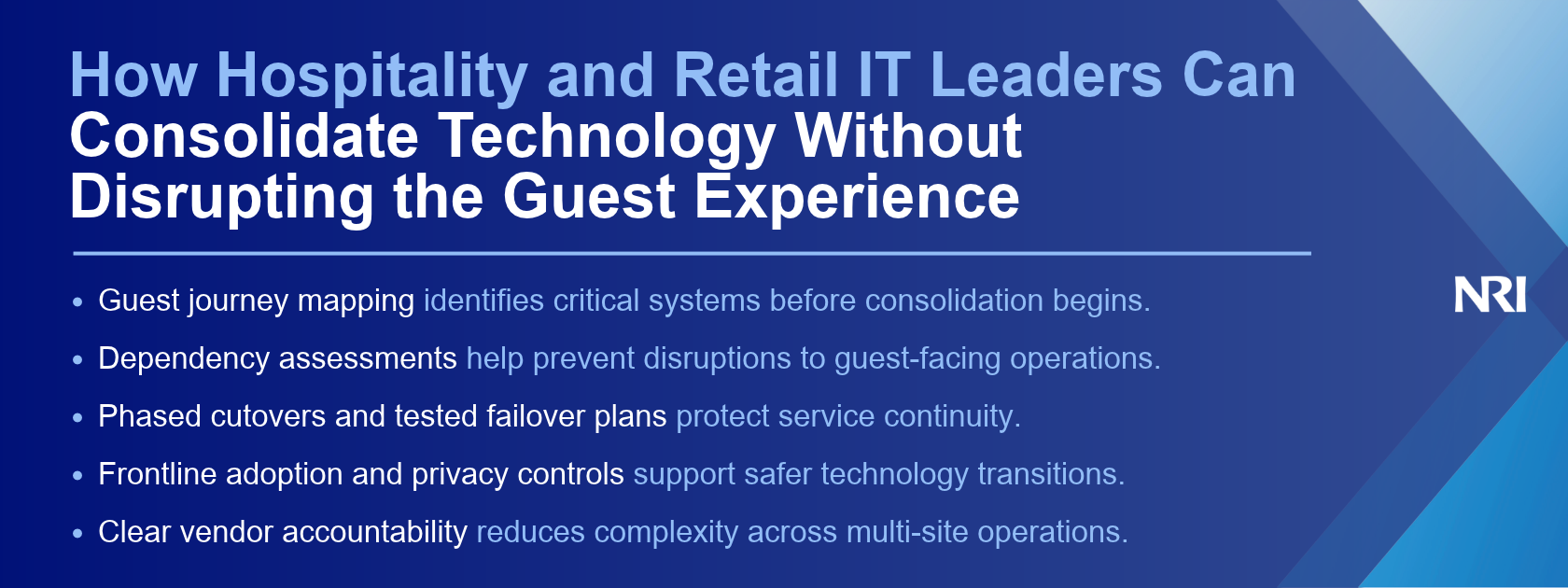
A safer approach begins with guest journey mapping, followed by phased deployment, tested recovery procedures, and clear operational ownership.
Keep reading to see how you can consolidate hospitality technology without disrupting the services your guests depend on.
Guest-Centric Mapping: What to Evaluate Before Removing Systems
Before retiring an application or consolidating vendors, you need to understand how your systems support guest services and daily operations. A platform that appears redundant may still handle essential transactions or connect systems across multiple venues.
Focus on three areas before making changes.
- Mapping the digital-to-physical guest journey
Follow each guest interaction from booking through checkout, including the systems employees use to deliver the service.
For a hotel, that means tracing reservations, mobile check-in, property management systems (PMS), point-of-sale (POS) transactions, and loyalty programs. Retail operators should include purchases, returns, and rewards, while casino gaming operators need to account for gaming management systems and related transactions.
Ask your team to identify which systems exchange information, where manual workarounds exist, and what happens when an integration fails.
For example, if a restaurant POS can no longer communicate with the PMS, guests may lose the ability to charge meals to their rooms. You can address that dependency before replacing either system.
- Identify critical system dependencies
Some of your most important integrations may not appear in a standard application inventory. Payment gateways, digital signage, gaming platforms, and guest Wi-Fi can depend on shared networks, identity services, or third-party connections.
Request a dependency map that identifies:
- Connected systems: Which applications, networks, and vendors support each service?
- Failure points: What transactions stop when a connection becomes unavailable?
- Recovery procedures: Can employees continue working, and under what conditions?
- Ownership: Who investigates and resolves incidents involving multiple providers?
Use the findings to determine which systems can be consolidated, which integrations must remain, and what needs further testing.
- Privacy and data governance compliance
Combining systems can change how guest information moves between applications, vendors, and locations. Before migrating data, confirm where sensitive records are stored, who can access them, and which requirements apply.
Review personally identifiable information (PII), payment card data, PCI DSS obligations, encryption, access controls, and retention policies. Casino gaming environments may also have specific regulatory and reporting requirements.
Document these requirements alongside your integration dependencies so you address security and compliance decisions before deployment.
Executing Zero-Downtime Migration: The Phased Cutover Strategy
Once you’ve identified critical systems, the next decision is how to replace or consolidate them without interrupting services.
A phased cutover allows your team to validate integrations, test recovery procedures, and resolve problems before expanding changes across multiple properties or stores.
- Phase 1: Pilot and parallel testing
Begin with one representative venue or a limited set of applications. Where feasible, run the existing and replacement systems in parallel to compare results before retiring the original.
Test the transactions employees handle during normal operations, including check-ins, payments, refunds, loyalty updates, and, where applicable, gaming-related processes.
Before approving the next rollout, confirm:
- Which transactions passed end-to-end testing?
- Were data transfers and integrations verified?
- What conditions would trigger a rollback?
- Who has authority to approve or stop deployment?
Schedule changes around venue activity and confirm that support teams are available throughout the cutover.
- Phase 2: Network resilience and edge failover
A successful application migration won’t protect operations if a network outage prevents employees from processing transactions.
Review redundant connectivity, local processing capabilities, and recovery procedures for every critical venue system.
Some POS platforms support limited offline transactions, depending on their configuration and payment provider. Your team should verify which functions remain available, what restrictions apply, and how transactions reconcile when connectivity returns.
For casino gaming operations, confirm that contingency procedures meet applicable regulatory and system requirements.
Request evidence from failover tests rather than relying solely on vendor assurances.
- Phase 3: Frontline enablement and change management
Your frontline employees need to understand the new workflows before guests encounter them.
Provide role-specific training for front desk agents, cashiers, servers, and casino floor teams. Include common exceptions such as missing reservations, failed payments, and unavailable loyalty information.
After deployment, measure whether the systems work as intended through:
- Guest check-in and transaction completion times
- Payment failures and recovery rates
- Help desk incidents by venue
- Employee workarounds and unresolved issues
Training attendance alone won’t confirm successful adoption. Use operational results and frontline feedback to determine whether the next location is ready.
Reducing Vendor Sprawl Without Losing Agility
A hotel group may use separate vendors for guest Wi-Fi, network monitoring, POS integrations, and property management connectivity. Some capabilities may overlap, but removing a provider without reviewing its responsibilities can create new support problems.
Reducing vendor sprawl means cutting down on overlapping tools and suppliers that complicate IT management. EY’s 2025 press release noted that 35% of respondents across sectors planned to reduce their ICT vendors over the following 12 months.
Reducing vendor sprawl should make your technology easier to manage without limiting your ability to change systems as business requirements evolve.
Focus on two priorities:
- Consolidate overlapping tools without creating lock-in. Compare capabilities, integration requirements, data portability, and switching costs before replacing specialist platforms. A single vendor may simplify management, but that benefit needs to outweigh any loss of flexibility or resilience.
- Establish clear SLAs and support ownership. Define who responds to incidents, how providers coordinate escalations, and what recovery commitments apply to critical services.
Consider a payment terminal that stops communicating with the network. Your team shouldn’t have to spend valuable time determining whether the POS, network, or payment provider owns the problem.
Ask vendors to agree on an escalation process that identifies the incident owner, response expectations, and responsibilities when several systems are involved.
How NRI Delivers Digital Backbones for Multi-Site Leaders
Managing technology across hotels, retail stores, and casino gaming venues requires coordination between applications, networks, security, and frontline operations.
NRI North America helps organizations connect these responsibilities through strategic advisory, technology implementation, and managed operational support. Our gaming and hospitality capabilities support the infrastructure and systems that keep complex venues operating.
We bring these capabilities together through three service pillars:
1. Strategize & advise: establish the consolidation roadmap
NRI helps assess your existing technology estate, identify overlapping applications, and map critical dependencies. That assessment provides a basis for prioritizing consolidation opportunities against operational requirements, security risks, and business objectives.
2. Build & transform: modernize connected systems
Our engineering capabilities support infrastructure modernization, application integration, and architecture planning across multiple locations. The goal is to connect essential systems while accounting for existing dependencies and future business requirements.
The Raydia Food Group case study illustrates this work. Following acquisition-led growth, Raydia needed to address fragmented IT systems and establish consistent support. NRI helped modernize its infrastructure, strengthen security, and build a scalable foundation for future growth.
3. Protect & manage: support ongoing operations
Consolidation doesn’t end when replacement systems go live. Your venues still need reliable support, security oversight, and clear incident management.
NRI’s managed services capabilities help organizations maintain visibility across their technology operations and respond to evolving requirements.
Together, these services connect technology planning, implementation, and operational support so modernization decisions account for the people and systems affected.
Deliver Flawless Operations and Memorable Guest Experiences with NRI
Successful hospitality technology consolidation depends on understanding how your systems connect, protecting critical guest transactions, and preparing your teams for changes across venues.
Your plan should also define who approves changes, how you’ll support frontline employees, and which operational measures must improve before you expand deployment.
Those decisions give you a stronger basis for reducing vendor complexity without putting venue operations at unnecessary risk.
NRI can help you connect your consolidation priorities to your technology roadmap, infrastructure requirements, and operational capacity.
Talk to NRI about your hospitality or retail technology estate, the dependencies you need to address, and how a focused workshop can help you plan your next consolidation initiative.