
A strong proposal doesn’t tell you how a partner will handle a stalled project. Learn how to evaluate delivery, governance, adoption, and results before you commit.
Your shortlist looks impressive. Every technology partner has certifications, vendor badges, and recognizable client logos on their website. You still have to decide who can deliver without overloading your team.
The difference becomes clearer when an integration fails, a deadline slips, or employees struggle with new workflows. That’s when you need a partner whose delivery practices hold up under pressure.
BCG’s 2024 research found that more than two-thirds of large-scale technology programs weren’t expected to meet their schedule, budget, or scope commitments.
Many of those failures stem from execution challenges rather than technology choices alone. The study points to weaknesses in planning, management, and delivery that certifications and partner badges don’t reveal. Credentials alone won’t tell you how a prospective partner handles those responsibilities.
For IT leaders, those gaps have practical consequences: more rework, delayed business benefits, and less time for day-to-day operations.
Technology partner evaluation should test how a provider delivers, communicates, manages change, and demonstrates results on projects like yours.
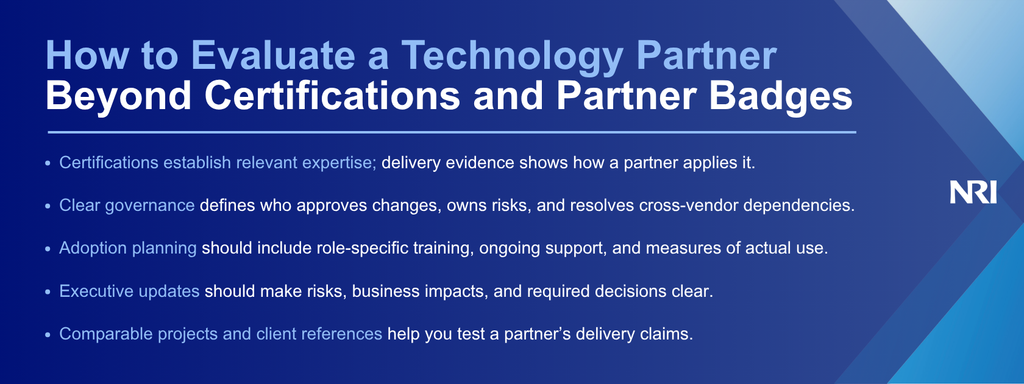
When evaluating a technology partner, focus on four areas that directly affect project outcomes: delivery governance, adoption and change management, executive communication, and proven results from similar engagements. Certifications may validate technical expertise, but these factors determine whether a project stays on track and delivers business value.
Use the four areas below to guide that evaluation, then ask for evidence you can compare before signing a contract.
The 4 Core Pillars of Technology Partner Evaluation
Start with your own requirements: the business outcome, critical systems, internal capacity, and constraints the project must respect.
Give each shortlisted partner the same context. Then assess how its approach addresses these four areas:
1. Delivery Governance & Decision-Making
Requirements evolve, integrations reveal hidden dependencies, and priorities compete. Your partner needs a clear process for making decisions when the original plan changes.
Ask the partner to walk you through how it manages:
- Scope drift: How are changes identified, documented, approved, and reflected in timelines and costs?
- Architectural changes: Who reviews technical decisions when business or infrastructure requirements change?
- Escalation paths: Who takes ownership when an issue can’t be resolved within the project team?
- Multi-vendor environments: How are dependencies coordinated across vendors, platforms, and your internal teams?
Ask to see an anonymized change log or responsibility matrix from a comparable project. It should show who made decisions, what changed, and how the team handled the impact on cost and timing.
2. Adoption Change Management
A system can pass every technical test and still disappoint if employees avoid it. Evaluate how the partner prepares people for new workflows alongside the technical implementation.
Look for stakeholder engagement, role-specific communications, training, and support after launch. Ask who owns that work and whether it’s included in the proposed scope.
Request an adoption plan with measures tied to the work, such as use of the new workflow, fewer manual workarounds, or faster task completion.
Training attendance alone won’t show whether employees can use the technology effectively.
3. Executive Communication & Transparency
A status report is only useful if it helps your leadership team act. Ask how the partner explains delivery risks and connects them to business consequences.
Confirm the update schedule, executive escalation contact, and triggers for raising an issue between meetings. Changes to budget, scope, or timelines shouldn’t wait for the next routine report.
Request a sample executive update. Look for the issue, its business impact, the available options, and the decision owner and deadline.
Ask how the partner handled a past setback. You’re looking for early disclosure and a workable response.
4. Verifiable Case Evidence
A familiar client logo doesn’t tell you whether a partner can manage the complexity of your environment, stakeholders, and delivery requirements. Look for projects with comparable scale, integrations, regulatory requirements, and vendor dependencies.
Ask what the client needed to achieve, how results were measured, and what changed after launch. Separate technical completion from outcomes such as adoption, productivity, or service reliability.
Where possible, speak with a client reference about what went wrong and how the partner responded. Confirm that the proposed team has relevant experience, too.
The Evaluation Checklist: 3 Questions to Ask Before You Sign
Use the sales conversation to clarify who will do the work, what discovery will produce, and how difficult decisions will get made.
Ask each shortlisted partner the same three questions:
- Who will actually deliver the project? Request named leads, specialist availability, and the handoff plan from sales through discovery and delivery.
- What will discovery produce? Ask to see a sample dependency map, risk assessment, or roadmap, and how it helped a previous team reduce rework.
- What happens when an integration stalls? Confirm the issue owner, escalation timing, and how changes to scope, cost, or delivery dates get approved.
- How will success be measured? Ask which operational, adoption, or business outcomes will be tracked and who is responsible for reporting progress after launch.
Record what each partner can demonstrate, what it has only described, and what remains unresolved. Confirm material commitments in the agreed scope so you’re comparing evidence, not presentation quality.
The NRI Difference: Connecting Strategy, Delivery, and Adoption
Many technology initiatives struggle when strategy, implementation, adoption, and ongoing operations are managed separately. NRI helps organizations connect those efforts so technology decisions lead to measurable business outcomes, not just completed projects.
Our IT advisory and consulting services help establish the priorities that guide delivery. That work connects with three integrated capabilities:
- Strategize & Advise: We assess your environment and build a roadmap that ties technology decisions to your business objectives.
- Build & Transform: We bring the strategy into implementation across applications, data, infrastructure, and business platforms.
- Protect & Manage: We support security, resilience, and ongoing operations as your technology needs change.
Our Organizational Change Management & Adoption services address the people side of implementation through communication, training, and stakeholder engagement.
Together, these capabilities help organizations plan effectively, implement confidently, drive adoption, and support ongoing operations.
Choose a Partner You Can Hold Accountable
Before you decide, review each partner’s proposed team, delivery evidence, adoption plan, and escalation process against your project’s requirements.
Resolve unclear responsibilities before they become delivery problems. Agree on what success looks like, how you’ll measure it, and who owns the next step when the plan changes.
Those answers give you a more useful basis for selecting a partner than credentials alone.
We can help you connect that evaluation to your technology roadmap, internal capacity, and business priorities.
Talk to NRI North America about the delivery risks, governance requirements, and adoption challenges in your next initiative. We’ll help you evaluate the options, identify potential obstacles, and build a plan that aligns with your business priorities.