
Turn your technology assessment findings into clear investment priorities, defensible budgets, and an executable modernization roadmap with NRI.
Enterprise technology assessments frequently deliver comprehensive infrastructure inventories while leaving IT leaders without a clear path forward. Which risks deserve attention first? How much will remediation cost? And what evidence will convince leadership to approve the investment?
These questions become harder when asset records are incomplete, or system dependencies are unclear. Gartner estimates that poor data quality costs organizations an average of $12.9 million annually, underscoring the importance of reliable information when making business decisions.
An effective technology assessment bridges technical discovery with capital funding and operational execution. NRI connects those steps, so your team can prioritize risks, justify investments, and build a roadmap that supports business goals. The following framework outlines what that delivery model provides.
Here’s what that process should deliver.
The 5-Stage Progression: From Raw Data to Funded Execution
Your assessment findings should help answer the questions leadership will ask before approving modernization work. What needs fixing, why does it matter, and what will it take to get the work done?
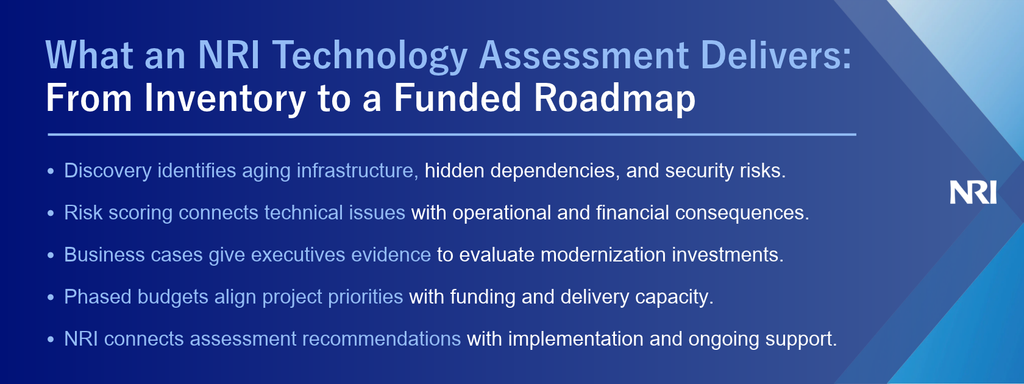
NRI connects those decisions through five stages.
- Comprehensive discovery and inventory
Planning an infrastructure upgrade is difficult without a reliable record of the systems supporting your business.
A technology assessment reviews infrastructure, applications, data flows, network connections, and security controls. This helps uncover aging equipment, undocumented dependencies, and potential vulnerabilities that could affect operations.
Consider a server scheduled for replacement. If several critical applications still depend on it, the upgrade may require additional planning to avoid service disruption.
Your assessment should produce an accurate asset inventory and dependency map that show what needs attention and how proposed changes could affect critical services.
- Risk Scoring and business impact prioritization
Once the inventory is complete, you’ll have a list of findings. The next decision is which issues deserve funding first.
An unsupported system handling sensitive customer data may pose a greater business risk than an aging device used for noncritical tasks.
A consistent scoring approach should consider security exposure, operational importance, potential downtime, and financial consequences.
A prioritized risk register should explain each major finding, its business impact, recommended response, and urgency. That gives your leadership team a clearer basis for allocating resources.
- Business case development
Knowing which systems need attention is useful. Getting funding requires a clear explanation of the costs and expected benefits.
Your business case should show what each proposed improvement will cost, what risks it addresses, and how the investment supports business operations.
For example, replacing unsupported infrastructure may reduce maintenance expenses and exposure to costly outages. Executives need to see the assumptions behind those benefits before approving spending.
- Initiative sequencing and phased budgeting
Your team may have several important projects competing for the same budget. Some also need to happen in a particular order.
For example, an application migration may depend on network upgrades or security changes that haven’t been completed.
A phased plan helps you schedule work around technical dependencies, business priorities, available funding, and internal capacity.
The assessment should provide capital expenditure (CapEx) and operating expenditure (OpEx) budget ranges for each phase, including implementation, licensing, support, and resource requirements. These estimates help leadership plan investments across multiple budget cycles.
- The executable technology roadmap
Once leadership understands the priorities and costs, your assessment needs to show how the approved work will proceed.
The roadmap should identify project milestones, dependencies, decision-makers, funding checkpoints, and the teams responsible for delivery.
It should also explain how you will measure progress and how you will escalate implementation challenges that affect costs or timelines.
Together, these five stages connect discovery findings with a prioritized risk register, an executive business case, phased budgets, and a technology roadmap your team can use to guide implementation.
NRI helps you connect assessment findings with risk priorities, budget decisions, and project ownership, giving your team a clearer basis for data center transformation and long-term technology planning.
Tooling with Purpose: Where Specialized Platforms Fit
If your infrastructure spans multiple sites, cloud platforms, and legacy systems, collecting accurate assessment data can take considerable time.
Specialized tools may help accelerate discovery. NRI can evaluate Smart Track, Dr. Migrate, and COMPASS once program eligibility, supported capabilities, and the assessment scope are confirmed.
Before selecting a platform, ask what it can assess, which systems it may miss, and how it will validate the findings.
Your team also needs engineering expertise to interpret the results and connect them to business risks, investment priorities, and modernization decisions.
Preventing Shelfware: The NRI Execution Difference
Even a robust assessment report can identify the right priorities and still sit unused if nobody takes ownership of the next steps.
Once the roadmap is ready, projects need approval, engineering teams need clear requirements, and operations teams need to prepare for the changes.
NRI connects these responsibilities through three service pillars.
- Strategize & advise. We help you assess infrastructure, prioritize technical risks, and develop business cases and roadmaps that support funding decisions.
- Build & transform. Our engineering teams help carry approved recommendations into architecture and implementation, accounting for technical dependencies and delivery milestones.
- Protect & manage. We support monitoring, security oversight, and ongoing technology management so your investments continue to serve operational needs after implementation.
These capabilities connect the people developing your roadmap with those responsible for delivering and maintaining the improvements.
Transform Technical Debt into Strategic Advantage with NRI’s Support
Aging infrastructure, security vulnerabilities, and inefficient technology spending can make modernization harder to fund. Flexera’s 2026 State of the Cloud Report found that organizations estimate 29% of IaaS and PaaS cloud spending is wasted, underscoring the importance of understanding where technology budgets go.
A structured assessment helps you identify business risks, set investment priorities, and plan improvements around available funding and resources.
NRI connects that work with the engineering and operational support needed to carry it forward. From discovery and business case development to implementation planning, we help your team turn assessment recommendations into projects with clear responsibilities and measurable outcomes.
Schedule a scoped technology-estate assessment with NRI to review your infrastructure risks, establish funding priorities, and develop a roadmap your leadership team can approve, and your IT team can execute.