
Master the mundane to unlock efficiency, agility, and cost savings.
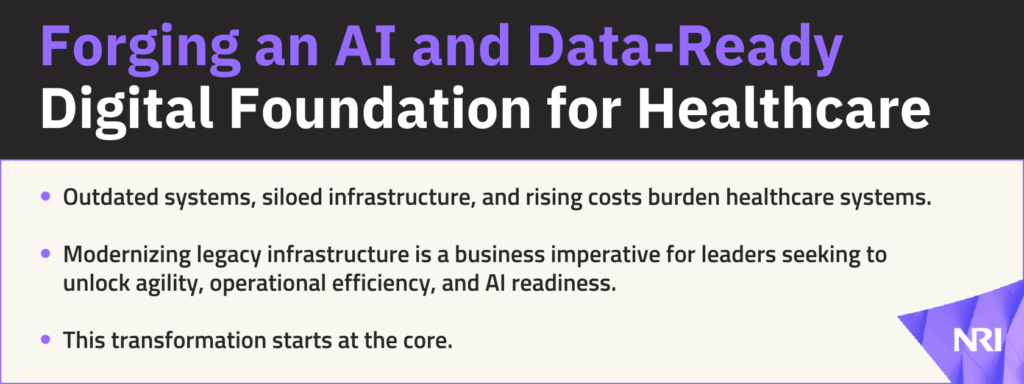
The U.S. healthcare sector is at a critical inflection point. Organizations are contending with rising operational costs, increasing regulatory requirements, and growing patient expectations, all while relying on legacy systems that constrain agility and innovation.
Disparate applications, fragmented data environments, and outdated infrastructure not only impede clinical workflows but also prevent the effective deployment of transformative technologies such as AI and advanced analytics.
In this context, modernizing foundational IT systems, or what we call “mastering the mundane,” is imperative. Streamlining infrastructure, consolidating platforms such as Epic and Microsoft 365, and reducing operational redundancies establishes a reliable and scalable digital foundation. This foundational modernization drives operational efficiency, cost reduction, and staff productivity, while positioning healthcare organizations to leverage AI and data-driven capabilities at scale.
This article examines the challenges of legacy healthcare IT, explores the concept of mastering core infrastructure, and outlines the strategic capabilities needed to build a data- and AI-ready healthcare environment.
The Current Challenge: Healthcare’s Legacy Burden
Healthcare’s core clinical, financial, and administrative systems are often decades old, built in silos, and merely patched together. Fragmented patient data, manual processes, and outdated interfaces are pervasive. Experts estimate that 97% of health data today is “trapped in fragmented systems” that can’t communicate with one another.
This technical debt has real consequences. It throttles innovation and new initiatives. For instance, even as healthcare leaders expect AI to transform care, 88% of projects stall because basic infrastructure and data aren’t ready.
Meanwhile, legacy systems in healthcare mean that clinicians routinely deal with disjointed workflows and administrative overload. In one survey, over 95% of healthcare professionals agreed that outdated systems contribute to burnout, with many turning to shadow IT just to get basic tasks done.
With the burden of these legacy systems, IT can feel like a cost center rather than a growth driver. Fortunately, that’s something you can overcome. The first step is to “master the mundane” so the organization can move forward with confidence.
Transformation Starts at the Core: Mastering the Mundane
“Mastering the mundane” may not sound exciting, but it’s where transformation actually begins. It means focusing on the unglamorous work that keeps systems healthy, scalable, and resilient.
This includes:
- Infrastructure Rationalization: Decommissioning legacy hardware, consolidating redundant systems, and standardizing platforms.
- Platform Optimization: Enhancing the performance and integration of critical systems, including Epic and Microsoft 365.
- Enhancing Operational Reliability: Ensuring consistent uptime, proactive maintenance, and reduced system interruptions.
Executing these basics well makes everything else easier.
System performance improves. Downtime decreases. Clinicians experience fewer interruptions during care delivery. Patients get better care quality. IT teams spend less time firefighting and more time planning. And importantly, organizations start to see cost savings, not from sweeping budget cuts, but from incremental efficiencies that compound over time. These savings can be used to fund innovation.
Building the Foundation for Data and AI-Driven Healthcare
AI and advanced analytics hold immense promise in improving diagnostics, supporting clinical decision-making, and streamlining administrative tasks. But unlocking these capabilities requires a scalable cloud architecture, an integrated data environment, and secure, compliant automated operations.
Hybrid cloud models allow organizations to scale compute and storage while maintaining security and compliance. Integrated data environments, on the other hand, bring together clinical, operational, and financial data into a consistent, governed framework. Meanwhile, automation reduces manual effort and improves accuracy.
When this foundation is in place, predictive models can operate on real-time data. Clinical decision support tools can surface insights at the point of care. Streamlining administrative workflow reduces burdens and improves throughput.
Perhaps most importantly, AI-enabled workflows help address burnout. By reducing documentation overhead and automating routine tasks, clinicians can spend more time doing what they trained for: caring for patients. The technology fades into the background, where it belongs.
Without modern infrastructure, these outcomes remain out of reach. With it, they become scalable and sustainable.
Strategic Capabilities Healthcare Leaders Need
To achieve this transformation, leaders need to focus on five core capabilities:
- Data Foundations and Architecture: Build scalable, governed data pipelines for consistent, reliable analytics.
- Secure Hybrid Infrastructure: Support AI, telehealth, and other real-time applications without compromising HIPAA compliance.
- EHR Optimization and Integration: Continuously improve Epic to drive full ROI.
- Modern Productivity Platforms: Enterprise-wide governance and enablement of Microsoft 365 and AI assistants to prevent shadow IT and improve collaboration.
- Intelligent Network Infrastructure: Ensure fast and reliable access across systems.
NRI can help you develop these capabilities.
What Differentiates NRI
NRI brings a unique blend of qualities that help health systems bridge the gap between foundational work and innovation:
- Insight-to-Execution Model: NRI doesn’t just design ideal architectures on paper; we help build them and then onboard the staff to run them. This end-to-end partnership ensures recommendations translate into real change.
- Cross-Industry Expertise in the Healthcare Context: NRI leverages lessons from financial services, retail, manufacturing, and other industries and adapts proven cloud and data practices to drive innovation in healthcare’s stringent environment.
- Boutique Agility, Enterprise-Grade Scale: We offer the nimbleness and personal attention of a boutique firm, yet have the bench strength and processes to manage large, complex transformations. This means faster iterations, shorter timelines, and the ability to tackle massive projects seamlessly.
- Deep Platform Specialization: NRI seasoned engineers are highly skilled in Microsoft technologies, leading cloud platforms such as Azure and AWS, as well as EHR systems, giving you the confidence that you’re in safe hands.
- People-First, Tech-Enabled Approach: Technology investments succeed only when people adopt them. That’s why NRI emphasizes change management as a critical component of your transformation and trains and empowers your end users with the skills needed to drive adoption.
In short, NRI combines strategic leadership with hands-on execution for a minimally disruptive digital transformation.
Lay the Digital Bedrock for the Future of Care with NRI
Healthcare is on the cusp of unprecedented change. AI, predictive analytics, and personalized medicine promise breakthroughs, but only if the groundwork is in place. Today’s legacy systems are the bottleneck. To move beyond pilot projects and start realizing ROI, health IT leaders must invest in mastering the mundane: modernizing and unifying the core infrastructure. This is the digital bedrock that will support all future innovations.
NRI stands ready to partner in this journey. Schedule a custom consultation to learn about next steps.