
How AI regulation compliance is reshaping governance, risk, and enterprise AI adoption for IT leaders.
AI initiatives rarely fail because the technology itself stops working. More often, problems arise for organizations when tasked with explaining how an AI system reached a decision, where the data came from, or who is responsible when outcomes raise concerns.
As AI becomes part of day-to-day business operations, these questions now feature in daily conversations. They now factor directly into evaluation, approval, and scaling across the enterprise.
However, many organizations are still catching up to this reality. According to McKinsey, less than 30% of enterprises report having proper AI governance in place, despite the widespread adoption.
That imbalance between AI adoption and governance is a major reason governments are stepping in to set clearer expectations for transparency, accountability, and risk.
For instance, Europe is enforcing AI-specific rules through the AI Act. In the United States, a combination of federal frameworks, executive orders, and state-level initiatives is beginning to influence how AI systems are assessed and managed.
Similar efforts are taking shape in other regions as well. For IT leaders, AI regulation compliance is becoming part of how AI solutions are designed, deployed, and scaled, regardless of whether the organization operates locally or globally.
The real challenge is not choosing between innovation and compliance, but building governance structures that allow AI programs to grow while standing up to scrutiny. This responsibility increasingly sits with IT leadership.
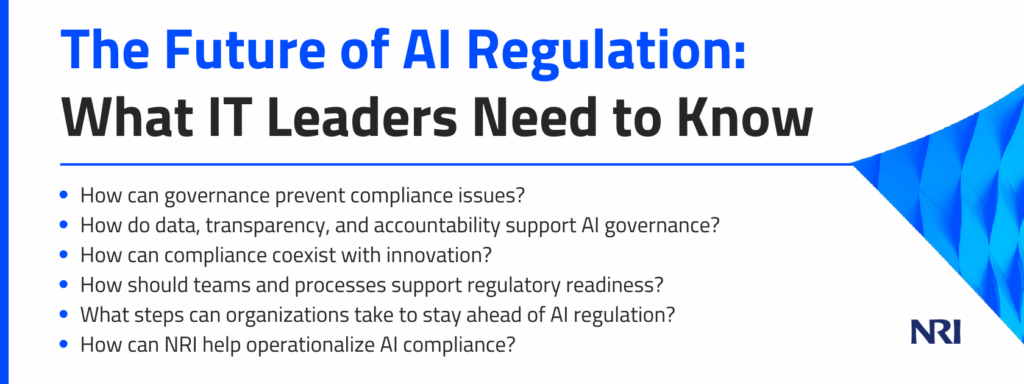
This blog examines how decisions on data, architecture, and oversight shape whether AI becomes a durable capability or a future liability, and what IT leaders can do now to prepare for that reality.
Why AI regulation changes the game
AI isn’t anything like traditional software. It learns from data, evolves, and can produce outcomes that are difficult to trace back to a clear rule or instruction, even when systems are well-designed. That difference has prompted regulators to look more closely at how AI is built and governed.
Regulators are focusing on a small set of core requirements that directly affect enterprise AI:
- Transparency: Can you explain how an AI system makes decisions?
- Explainability: Can those explanations be understood beyond technical teams?
- Data accountability: Do you know where data comes from, how it is used, and how it is governed?
- Ethical safeguards: Are bias, misuse, and unintended consequences actively addressed?
When organizations fall short in any of these areas, the consequences are usually evident. Non-compliance can lead to fines, regulatory intervention, reputational damage, or limits placed on AI use. Just as important, uncertainty around compliance slows internal adoption as leaders hesitate to scale systems they cannot confidently explain or defend.
That’s why AI regulatory compliance can no longer rest solely with Legal or Risk teams. It now sits squarely with IT leadership, shaping architectural choices, data strategy, and the pace of AI initiatives.
The global regulatory landscape
AI regulation is taking shape around the world, but not in a single, consistent way. For IT leaders, the challenge is less about memorizing individual rules and more about understanding how different frameworks overlap and where they diverge.
- Europe: The AI Act
The EU AI Act introduces a risk-based approach that classifies AI systems based on their potential impact. Systems considered high risk, such as those used in employment, healthcare, financial services, or public safety, face strict requirements around documentation, human oversight, and transparency. Penalties can reach up to 7% of global annual revenue, placing AI regulatory compliance firmly at the board and executive levels, not just within technical teams.
- United States: A Framework-Driven Approach
In the United States, regulation is developing through a mix of frameworks and guidance rather than a single comprehensive law. The NIST AI Risk Management Framework outlines expectations for identifying, measuring, and managing AI risk. At the same time, executive orders and agency guidance continue to shape standards around accountability, security, and responsible use. At the same time, states are introducing their own AI-related laws, adding another layer of complexity.
- Other Regions: Asia-Pacific and Beyond
Many Asia-Pacific countries emphasize AI safety and data sovereignty, often building on existing privacy laws. These initiatives affect how data is stored, transferred, and used across borders.
For global enterprises, the challenge isn’t choosing one framework. It’s building governance that adapts to overlapping and evolving requirements.
Building AI governance models that scale
The fastest way to turn AI regulation compliance into a burden is to treat it as a cleanup exercise. Introducing governance after an AI system is already in production tends to be expensive, slow, and disruptive. Teams are forced to retrofit controls, revisit data pipelines, or pause initiatives that were already delivering value.
Scalable AI governance works differently. It starts early and develops alongside AI programs rather than slowing them down. At its core, it rests on three foundational pillars.
- Data Management
AI governance begins with data discipline. That means knowing where your data comes from, how it’s used, how long it’s retained, and whether consent and usage align with regulatory expectations. When data quality and lineage are unclear, explainability and accountability tend to fall apart the moment regulators or auditors start asking questions.
- Transparency and Explainability
Not every AI model requires the same level of transparency, but governance must clearly define when explainability is needed and how it will be delivered. Executives, regulators, and risk teams are looking for understandable answers, not technical deflection. Clear standards prevent confusion and help teams respond with confidence when scrutiny increases.
- Accountability
Every AI system needs a clearly defined owner. Governance should define who approves use cases, who monitors performance, and who is responsible for intervening when risks arise. When accountability is vague or shared too broadly, compliance gaps appear quickly, and fixing them later is rarely simple.
NRI works with organizations to design AI governance models that embed these principles without freezing innovation. The goal is not heavy-handed control, but practical, risk-aligned frameworks that scale as AI adoption and regulatory expectations continue to evolve.
Balancing innovation with regulation
Overcorrecting can be just as damaging as ignoring regulation altogether. When organizations respond to AI regulation by adding layers of control without direction, innovation slows. Approval cycles drag on, teams lose momentum, and AI feels like a liability rather than an advantage.
A more effective approach is to operationalize compliance rather than treat it as a friction point. Gartner predicts that by 2026, more than 30% of AI initiatives will be abandoned due to governance and risk issues, not because the technology fails. Organizations that standardize and automate compliance are better positioned to scale AI responsibly and consistently.
In practice, this often includes:
- Automated monitoring for model drift and bias
- Built-in documentation to support audits and regulatory review
- Compliance dashboards that give executives clear visibility
- Risk scoring that focuses oversight where impact is highest
When AI is used to support AI regulatory compliance, oversight becomes part of how systems move forward, not a reason to slow them down.
Preparing the organization for regulatory readiness
AI regulation compliance is not something technology teams can solve on their own. People, processes, and decision-making discipline matter just as much, and organizations that prepare early tend to handle regulatory pressure with far less disruption.
- Engage executives and the board
AI risk needs regular visibility at the leadership level. When executives and board members understand exposure, trade-offs, and downstream implications, decisions are made faster and with greater confidence. Ongoing discussion at this level helps position compliance as a leadership responsibility rather than a last-minute control exercise.
- Train compliance-aware teams
Developers, data scientists, and AI teams make better decisions when they understand how design choices affect regulatory expectations. Explaining the intent behind regulations, not just the rules themselves, helps make responsible AI part of daily work rather than an afterthought. Practical training and real examples make governance easier to apply in real projects.
- Build cross-functional governance
Effective governance requires shared ownership. Bringing together IT, Legal, Compliance, Risk, and business leaders reduces friction, avoids silos, and prevents surprises late in the process. Clear roles and accountability help teams move forward without confusion over who is responsible for what.
- Embed change management
Governance works best when built into adoption plans from the start. Clear communication, consistent reinforcement, and realistic rollout plans help compliance become part of how the organization operates, rather than something teams work around.
Stay ahead of the curve with AI
AI regulation is moving quickly, and organizations that wait to respond often find themselves exposed. Staying ahead requires deliberate action, not last-minute adjustments.
- Audit your current AI use cases: Take a clear inventory of where AI is being used across the organization. Identify which models are in production, how they support business processes, and which regulatory obligations apply to each use case.
- Define and track key metrics: Governance only works when it is measurable. Track compliance adherence, monitor bias and risk indicators, and assess explainability coverage across AI systems to identify gaps.
- Leverage expert guidance: Interpreting evolving regulations and translating them into operational practice is complex. Partnering with experienced advisors helps turn uncertainty into clear direction, allowing internal teams to stay focused on delivering value rather than reacting to regulatory pressure.
With NRI’s experience in AI governance, regulatory compliance, and operational execution, IT leaders can move forward with confidence. NRI supports organizations in auditing AI portfolios, implementing scalable governance models, and tracking the metrics that matter.
Ready to strengthen AI regulation compliance without slowing innovation? Connect with NRI to explore governance strategies that protect your organization while keeping your AI initiatives on track.