
Align AI initiatives with business objectives with an effective enterprise AI strategy
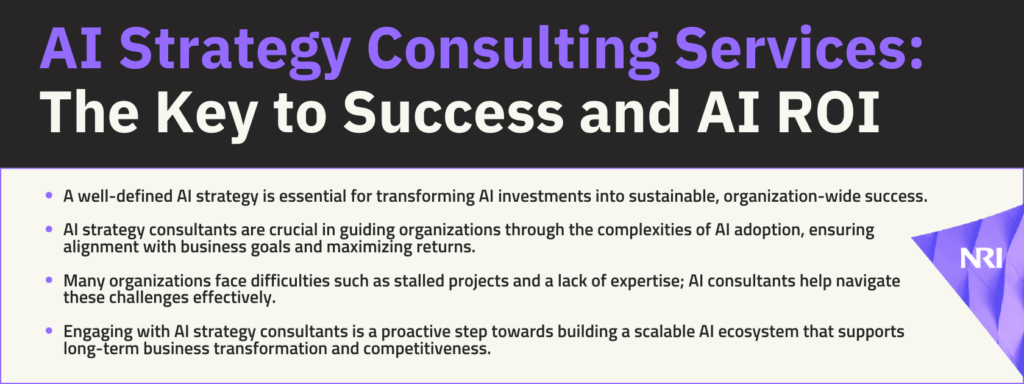
Artificial intelligence (AI) is a transformative force in the technological landscape, with the potential to revolutionize industries. However, challenges abound in the journey from AI hype to tangible business outcomes.
The allure of AI is undeniable, yet statistics reveal that as many as 80% of AI projects never reach production without a formal strategic roadmap. The distinction between merely using AI tools and having a comprehensive enterprise AI strategy is significant: the first leads to isolated successes, the latter ensures sustained, scalable impact across the organization.
AI strategy consulting services are invaluable for bringing order to chaos, harnessing AI’s full potential, and delivering on the financial investment.
A recent report from MIT reveals that even with a $30 to $40 billion investment in enterprise Generative AI, 95% of organizations are seeing no measurable returns. The report highlights that no other technology category has ever drawn such significant investment with such underwhelming results.
For CIOs and innovation leaders, understanding the role of AI strategy consultants is crucial to aligning AI initiatives with business objectives, turning hype into measurable ROI.
What Do AI Strategy Consultants Do?
AI strategy consultants play a pivotal role in guiding organizations through the AI adoption journey with an enterprise AI strategy.
The first step is a readiness assessment to evaluate an organization’s data maturity, infrastructure, and cultural alignment. This foundational step ensures the enterprise effectively integrates AI.
Then, use cases are prioritized into quick wins that offer immediate value and long-term transformations that require a more substantial investment but promise significant returns.
They also assist with architecture and tool selection, designing a tech stack that leverages cutting-edge technologies such as large language models (LLMs), retrieval-augmented generation (RAG), and vector databases, all while avoiding vendor lock-in.
Governance and Risk Management
A robust enterprise AI strategy is incomplete without a strong governance framework. AI strategy consultants help establish ethical guidelines and bias mitigation strategies, ensuring that AI systems operate fairly and transparently. Traditional IT governance frameworks work with systems that have predictable behavior, but AI operates differently.
As data changes, AI models evolve, leading to variable outputs and limited interpretability. Decision-making logic is now often embedded within applications rather than being an external layer. This shift introduces new types of risks for enterprises:
- Bias can arise from outdated or unbalanced datasets.
- Explainability gaps make it challenging to justify AI-driven decisions to regulators, customers, or even internal teams.
- Security issues become more pronounced, particularly when AI models are close to sensitive data.
- Regulatory uncertainty arises when global frameworks and guidelines evolve faster than enterprises can keep pace.
As AI becomes integral to APIs, workflows, and business processes, governance must be a foundational element, rather than an afterthought.
When Should Enterprises Seek AI Consulting?
Organizations should consider partnering with AI consultants when they need to connect strategic vision with technical execution. One clue is the emergence of “Shadow AI,” unauthorized AI initiatives across departments, which signals a lack of oversight and coordination.
These experts are invaluable for addressing operational inefficiencies, controlling escalating expenses, and developing reliable, compliant AI systems from the ground up. It’s time to call in consultants for:
- Stalled AI projects: When initial proof-of-concept efforts cannot transition to full-scale production.
- Lack of internal expertise: When the in-house team lacks the necessary experience in data science, AI strategy, or specialized areas like Generative AI and Natural Language Processing.
- Strategic business transformation: When AI is essential for gaining a competitive edge, reshaping business models, or streamlining inefficient processes.
- Risk management and compliance: When operating in highly regulated sectors such as finance or healthcare, robust governance frameworks are needed to mitigate AI-related risks and protect reputation.
- Operational challenges: When aiming to enhance complex supply chains, automate tasks, or improve forecasting accuracy.
- Developing a data strategy: When an organization needs to create a comprehensive plan to manage and utilize data effectively, it ensures that data assets are aligned with business goals and can support AI initiatives.
AI as a Long-term Competency
AI strategy consulting is not a short-term solution but a long-term investment in building a governed, scalable AI ecosystem. By avoiding expensive architectural mistakes and aligning AI initiatives with business goals, organizations can unlock the full potential of AI. For CIOs and innovation leaders, engaging with AI strategy consultants is a proactive step towards transforming fragmented experiments into a cohesive, enterprise-wide AI strategy.
To begin your transformative journey, start an AI readiness conversation with our advisory team. Our experts are ready to guide you in developing a robust strategy that positions your organization for success in the AI-driven future.