
Safely scaling agentic workflows requires human oversight
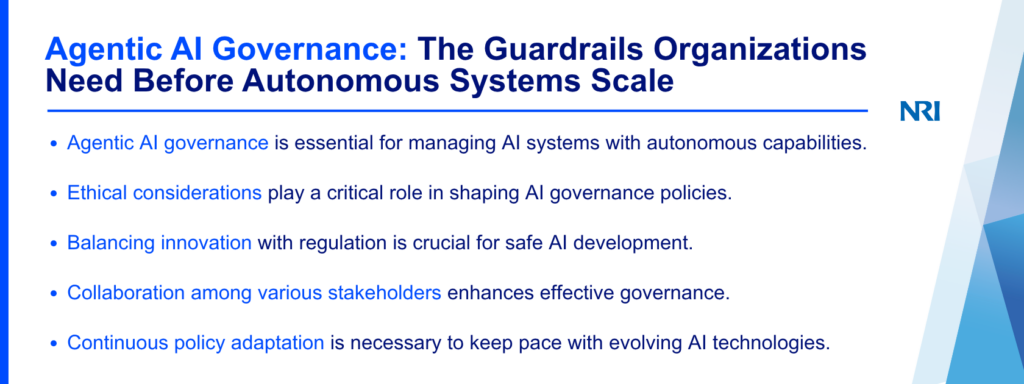
Agentic AI represents a significant shift from traditional generative models. While conventional AI typically generates content or recommendations, agentic AI can initiate actions across applications, workflows, and data.
This expanded functionality offers immense potential for value creation but also amplifies the speed and scale of potential risks. As organizations increasingly adopt these autonomous systems, robust governance frameworks are essential to ensure safe and effective deployment.
Managed IT services play a crucial role in this landscape by helping organizations scale with intention. They provide the expertise and infrastructure needed to implement and maintain these governance frameworks, ensuring agentic AI systems are deployed responsibly, aligned with business objectives, and protected from potential risks.
How Agentic AI is Different from Traditional AI
Agentic AI is not just an evolution of traditional AI; it is a transformation in how AI systems interact with the world. Unlike static generative models that focus on producing content, agentic AI can autonomously execute tasks, make decisions, and take actions with minimal human oversight.
This capability requires a new approach to governance, focusing on both the outputs and the actions of the AI.
- Agentic AI can plan and execute tasks without direct human input, operating at a scale and speed that traditional AI cannot match.
- These systems can make decisions based on data inputs, which requires careful oversight to ensure decisions align with organizational goals and ethical standards.
- Agentic AI can call on various tools and access data across systems, requiring strict controls to prevent unauthorized actions.
Set Autonomous AI Guardrails for Agent Actions
As organizations integrate agentic AI into their operations, setting clear guardrails for agent actions becomes a foundational step in ensuring safe and effective deployment. These guardrails define the boundaries within which AI agents can operate, helping to prevent unauthorized access, mitigate risks, and maintain alignment with organizational objectives.
AI Agent Identity Management: Give Every Agent a Controlled Identity and Least-Privilege Access
To manage the unique risks posed by agentic AI, each agent must operate under a distinct identity with role-based permissions and credential controls. This ensures that agents access only the systems and information necessary for their specific tasks, rather than inheriting broad user or application privileges. Implementing least-privilege access is critical to preventing unauthorized actions and maintaining agentic AI security.
- Each AI agent should have a unique identity that is distinct from human users and other agents, ensuring clear accountability.
- Assign permissions based on the agent’s role and function, limiting access to what is necessary.
- Secure credential management prevents unauthorized access and ensures that agents can only perform approved actions.
- Establish clear ownership of each agent’s actions to ensure accountability and facilitate oversight.
Constrain the Data, Tools, and Actions an Agent Can Use
Organizations must set clear action boundaries for agentic AI by defining approved data sources, connected applications, transaction limits, external communications, and code execution. By constraining an agent’s reach, organizations can minimize the risk of unintended consequences. The safest agents have clearly defined roles and limited capabilities.
Agentic AI identity management includes:
- Limit agents to accessing only approved data sources to prevent unauthorized data retrieval and potential breaches.
- Specify which applications agents can interact with to reduce the risk of unauthorized actions or data manipulation.
- Set limits on the size and scope of transactions agents can perform, particularly in financial or sensitive domains.
- Restrict agents’ ability to communicate externally, preventing unauthorized information dissemination.
Build Audit Trails and Explainability for Agent Actions
Transparency is key to effective governance. Organizations need comprehensive records of agent activities, including accessed data, followed instructions, decisions made, tools used, and resulting actions. These audit trails support investigations, board oversight, auditor inquiries, and continuous improvement, ensuring accountability and traceability in agentic AI operations.
Audit trails and explainability are critical components of effective agentic AI governance. Maintaining comprehensive activity logs is essential for providing a clear record of all agent actions. These logs provide a transparent account of activities and decisions, ensuring every step an AI agent takes is documented and traceable.
Beyond logging activities, documenting the rationale behind agent decisions is vital for understanding and accountability. By recording AI agents’ decision-making processes, organizations can ensure these decisions align with their goals and ethical standards.
Monitoring tool usage is another important aspect of audit trails. Tracking which tools agents use and how they use them helps organizations ensure compliance with internal policies and regulations.
Analyzing the outcomes of agent actions is essential to assess effectiveness and identify areas for improvement. Organizations can refine their processes and enhance the performance of their agentic AI systems by evaluating the results of AI-driven activities. A
continuous improvement cycle is key to maximizing AI benefits while minimizing potential risks.
Keep Humans in the Loop for Consequential Decisions
While agentic AI can automate many tasks, some decisions should require human approval. Financial transactions, sensitive-data access, customer-facing actions, system changes, and regulated determinations are examples of high-impact activities that benefit from human oversight. This oversight should be risk-based, focusing on consequential decisions rather than applying it indiscriminately to every task.
- Create approval processes for high-risk actions, ensuring human oversight where it matters most.
- Implement a tiered decision-making approach, with human involvement increasing as risk levels rise.
- Regularly review and adjust HITL processes to ensure they remain effective and aligned with organizational goals.
- Ensure that all stakeholders, including IT staff and decision-makers, understand the importance of human oversight in agentic AI operations.
- Use real-world scenarios to train staff on when and how to intervene in agentic AI processes, enhancing their ability to make informed decisions.
- Establish feedback mechanisms to improve human-in-the-loop (HITL) processes based on lessons learned and evolving risks.
- Set HITL pause points that force the AI to stop and consult a human before making high-stakes choices.
Protect Against Prompt Injection and Data Exfiltration
Agentic AI systems are vulnerable to malicious instructions, manipulated content, and untrusted data, which can influence agent behavior. To mitigate these risks, organizations must implement guardrails that validate inputs, restrict sensitive outputs, separate trusted and untrusted contexts, and block actions exceeding approved policies. These measures are essential to safeguarding against prompt injection and data exfiltration threats.
- Implement robust input validation to ensure agents process trusted, verified data.
- Control the types of outputs agents can generate, especially when handling sensitive or confidential information.
- Clearly delineate between trusted and untrusted data contexts to prevent unauthorized data manipulation.
- Use automated policy enforcement tools to block actions that exceed predefined boundaries or violate organizational policies.
Agentic AI Governance is an Operating Model, Not a One-Time Configuration
Agentic AI governance is an ongoing process, not a one-time setup. As agent identities, permissions, models, data sources, and connected tools evolve, organizations must regularly review, monitor, test, escalate incidents, update controls, and report to executives. This dynamic approach ensures that governance structures remain effective as agentic AI capabilities expand
The Key Elements of a Dynamic Governance Model
- Regular Reviews: Conduct periodic reviews of agentic AI systems to assess compliance with governance policies and identify areas for improvement.
- Continuous Monitoring: Implement real-time monitoring tools to detect anomalies and potential security threats promptly.
- Incident Management: Develop a robust incident management framework to respond quickly and effectively to any breaches or governance failures.
- Governance Updates: Regularly update governance policies and controls to reflect changes in technology, business needs, and regulatory requirements.
- Executive Reporting: Provide regular reports to executive leadership to ensure transparency and alignment with organizational objectives.
Agentic AI Needs Boundaries Before It Needs Scale
Organizations do not need to shy away from agentic AI to manage its risks. Instead, they require a governance architecture that appropriately limits autonomy, preserves human accountability, and ensures visibility and reviewability of every meaningful action. By establishing these guardrails, organizations can confidently scale autonomous AI systems while maintaining control and security.
Preparing to scale autonomous AI? Talk with NRI about building agentic guardrails and accountable governance.