
Avoid the AI anxiety trap by building an enterprise AI governance framework that enables confident, scalable AI adoption.
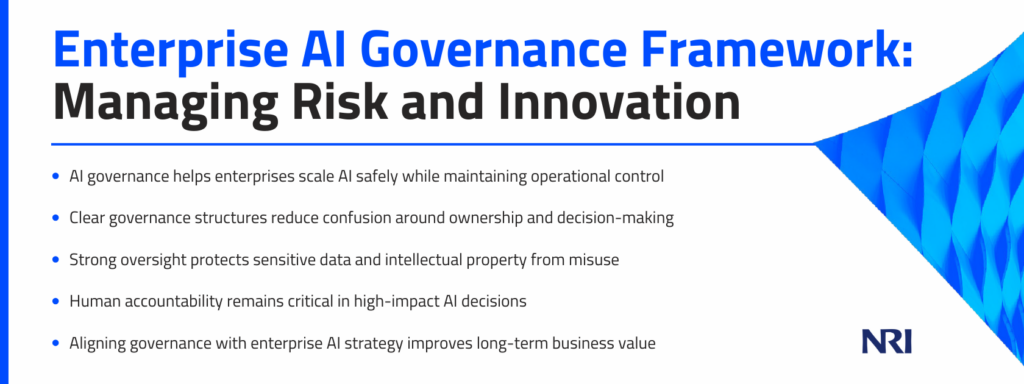
AI adoption is moving faster than many organizations expected. Teams are testing copilots, automating workflows, and experimenting with generative AI across departments. Yet many leaders still hesitate to scale those initiatives across the enterprise.
That hesitation usually comes from uncertainty, not lack of ambition. Questions around data exposure, biased outputs, security gaps, and regulatory pressure often leave organizations stuck in low-value pilots.
According to survey data from the American Arbitration Association, 87% of organizations say they already have some form of AI governance in place, but only 22% believe those systems operate efficiently. Governance, therefore, exists in many organizations, but execution often remains inconsistent across teams and business units.
A strong enterprise AI governance framework helps close that gap by establishing clear roles, decision pathways, and operational guardrails that enable AI adoption to scale with greater confidence. More importantly, governance stops feeling like a restriction and starts acting as the structure that supports safer and faster innovation across the enterprise.
Continue reading to explore what AI governance means in practical terms, why enterprises need stronger governance frameworks, and how organizations can move from isolated AI experiments to scalable, production-ready adoption.
What is AI Governance?
AI governance refers to the systems, policies, and operational controls that guide how organizations develop, deploy, and manage artificial intelligence. It brings together data ethics, model transparency, operational compliance, and accountability so AI systems behave consistently and responsibly across the enterprise.
Traditional IT governance mainly focuses on infrastructure, software access, and security controls. AI governance goes further because AI systems continuously learn, adapt, and influence business decisions in ways traditional governance models were never designed to manage.
Organizations, therefore, need governance structures that address issues such as biased training data, explainability gaps, model drift, and unintended outcomes from automated decision-making. Strong governance also helps enterprises maintain trust by ensuring AI systems remain aligned with organizational values, regulatory expectations, and business priorities over time.
Effective AI governance connects technical teams with legal, compliance, risk, and business stakeholders. That coordination allows organizations to innovate more confidently while maintaining accountability, transparency, and operational control across the full AI lifecycle.
The Strategic Mandate: Why Enterprises Need AI Governance Frameworks
Enterprises increasingly rely on AI to improve efficiency, accelerate decisions, and unlock new business opportunities. However, scaling AI without clear governance often introduces risks that become harder to control as adoption grows.
The following priorities explain why enterprises now treat AI governance as a strategic requirement instead of a secondary compliance exercise.
- Protecting intellectual property and sensitive data
AI systems often process proprietary models, training data, and sensitive customer information across multiple systems and platforms. Weak controls can therefore expose intellectual property to misuse, leakage, or unauthorized access, creating both financial and reputational risk.
Strong governance helps organizations define clear policies around data access, storage, monitoring, and usage. Teams can then innovate more safely without unnecessarily exposing critical enterprise assets.
- Human-in-the-loop accountability
AI systems now influence decisions across areas such as hiring, finance, customer service, and operations. Without clear human oversight, automated outputs can lead to biased decisions, compliance failures, or operational mistakes that are difficult to explain later.
Enterprises reduce that risk by embedding human review and escalation processes directly into AI workflows. Therefore, critical decisions remain accountable even when automation plays a larger operational role.
- Aligning AI with business and IT strategy
Many AI initiatives begin inside isolated teams without strong alignment to broader enterprise priorities. Organizations then end up with duplicated efforts, disconnected tools, and AI investments that fail to deliver measurable business value.
Strong governance helps enterprises align AI adoption with their broader enterprise AI strategy and operational roadmap. In addition, organizations can use IT Advisory Consulting to strengthen prioritization, improve cross-functional coordination, and ensure AI investments support long-term business goals.
Strong AI governance brings these priorities together into one coordinated strategy that protects the enterprise while supporting innovation, accountability, and long-term business value.
Building Your Framework: From Theory to Practice
AI governance becomes effective when organizations move beyond policy documents and apply governance consistently across teams, systems, and operational workflows. Practical frameworks create clearer accountability and help enterprises manage AI adoption with more structure and confidence.
The following areas form the foundation of a scalable enterprise AI governance framework.
- Identifying key stakeholders
Strong AI governance depends on clearly defined ownership across the organization. Effective governance requires collaboration between multiple functions, each with a distinct responsibility:
- Legal: Legal teams interpret regulations and ensure AI systems comply with applicable laws and contractual obligations.
- Risk: Risk teams identify potential failures and establish controls that reduce operational and model-related exposure.
- Data Science: Data science teams design, build, and validate models while ensuring technical transparency and performance.
- Business Leads: Business leaders align AI use cases with strategic goals and ensure outcomes deliver measurable value.
Clear stakeholder alignment improves coordination, reduces operational overlap, and strengthens accountability throughout the AI lifecycle. Decision-making also becomes faster when responsibilities remain visible across teams.
- Monitoring model drift and algorithm bias
AI systems evolve as data patterns, user behavior, and operational conditions change. Without continuous oversight, models can gradually lose accuracy or produce biased outcomes, affecting business performance and trust.
Organizations need monitoring loops that track performance, detect anomalies, and identify model drift before issues become operational problems. Regular evaluation also helps teams retrain or adjust models when outputs no longer align with expected results.
- Turning regulatory roadblocks into competitive advantages
Regulations often feel like barriers that slow AI adoption. However, organizations that embed transparency directly into governance frameworks usually move with greater confidence because compliance expectations remain clearer from the beginning.
Explainability frameworks, documented controls, and transparent decision-making processes help enterprises strengthen trust with regulators, customers, and internal stakeholders. Governance, therefore, becomes less about slowing AI down and more about creating the structure needed to scale AI safely and responsibly.
Strong frameworks turn governance into an operational advantage instead of a control mechanism. Organizations that consistently apply these practices are often able to scale AI faster, reduce risk more effectively, and build stronger long-term trust in enterprise AI adoption.
Turn AI Governance into Action with NRI Advisory Support
AI governance creates the structure organizations need to scale AI responsibly without exposing the enterprise to unnecessary operational, regulatory, or security risk. Consequently, strong governance frameworks help enterprises move beyond isolated AI experiments and into larger, production-ready adoption with more confidence and control.
If you are looking to strengthen your enterprise AI governance framework, partnering with NRI North America can help you get there with confidence. We help organizations design and operationalize governance structures that align AI initiatives with business goals, strengthen accountability, and support safer AI adoption across the enterprise.
Contact us today to speak with an AI strategy advisor and explore how to build a governance framework that accelerates innovation while keeping your enterprise in control.