AI leadership is redefining enterprise success by combining human expertise with intelligent systems to drive trust, accountability, and measurable outcomes.
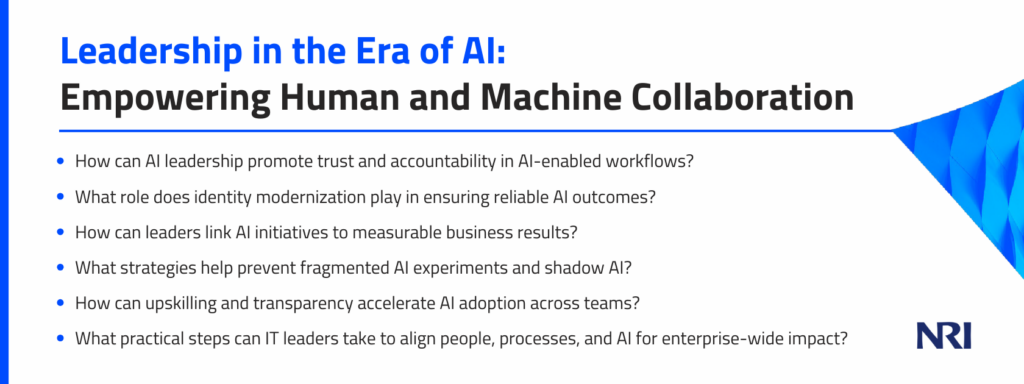
AI is becoming a driving force behind how successful companies operate. Gartner predicts that by the end of 2026, 40% of enterprise applications will feature task-specific AI agents, up from less than 5% in 2025, a clear sign that AI is no longer just a back-end tool but a front-line collaborator. But the real advantage will not come from adoption alone. It will come from practicing AI leadership with purpose, clarity, and accountability.
This shift calls for more from IT leaders; they should stop viewing AI as just a technology decision and see it as a tool that can transform how teams collaborate, how processes operate, and how leadership shows up in a digital-first world.
As an IT Director or VP, you will be guiding how humans and AI work together. It’s your responsibility to make sure intelligent applications support your workforce rather than disrupt it, and that innovation doesn’t come at the expense of accountability.
Are you empowering AI, or allowing it to shape your organization without guardrails? Your influence, clarity, and ability to guide change will determine which direction your enterprise takes.
AI Leadership: Balancing innovation and accountability
AI-enabled modernization is reshaping how people work, make decisions, and how value moves across the business. Intelligent applications can route requests, recommend next steps, generate documentation, and support employees in real time. The speed and automation are powerful, but they only deliver real results when teams trust the systems they rely on.
Trust in AI leadership is non-negotiable and has become a critical part of business strategy. While efficiency is helpful, you must strive to maintain accountability in every AI-driven workflow. As a leader, it’s your responsibility to make sure intelligent apps:
- Operate transparently
- Respect governance boundaries
- Follow identity and access controls
- Avoid amplifying bias
- Protect privacy and compliance requirements
Research shows that 74% of CEOs believe their teams struggle to adopt AI responsibly because governance frameworks are not mature enough. Their sentiment reinforces a key point: success with AI is not just about the technology you deploy, but about building confidence in how that technology works and how it supports your people.
When you set clear identity controls, champion responsible AI use, and communicate how AI fits into daily work, you build an environment where teams can adopt AI with confidence.
Leading AI-enabled modernization
Modernization is no longer just about updating infrastructure or remediating applications. With the rise of AI, intelligent capabilities are becoming part of every modernization effort, reshaping how applications operate and, more importantly, how leaders like you guide change.
As you incorporate AI into modernization, keep three principles at the center:
- Treat identity modernization as the foundation
AI decisions depend on roles, permissions, and context. A strong identity framework is necessary for trusting those decisions. Modernizing identity ensures that user access aligns with AI-driven actions, that audits remain accurate, and that accountability remains clear across automated workflows.
Many programs struggle not because of the AI itself, but because identity management was treated as an afterthought. Prioritizing identity gives your AI initiatives a transparent, secure, and trusted foundation that delivers real business impact.
- Anchor AI use cases to measurable outcomes
AI adoption only succeeds when it produces clear business value. Every initiative should be able to answer:
- What process becomes faster?
- What decision becomes clearer?
- What dependency becomes simpler?
- What outcome becomes measurable?
If an AI capability cannot connect to a business metric, it risks becoming a novelty rather than a transformational tool.
- Avoid fragmented AI experiments
Scattered pilots without governance create risk: duplicate capabilities, inconsistent models, and shadow AI efforts that work against each other. A structured, federated approach keeps innovation aligned with enterprise strategy and reduces unnecessary operational friction.
Building trust and cultural alignment
Technology alone will not ensure successful AI adoption. People will, if led by strong AI leadership. As a leader, your responsibility is to position AI in a way that builds confidence and encourages engagement, and fosters trust. Practicing AI leadership means guiding your teams through uncertainty with clarity and accountability, ensuring that AI enhances, not replaces, human potential.
- Position AI as augmentation, not replacement
Your teams need to know that AI is elevating their work, not replacing it. Leaders who explain AI as a tool that enhances judgment rather than substituting expertise see faster adoption and lower resistance.
- Create transparent AI workflows
Teams want clarity on how AI operates. They need to understand:
- How recommendations are generated
- Which data is used
- Where decision limits are defined
- When human review is required
Transparency builds confidence, and confidence accelerates adoption.
- Develop continuous upskilling paths
Your workforce cannot thrive in AI-enabled environments without new skills. Focus on developing capabilities such as:
- Prompt-driven workflows
- AI-assisted analysis
- Data literacy
- Governance awareness
- Human-in-the-loop decision models
Upskilled teams do not fear AI. They use it to strengthen their impact.
- Establish clear communication loops
AI evolves quickly. Structured forums for questions, feedback, and shared insights help prevent misinformation, reduce resistance, and keep leadership connected to real user sentiment. For more strategies on digital transformations, see NRI’s ebook on organizational change management.
Championing collaboration: the leadership playbook
AI leadership is not an abstract concept. It comes to life through the choices you make about how teams collaborate, how decisions are supported, and how AI integrates into real processes.
As you plan these initiatives, consider how your IT modernization roadmap will evolve so AI adoption aligns with enterprise strategy and delivers measurable outcomes.
- Assess organizational readiness: Evaluate how your workforce perceives AI, the maturity of your identity systems, data quality, process complexity, and which applications are suitable for automation. This creates a clear baseline for responsible adoption.
- Modernize identity before modernizing AI: Identity determines what AI can access, understand, and decide. Strengthening identity first helps reduce downstream risk and ensures AI operates within proper boundaries.
- Launch small AI-enabled pilots with strong governance: Select workflows with clear, measurable metrics such as response time, accuracy, throughput, and approval duration. Include transparent models, defined human approvals, escalation paths, and visible performance metrics. Use real user feedback to refine each pilot.
- Track metrics that reflect human and machine collaboration: Measure adoption, trust, time saved, decision quality, innovation velocity, and accuracy improvements. These metrics validate value, reduce ambiguity, and guide the next steps of your AI strategy.
Future-ready organizations align people and intelligent systems
AI leadership represents a change in how organizations think about technology and talent. It is also an opportunity for leaders to bring people and intelligent systems together to strengthen the entire business. When your teams, AI-enabled applications, and modernization efforts are aligned, you build an operating model that is resilient, adaptable, and ready for the future.
At NRI, we help IT leaders create this alignment by building cultures of trust, preparing teams to work confidently with AI, and ensuring clarity at every stage of adoption. Leaders who approach AI with intention do more than introduce new tools. They drive measurable outcomes and create confidence across the enterprise.
Ready to get started? Contact NRI to turn AI initiatives into meaningful results. You can also explore our strategies and insights to help you lead AI-enabled modernization effectively.