
Build a hybrid cloud infrastructure management strategy that keeps cloud and on-prem systems connected, visible, and easier to control as operations scale.
Not long ago, most infrastructure lived in one place, with applications, storage, networking, and security systems managed in centralized data centers. IT teams had clearer visibility, tighter operational control, and fewer moving parts to manage daily.
Today, organizations operate across cloud platforms, on-prem systems, remote infrastructure, and distributed workloads that must all work together consistently. That combination creates a hybrid cloud infrastructure model and also makes management more difficult as infrastructure grows.
According to IDC research, 88% of cloud buyers say they already operate a hybrid cloud model or are actively moving toward one. However, hybrid growth has introduced a new layer of operational complexity because cloud and on-prem systems often evolve separately over time.
As a result, visibility becomes fragmented, governance becomes inconsistent, and infrastructure costs become harder to predict or control. Many IT teams therefore spend more time troubleshooting outages, integration issues, and performance gaps rather than focusing on long-term optimization.
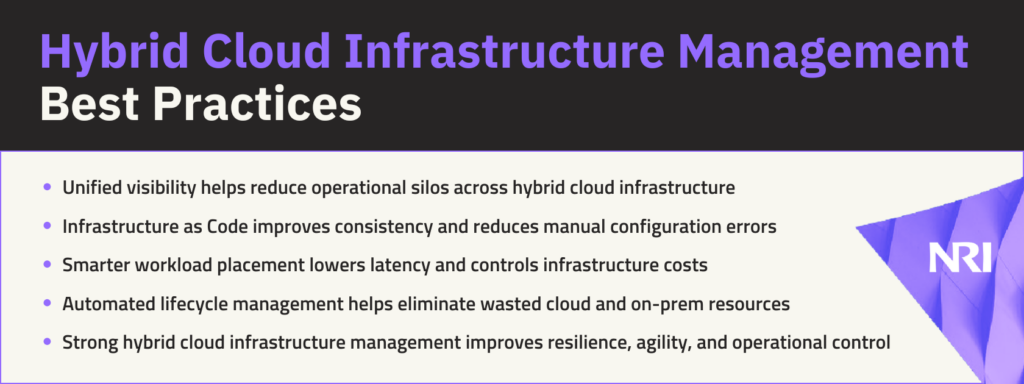
Strong hybrid cloud infrastructure management helps organizations bring those moving parts together through unified visibility, centralized automation, and standardized governance.
Continue reading to explore the best practices that help organizations improve resilience, reduce operational overhead, and maintain stronger control across hybrid infrastructure systems.
The Essentials: What Are Hybrid Cloud Management Best Practices?
Many organizations adopt a hybrid cloud infrastructure without first building a clear operational strategy. Cloud and on-prem systems therefore grow separately, making infrastructure harder to monitor, secure, and optimize over time.
Operational silos become a serious problem when teams rely on disconnected tools and inconsistent management processes. Over time, troubleshooting slows down, governance weakens, and technical debt continues building across infrastructure systems.
Here are the core practices that help organizations manage hybrid cloud infrastructure more effectively.
- Infrastructure as Code (IaC)
Infrastructure as Code uses automation to deploy and manage infrastructure consistently across cloud and on-prem systems. Instead of relying on manual configuration, teams use version-controlled templates that reduce human error, improve operational consistency, and create more predictable infrastructure performance as systems scale.
- Workload portability
Workload portability allows applications and services to move across infrastructure systems without requiring major redesign. Containerization supports that flexibility by helping teams deploy workloads consistently across cloud and on-prem platforms, which improves resilience, operational agility, and long-term scalability.
- Identity convergence
Identity convergence creates a unified access management model across cloud and on-prem systems. Users, services, and applications operate under aligned authentication and authorization policies regardless of where workloads run, which improves security while reducing administrative complexity across distributed systems.
Strong hybrid cloud infrastructure management depends on integrating these practices into a coordinated operational strategy that supports agility, resilience, and long-term infrastructure stability.
Optimization: Performance and Financial Control
Performance and cost problems often appear when organizations expand hybrid infrastructure without carefully considering how workloads and data move across systems. Small inefficiencies, therefore, grow quickly into larger operational and financial issues when cloud and on-prem systems operate without coordinated oversight.
So, where does effective optimization actually begin? Here are the core areas organizations should focus on to improve performance, maintain stability, and strengthen financial control across hybrid infrastructure systems.
- Solving for data gravity
Real cloud cost optimization starts with understanding data gravity and making smarter decisions about where workloads should run. Data gravity refers to how large data sets naturally pull applications and services toward them, as constantly moving data between cloud and on-prem systems increases latency, network traffic, and cloud transfer costs over time.
Organizations usually achieve better performance when workloads stay closer to where data is actively stored and processed. Another effective way to reduce infrastructure overhead is to limit unnecessary data movement, which improves operational efficiency while keeping hybrid infrastructure costs under better control.
- Automated lifecycle management
Infrastructure costs often rise quietly when unused resources continue running across cloud and on-prem systems without clear visibility into actual usage. Many organizations, therefore, end up paying for inactive assets, oversized workloads, and hardware that no longer support operational demand efficiently.
Automated lifecycle management helps teams continuously identify unused resources, remove unnecessary assets, and optimize infrastructure allocation. Another advantage is that on-prem hardware can be reassigned based on real operational demand instead of fixed assumptions that waste capacity and increase cost pressure.
- Proven migration stages
Infrastructure optimization also depends on how organizations manage operational change, as rushed migrations often create instability, downtime, and performance issues that are difficult to resolve later. Following structured migration stages helps reduce that risk by moving infrastructure through controlled phases that are easier to validate, manage, and optimize over time.
Each stage reinforces system reliability while ensuring performance and cost improvements are sustained throughout the hybrid lifecycle.
Roadblocks to Opportunities: Turning Complexity into Agility
Hybrid infrastructure often becomes harder to manage when operational growth outpaces internal capacity. Teams start struggling with visibility, automation, and operational consistency as cloud and on-prem systems continue expanding across different platforms and operational layers.
However, complexity does not always have to slow progress down. Organizations can regain control and improve agility by strengthening technical capabilities while building infrastructure practices designed for resilience, automation, and long-term operational stability.
Here are the key areas organizations should focus on to reduce operational complexity and improve hybrid infrastructure agility.
- Bridging the skills gap
Modern hybrid cloud infrastructure management requires skills that go beyond traditional infrastructure administration. Teams now need stronger expertise in automation, orchestration, observability, and software-defined infrastructure management to manage distributed systems more efficiently and consistently.
Upskilling teams in these areas helps reduce operational friction by making repetitive processes easier to automate and scale. Another benefit is that infrastructure operations become less reactive as teams rely more on policy-driven management instead of constant troubleshooting.
- Enhancing resilience
Hybrid infrastructure also gives organizations the opportunity to build stronger resilience rather than relying too heavily on a single location or platform. Workloads can be distributed across cloud and on-prem systems to improve disaster recovery and reduce operational disruption during outages.
Recovery becomes faster and more reliable when systems are designed to fail over smoothly between locations without interrupting service continuity. Combined with better visibility and centralized automation, that level of resilience gives organizations more flexibility and operational confidence as infrastructure continues growing.
Unify Your Infrastructure Strategy with NRI
Hybrid cloud infrastructure rarely becomes difficult because of technology alone. More often, cloud and on-prem systems are managed separately, which creates disconnected tools, inconsistent governance, and fragmented visibility over time.
A strong hybrid cloud infrastructure management strategy helps bring those systems together through unified visibility, centralized automation, and standardized operational control. Teams therefore spend less time reacting to isolated issues and gain better control over performance, resilience, and infrastructure costs.
If you are looking to move in that direction, partnering with NRI North America can help you get there with confidence. We help organizations design and manage hybrid infrastructure strategies that unify operations, improve resilience, and reduce inefficiencies across distributed infrastructure systems.
Contact NRI today to explore hybrid infrastructure consulting and build a more connected and future-ready hybrid cloud infrastructure strategy.