
Balance on-premises systems and cloud environments with a structured hybrid cloud migration strategy that delivers long-term agility, control, and resilience.
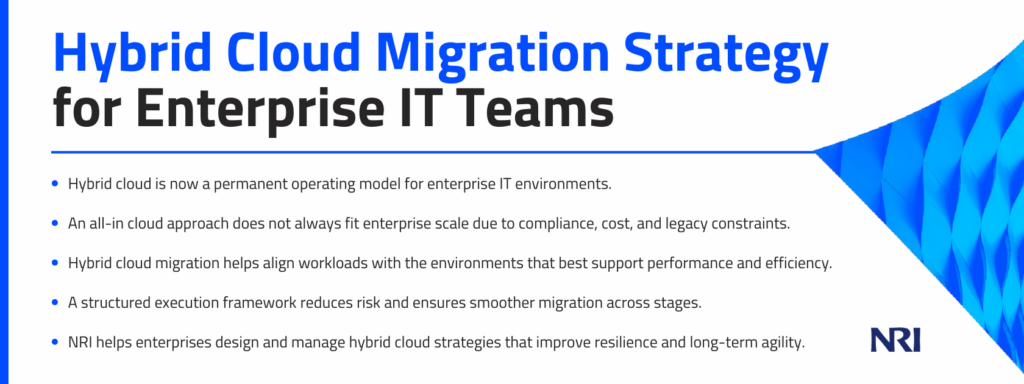
What drives the decision to move critical workloads to the cloud? For some organizations, it is the need to simplify operations and reduce infrastructure overhead. For others, it is about scaling faster, improving resilience, or gaining access to advanced capabilities like AI and analytics.
However, not every workload benefits from a full cloud move. Legacy dependencies, regulatory requirements, and latency-sensitive applications often perform better outside a single cloud model. Many organizations discover this only after encountering rising costs, performance trade-offs, and gaps in control.
That is why hybrid has become the practical path forward. A hybrid cloud migration strategy places workloads where they perform best, across on-premises infrastructure and cloud environments, while maintaining control over cost, compliance, and performance.
Research from Edge Delta shows that 89% of organizations use multi-cloud environments, with 80% adopting hybrid models that combine private and public infrastructure. The shift reflects a clear trend: enterprises are optimizing workload placement rather than forcing everything into the cloud.
Continue reading to understand what hybrid cloud migration involves, how to execute it step by step, and how to overcome common challenges that come with managing hybrid environments.
What is hybrid cloud migration?
Hybrid cloud migration is a structured approach to synchronizing traditional infrastructure with the flexibility and scalability of cloud environments. Instead of replacing existing systems, organizations integrate on-premises and cloud environments so they work together efficiently.
At its core, hybrid cloud migration focuses on workload placement and interoperability. Critical or sensitive systems may remain on-premises for stability, while scalable or innovation-driven workloads move to the cloud. This balance allows organizations to maintain control over essential operations while still benefiting from cloud agility.
A key concept in this model is cloud adjacency, which keeps on-premises and cloud environments closely connected for seamless data flow and operational consistency. This proximity reduces latency and supports better performance for workloads that depend on both environments.
Unlike traditionally isolated environments, hybrid cloud infrastructure management and cloud adjacency enable real-time coordination across environments. Data, identity, and workloads can move securely and efficiently, turning hybrid cloud migration into an ongoing process of optimization rather than a one-time transition.
The step-by-step execution framework
A structured approach is essential for executing a hybrid cloud migration strategy at enterprise scale. It reduces risk while maintaining continuity across critical systems and environments.
Here are the steps that guide a controlled and practical migration journey:
Step 1: Portfolio discovery
Portfolio discovery focuses on building a clear view of the application and infrastructure landscape. The goal is to identify which workloads are latency-sensitive and which can scale more effectively in the cloud.
Dependencies, performance requirements, and business criticality are assessed at this stage. That clarity places each workload in the environment where it performs best.
Step 2: Foundation building
Foundation building establishes secure and reliable connectivity between on-premises systems and cloud platforms. Solutions such as Direct Connect and ExpressRoute provide consistent network performance across environments.
Strong connectivity ensures stable data flow and application performance while supporting secure hybrid operations at scale.
Step 3: Phased execution
Phased execution focuses on migrating workloads in stages rather than all at once. This approach reduces downtime and allows teams to validate performance at each step.
Most organizations follow a structured set of migration stages: assessment, planning, migration, and optimization. Working in phases helps maintain stability while enabling steady progress.
A well-defined execution framework provides a clear path for managing hybrid cloud migration. It allows organizations to balance speed, stability, and control as they move toward a more flexible, scalable infrastructure.
Overcoming hybrid roadblocks
Hybrid cloud environments introduce challenges that can slow migration and affect performance if left unaddressed. Managing these risks early is essential for maintaining stability, security, and cost efficiency across distributed systems.
Two areas typically require the most attention:
- The connectivity trap
The connectivity trap emerges when data movement between on-premises and cloud environments becomes slow or expensive due to data gravity. Large data volumes increase dependency on specific environments, often leading to higher egress costs and network bottlenecks.
Effective hybrid cloud infrastructure management depends on controlling how and where data moves. Optimizing data placement and minimizing unnecessary transfers helps maintain performance while keeping costs predictable.
- Governance parity
Governance parity focuses on maintaining consistent security and compliance across both cloud and on-premises environments. Without alignment, gaps can appear in identity management, access control, and monitoring.
A unified governance model ensures policies are applied consistently across environments. Aligning these controls strengthens the overall security posture and simplifies compliance management at scale.
Addressing these roadblocks early allows hybrid environments to operate as a cohesive system rather than a fragmented one, supporting scalable growth without sacrificing control over cost, security, or performance.
Partner with NRI to drive smarter hybrid cloud decisions
Hybrid cloud is not a compromise between on-premises and cloud environments. It is a strategic approach to placing each workload where it performs best, giving you greater control over cost, compliance, and performance while supporting innovation.
As enterprise infrastructure evolves, the need for clear direction and execution becomes more critical. NRI works with organizations to design and manage hybrid environments that align with long-term business goals and operational realities.
The focus is on building a hybrid cloud migration strategy that reduces complexity, strengthens governance, and supports scalable growth across environments.
Speak with a hybrid cloud expert to explore how your organization can build a more resilient and future-ready infrastructure strategy.