
While scaling AI initiatives is challenging, success is possible with the right foundations in place.
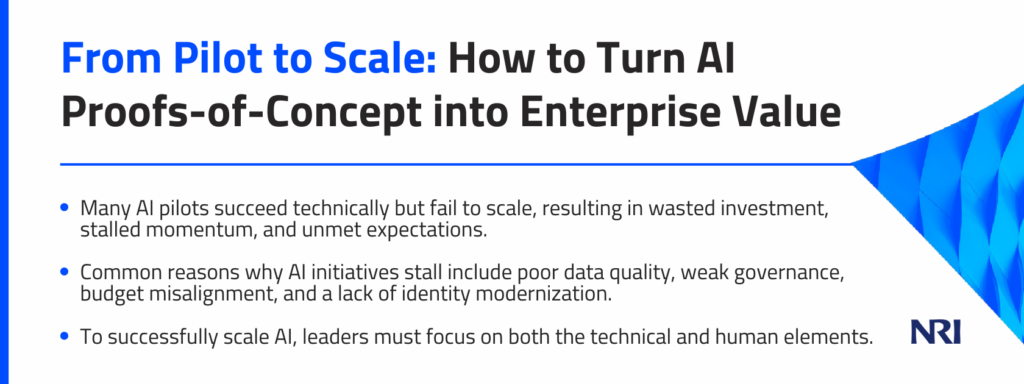
Are you at risk of falling into the “AI pilot trap”?
Only 16% of enterprises successfully move their AI initiatives from pilot to scale, according to IBM’s 2025 CEO study. Another recent MIT report places the figure at a mere 5% for generative AI projects.
As a senior IT executive, these figures are scarcely surprising: Scaling AI initiatives is no easy task.
You’ve likely seen (or know someone who has seen) this pattern before: An AI proof-of-concept delivers promising results. The model performs well in a controlled environment. Stakeholders are intrigued. The pilot proves the idea is technically feasible.
And then… progress slows.
The pilot doesn’t fail, but it doesn’t move forward either. It remains isolated, unsupported, and ultimately irrelevant to day-to-day operations. The result isn’t just wasted spend on model development. Over time, leadership becomes cautious. Teams hesitate to propose the next initiative. And AI momentum quietly evaporates.
Understanding how to avoid this “AI pilot trap” is critical to successfully scaling AI initiatives.
This article explains why AI pilots stall, what foundations are required to scale responsibly, and how IT leaders can turn early-stage success into sustainable value.
Why Pilots Stall
When AI initiatives fail to take off, it’s usually due to one or a combination of the following factors:
1. Poor Data Quality
Roughly 63% of data management leaders surveyed by Gartner said their data isn’t ready for AI or they are unsure, jeopardizing the success of their initiatives. The IT research firm and consultancy estimates that poor data quality will cause organizations to abandon 60% of AI projects by the end of 2026.
2. Weak Governance
Early pilots typically operate in a sandboxed environment outside formal risk, compliance, and security frameworks. That flexibility enables experimentation, but it doesn’t translate to production. As soon as AI outputs begin influencing business decisions, governance questions surface: Who is accountable? How is bias addressed? Can decisions be explained? Without strong governance, scaling brings considerable risk.
3. Budget Misalignment
Another issue is the funding of many pilot programs as innovation initiatives rather than operational programs. When it’s time to scale, there is no clear business owner responsible for outcomes, costs, or ongoing operations. Without that ownership, pilots never fully take off.
4. Lack of Identity Modernization
Finally, successful enterprise AI adoption highly depends on secure, auditable access to data, applications, and models. That means that without a modern IT infrastructure and robust identity controls, cybersecurity concerns can easily slow or stop expansion.
Now, let’s look at how to avoid these pitfalls.
Building the Foundation for Scaling AI
Aligning AI Projects with Business Outcomes
Typically, when implementing anything new, it’s wise to begin with a specific operational or strategic objective and work backward to the technology required. AI is no different. Therefore, IT leaders should start with the “why.” To what end are you implementing AI? Or more specifically, what business need will it serve? Aligning AI initiatives with business outcomes makes value measurable and creates a clear case for sustained investment.
Data Readiness and Governance
As discussed, data readiness is a make-or-break event in scaling AI initiatives. And you must define what that actually means for your organization. Generally speaking, AI-ready data accurately reflects the intended AI use case, including normal patterns, edge cases, errors, and anomalies. Getting there is an ongoing process that relies on strong metadata to align, govern, and continuously qualify data.
That said, here are five steps to take to make your data AI-ready:
- Align Data To Specific AI Use Cases. Start with the business outcome, then identify the right internal and external data sources to support it.
- Embed Governance Early. Work with legal and business leaders to manage ethical, regulatory, and security risks (especially around sensitive data and cross-system use).
- Level Up Your Meta Data. Move it from a passive inventory to an active intelligence layer. When metadata is continuously enriched and analyzed, it can drive smarter recommendations, automation, and ongoing improvement.
- Get The Data Pipelines Ready. Ensure they support both model training and live production feeds, based on clearly defined requirements.
- Assure and Improve Data Continuously. Once the data is fed to AI models, it needs to be tested, monitored, and optimized. This is where DataOps and data observability come into play to track changes, spot issues early, and make adjustments as needed.
As AI moves into production, governance must scale with it. Enterprise governance of AI (EGoAI) provides a practical approach by coordinating decision-making across IT, data, analytics, and risk domains. Here, governance begins at the executive level and is translated by chief information officers (CIOs) and chief data and analytics officers (CDAOs) into operational policies that balance value, risk, and cost.
Read more: The Executive’s Guide to Data Management
Identity Migration
This is critical for scaling AI as it ensures secure, consistent access to models, applications, and data across the enterprise. By moving from legacy on-prem systems to modern, unified identity platforms, your enterprise can enforce authentication, authorization, and auditing at scale. This not only protects sensitive data and supports compliance but also improves adoption. Employees can access AI tools seamlessly via single sign-on and role-based permissions, and IT can centrally manage access.
Change Management as the Scaling Engine
As you build the technical foundation, don’t forget the human element.
Communicate early, clearly, and consistently. AI adoption often raises concerns about transparency, accountability, and job impact. Avoiding these hard conversations creates resistance. So you must address them directly to build credibility and support for the initiative. Ensure users understand how AI supports decision-making, its limitations, and when human judgment is required. At the same time, upskill your team so that they can work confidently with all AI-enabled applications.
Finally, embed AI into existing workflows so users don’t have to change their entire workflow. When AI enhances the tools and processes people already use, it becomes part of normal operations, and it’s easier to scale.
Architecting for Scale
Enterprise-scale AI requires standardized, reusable platforms. Shared data services, consistent deployment pipelines, and centralized monitoring reduce duplication and make AI easier to govern. Teams can build faster when they don’t reinvent infrastructure for every use case.
AI capabilities also need to be integrated into modern application ecosystems. Cloud-native platforms, APIs, and modular services allow AI models to be consumed wherever business processes run.
Throughout this expansion, identity and access controls must scale in parallel. As more users and systems interact with AI, identity provides the enforcement mechanism that maintains security and compliance. Strong authentication, granular controls, and continuous monitoring provide the confidence to scale without hesitation.
Scaling AI Initiatives With Confidence
Scaling AI successfully is not about moving faster. It’s about moving strategically.
Here’s a practical roadmap to use:
- Modernize identity and data platforms to support secure AI access.
- Align funding and ownership with business outcomes.
- Prioritize high-value use cases that are easily scalable.
- Embed governance and change management into every phase.
- Measure ROI across departments, adoption, and compliance adherence.
Remember, while 84% of enterprise AI projects don’t move past the pilot phase, 16% still do. Therefore, scaling AI initiatives successfully is possible.
NRI experts can help you move beyond pilots and drive meaningful value at scale.
Contact us today to learn how to scale AI-enabled modernization with governance and identity at the core.