Managing cyber risk effectively starts with managed security services that help organizations detect, prioritize, and respond to threats faster.
Your security tools probably generate alerts throughout every working day. Firewalls, endpoint platforms, identity controls, and cloud security tools may all detect suspicious activity across your organization.
However, the biggest problem usually isn’t a shortage of alerts. It’s a shortage of time, ownership, and clear processes for deciding which threats require action first.
According to verified data breach statistics, organizations take an average of 277 days to identify and contain a breach. This delay shows why technology alone can’t protect your business when internal teams lack continuous monitoring and structured response.
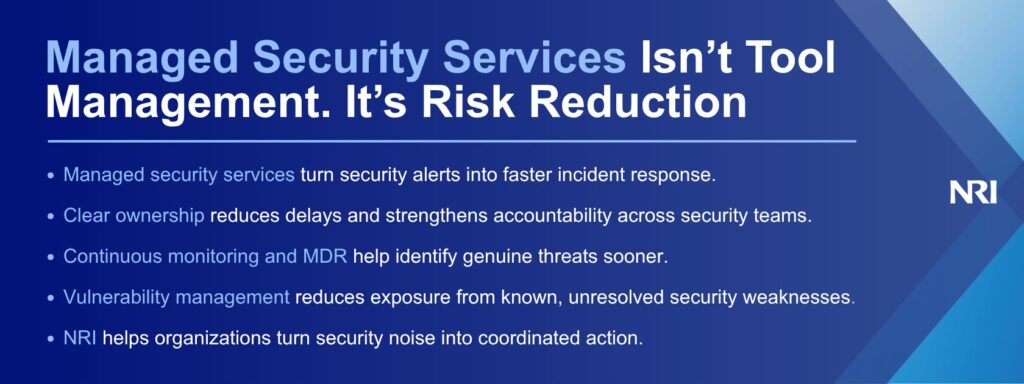
Managed security services help close that gap by connecting security monitoring, investigation, escalation, vulnerability management, and executive reporting through one coordinated operating model.
Continue reading to see why alerts keep piling up, what security teams often miss, and how managed security services turn security noise into faster action
Alerts Rarely Pile Up for Just One Reason
Security alert backlogs rarely stem from a single issue. They usually build over time as technology, processes, and resource constraints create operational bottlenecks.
Common causes include:
- Overlapping tools: Multiple security platforms generate duplicate alerts that make it harder to identify genuine threats.
- Weak alert tuning: Poorly configured detection rules create unnecessary noise and increase false positives.
- Unclear security ownership: Teams aren’t always sure who should investigate, escalate, or resolve specific alerts.
- Understaffed security teams: Limited resources make it difficult to keep pace with growing alert volumes.
- Limited after-hours coverage: Threats that emerge overnight or on weekends can remain undetected for hours.
- Poor escalation processes: Unclear response procedures slow investigations and delay containment.
- Competing IT priorities: Internal teams often balance security with infrastructure, projects, and user support.
Addressing these operational gaps helps reduce alert fatigue and allows teams to focus on the risks that matter most.
The Hidden Cost of Unclear Security Ownership
Security alerts become riskier when no one clearly owns investigation, escalation, remediation, or executive communication. Important alerts may remain unresolved while IT, security, compliance, operations, and leadership each assume another team is responding.
Unclear ownership creates inconsistent response processes that delay incident containment. Longer response times increase the risk of business disruption, compliance gaps, financial loss, and successful attacks.
Your organization needs defined roles, clear escalation paths, and accountability throughout the incident response process. Clear ownership ensures the right people take the right action at the right time.
Research shows that organizations containing breaches in fewer than 200 days spend $1.02 million less than those with longer containment times.
Many organizations also mistake dashboards for security visibility. Dashboards display information, but they do not explain what changed, which alerts matter most, what requires immediate action, or where risk is increasing.
Actionable visibility turns security data into clear priorities. It helps your teams respond faster, focus on the highest risks, and prevent incidents from becoming larger business problems.
What Most Teams Miss in Security Operations
Many security risks develop gradually because important warning signs are overlooked during day-to-day operations.
Areas organizations commonly miss include:
- Ignored low-priority alerts that reveal larger patterns: Individual alerts may seem insignificant, but recurring low-priority events can indicate the early stages of a larger attack.
- Unresolved vulnerabilities: Known security weaknesses remain exploitable when remediation is delayed, incomplete, or poorly tracked.
- Identity and access risks: Excessive user privileges, inactive accounts, and weak authentication controls increase the risk of unauthorized access.
- Security tool misconfigurations: Incorrect settings reduce detection accuracy and may leave gaps in monitoring or protection.
- Lack of historical trend analysis: Without reviewing long-term security data, your organization may miss recurring threats, emerging attack patterns, and areas where risk continues to grow.
Recognizing these overlooked issues helps your organization strengthen security operations before smaller problems develop into major incidents.
How Managed Detection and Response Changes the Conversation
Managed detection and response, or MDR, shifts the focus from reviewing alerts to investigating and responding to genuine threats. It provides the expertise and operational structure needed to identify what matters and take the right action.
Key MDR capabilities include:
- Continuous security monitoring: Detect suspicious activity across your systems and networks around the clock.
- Threat detection and investigation: Validate alerts, investigate suspicious behavior, and separate genuine threats from routine activity.
- Incident escalation: Ensure critical threats reach the right stakeholders without unnecessary delay.
- Remediation support: Help internal teams contain incidents, recover affected systems, and reduce the risk of similar events happening again.
These capabilities help your organization respond faster, reduce uncertainty, and improve overall security operations.
However, vulnerability management should not be treated as a periodic scanning exercise. Effective vulnerability and patch management requires continuous ownership, prioritization, and follow-through.
A stronger approach includes:
- Risk-based prioritization: Address the most critical vulnerabilities first based on business impact and likelihood of exploitation.
- Remediation tracking: Monitor progress until identified issues are fully resolved.
- Security reporting: Provide visibility into remediation progress, unresolved weaknesses, and outstanding risk.
- Continuous review: Reassess systems regularly as new vulnerabilities emerge and technology changes.
Ongoing ownership helps your organization reduce security gaps, improve compliance, and prevent known vulnerabilities from becoming successful attack paths.
How Managed Security Services Help Turn Noise into Action
Managed security services provide the expertise, processes, and continuous oversight needed to transform security data into measurable risk reduction.
An organization can also realize the cost-saving benefits of managed services by gaining access to specialized security expertise without the expense of building and maintaining a full internal security operation.
NRI North America is a cybersecurity consulting and managed security services provider that helps organizations strengthen security operations and reduce cyber risk.
Our managed security services include:
- 24/7 security monitoring: Continuously monitor your systems and networks for suspicious activity.
- Managed detection and response: Investigate, prioritize, and respond to verified threats.
- Vulnerability and patch management: Identify, prioritize, track, and remediate security vulnerabilities.
- Security posture management: Continuously assess security controls and identify areas for improvement.
- Executive-ready reporting: Deliver clear, business-focused reports that highlight risks, trends, response performance, and unresolved issues.
NRI helps your organization reduce alert fatigue, improve response times, and turn security operations into a proactive program that supports long-term risk reduction.
Security Visibility Should Lead to Faster Action
Security alerts only create value when they lead to better decisions and faster response. Managed security services help your organization reduce noise, clarify priorities, and strengthen resilience through continuous monitoring, expert analysis, and proactive risk management.
Whether your goal is to improve threat detection, accelerate incident response, or strengthen vulnerability management, the right security partner helps transform security operations into a measurable business advantage.
Need help turning security alerts into clear action? Talk with NRI North America about managed security services and see how our experts can help you reduce risk, improve response times, and build a more resilient security program.