Leverage managed security services to reduce operational strain, strengthen threat response, and give your internal IT team the support it needs to manage cybersecurity effectively.
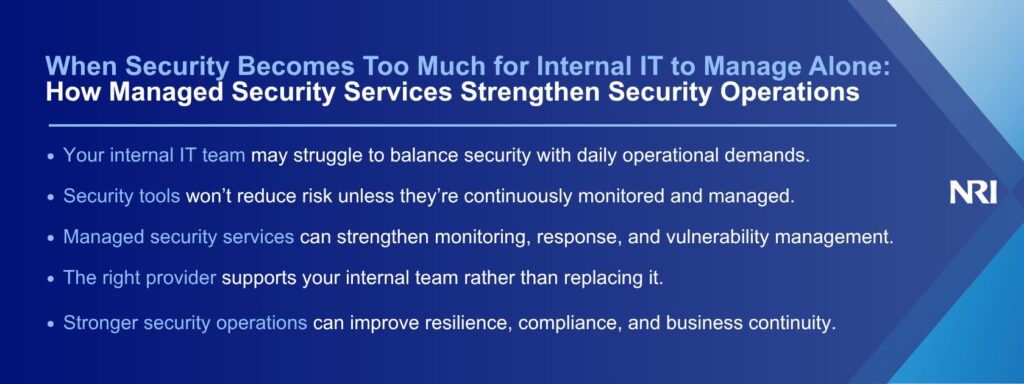
Internal IT teams are expected to do more than ever before. They manage infrastructure, cloud environments, user support, software deployments, vendors, compliance, and increasingly, cybersecurity.
However, as threats become more sophisticated and regulatory expectations continue to grow, security is no longer a responsibility that can be handled alongside everything else.
Your organization may already have firewalls, endpoint protection, identity management, and cloud security tools. Those investments won’t reduce risk by themselves. Someone still has to monitor the alerts, investigate suspicious activity, manage vulnerabilities, and respond before a minor issue becomes a costly incident.
According to the IBM Cost of a Data Breach Report 2025, organizations that extensively used AI and automation in their security operations saved an average of $1.9 million per breach compared with those that didn’t.
Yet technology wasn’t the only factor. Those savings also depended on experienced professionals, structured processes, and consistent execution. That’s where managed security services can support your organization.
Instead of replacing your internal IT team, they provide additional monitoring, managed detection and response, vulnerability management, and operational expertise. A stronger cybersecurity strategy can therefore reduce risk while giving your team more time to focus on business priorities.
Continue reading to see the warning signs that your current model may be under strain, why adding more tools won’t necessarily improve security, and what you should expect from the right provider.
The Clearest Signs Your Security Model Is Under Strain
Security problems rarely appear overnight. Instead, they usually build as your workloads increase, systems become more complex, and your team takes on additional responsibilities.
One of the clearest signs is inconsistent monitoring. Your team may not review alerts promptly, investigations may take longer, and lower-priority notifications may continue to accumulate. Although many alerts won’t represent serious threats, one overlooked warning could develop into a larger incident.
Slow vulnerability remediation is another warning sign. Your assessments may identify weaknesses, but patching often competes with cloud projects, infrastructure upgrades, user support, and software deployments. Consequently, known vulnerabilities can remain open longer than they should.
You may also notice:
- Inconsistent patching across servers, endpoints, and cloud platforms.
- Alert fatigue caused by growing notification volumes.
- Limited monitoring outside normal business hours.
- Unclear escalation responsibilities during an incident.
- Missing documentation for audits or cyber insurance.
- Greater reliance on reactive fixes instead of planned improvements.
Individually, these issues may appear manageable. However, when they become routine, your security posture can weaken without an obvious failure. At that point, your team may need additional operational support rather than another tool.
Why More Tools Don’t Always Mean Stronger Security
When you identify a security gap, buying another platform may seem like the easiest solution. Yet each new tool produces alerts, requires configuration, generates reports, and needs ongoing maintenance. As a result, your technology stack can create more work without meaningfully reducing your risk.
You may experience:
- Alert overload: Your team struggles to separate genuine threats from routine notifications.
- Disconnected tools: Staff must move between dashboards to understand what’s happening.
- Delayed investigations: Competing priorities slow the review of suspicious activity.
- Configuration drift: Controls become inconsistent as your environment changes.
- Operational complexity: Every platform adds updates, administration, and policy management.
For instance, the NIST Cybersecurity Framework treats identifying, protecting, detecting, responding, and recovering as connected functions. In other words, tools support your cybersecurity program, but they can’t replace clear ownership, investigation, or response.
Managed security services can help you gain more value from the tools you already own. Through continuous monitoring, dedicated analysts, and defined workflows, you can improve security outcomes without adding unnecessary complexity.
What Managed Security Services Should Take Off Your Plate
Your internal IT team plays an essential role in protecting the business. However, it shouldn’t have to manage every security responsibility alone. Routine monitoring and investigation can consume time that your team needs for cloud initiatives, infrastructure improvements, and other strategic work.
The right provider should help with:
- 24/7 monitoring: Reviewing activity, validating alerts, and escalating credible threats.
- Managed detection and response: Investigating incidents and supporting containment.
- Vulnerability management: Prioritizing weaknesses and tracking remediation.
- Patch management: Improving update consistency across your systems.
- Security reporting: Giving your leaders clear information about risks and progress.
- Security reviews: Assessing controls and recommending improvements as your needs change.
Most importantly, your provider shouldn’t remove your control. Your team should continue setting business and technology priorities, while security specialists handle the demanding operational work that’s difficult to sustain internally.
How Managed Security Services Support Your Internal IT Team
Your internal team understands your users, systems, business priorities, and long-term goals. Meanwhile, an external security team brings specialized expertise, additional capacity, and continuous coverage.
Working together can help you:
- Reduce the workload created by alerts, investigations, and reporting.
- Respond faster when suspicious activity is detected.
- Access specialists who understand current threats and attack methods.
- Improve resilience through documented response procedures.
- Scale your security capabilities without depending entirely on new hires.
Still, the partnership needs clearly defined responsibilities. Your internal leaders should retain control of strategy, while the provider supports daily execution. With that balance, you can strengthen security without disconnecting it from the rest of your organization.
What a Stronger Security Operating Model Should Include
A stronger operating model connects your people, processes, and technology. It helps you identify threats earlier, respond consistently, and understand whether your controls are working.
Your model should include continuous monitoring, documented incident response procedures, proactive vulnerability management, useful reporting, recurring control reviews, and clear collaboration between internal and external teams.
Moreover, it must evolve with your business. New users, applications, cloud services, and compliance requirements can introduce additional risks. Regular reviews help you address those changes before gaps develop.
What to Ask Before Choosing a Managed Security Services Provider
Not every provider will offer the same level of support. Some may focus mainly on maintaining tools, while others will help you improve your broader security operations.
Before choosing a provider, ask:
- Will your environment be monitored around the clock?
- What happens after a credible threat is detected?
- What reporting will your leaders receive?
- How will the provider support audits and compliance?
- How will responsibilities be divided between both teams?
- Can the service scale as your organization grows?
You should also consider whether the provider communicates clearly and understands your business priorities. When evaluating managed security services, focus on how the provider will strengthen monitoring, response, reporting, and long-term resilience.
Security Is Stronger When Your Team Doesn’t Have to Do Everything Alone
As cyber threats continue to evolve, protecting your organization requires more than investing in security tools. Your internal IT team needs the time, expertise, and operational support to monitor threats, respond quickly, and keep your security program working effectively as your business grows.
That’s where NRI North America can help. Through managed security services, our team works alongside your internal IT team to strengthen security monitoring, accelerate incident response, improve vulnerability management, and build a more resilient security posture without adding unnecessary operational pressure.
If you’re ready to strengthen your security operations while giving your IT team the support it needs, talk to NRI North America to see how managed security services can help protect your business.