
Stop managing cloud complexity and start mastering business outcomes with an expert Azure MSP.
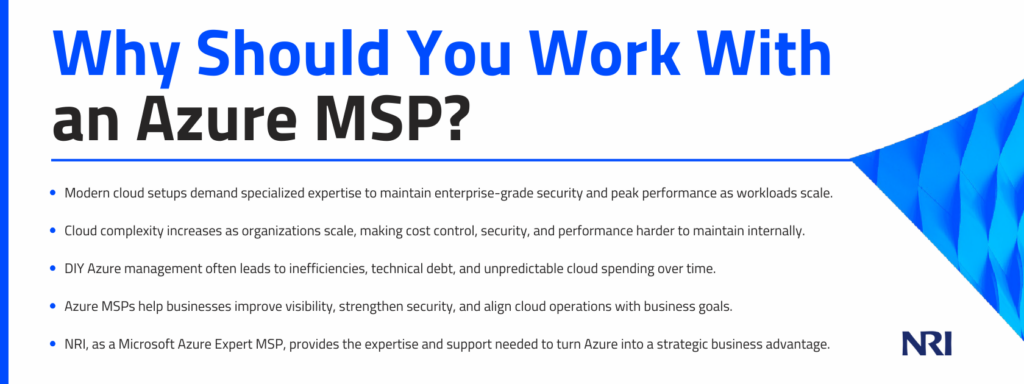
You didn’t move to the cloud to become a full-time infrastructure manager. You moved for the agility to build, the speed to deploy, and the freedom to scale.
But for many IT directors and CIOs, that promise has been replaced by the reality of mounting technical debt, unpredictable monthly invoices, and a team too busy fighting fires to innovate.
As your digital footprint expands, the complexity of the platform often outpaces the hands you have on deck.
According to HashiCorp’s Cloud Complexity Report, infrastructure hurdles remain the primary barrier for 50% of organizations, and 97% admit their current cloud setup is a significant source of friction.
While a do-it-yourself approach might seem like a way to save on overhead, it often results in fragmented processes and security gaps that eventually stall your migration.
Engaging an Azure MSP bridges this gap by providing the specialized automation and architectural discipline needed to turn your cloud investment back into a competitive engine.
Continue reading to explore how a managed partnership can resolve these operational bottlenecks and secure your technical roadmap.
What is an Azure MSP and What Do They Do?
A Microsoft Azure Managed Service Provider (Azure MSP) acts as a strategic extension of your IT department, offering deep technical expertise across the entire technology lifecycle.
Rather than simply watching a dashboard, these partners focus on evolving your setup to meet changing business demands.
Their support typically spans several critical operational pillars:
- Migration and seamless deployment: Beyond moving data, an MSP plans workload transitions to minimize risk and ensure that applications are ready for production from day one.
- 24/7 monitoring and system support: Continuous oversight identifies potential bottlenecks before they impact the end-user experience, ensuring uptime and system health.
- Direct cost optimization: Cloud spending can spiral out of control without oversight. An MSP analyzes usage patterns to identify waste, ensuring your budget is focused on high-performance resources.
- Active security management: Azure MSPs help organizations strengthen cloud security through access controls, threat monitoring, identity management, and backup strategies. Their support helps reduce vulnerabilities across cloud environments.
- Governance and regulatory compliance: MSPs establish automated guardrails and identity policies. This structured approach helps you meet industry-specific regulations without the need for constant manual audits.
- Architectural evolution: As technology changes, an Azure MSP helps modernize legacy workloads and integrate new capabilities, ensuring the infrastructure scales alongside the business.
By offloading these technical layers, your organization shifts from reactive maintenance to proactive architectural growth.
The Microsoft-Certified Difference
Selecting a partner requires a distinction between generalists and specialists. While many firms offer cloud support, the Microsoft Azure Expert MSP certification is reserved for a select group of partners who have passed a rigorous, independent audit of their technical capabilities and customer outcomes.
For a CIO or Cloud Architect, this certification serves as a validation of excellence. It confirms that the provider possesses the verified operational processes required to manage complex, high-stakes workloads at scale.
Partnering with a certified expert reduces the risk of “migration stall” and ensures that Microsoft’s gold standard backs the advice you receive for service delivery.
Certified expertise is the insurance policy that ensures your cloud strategy is built on a foundation of verified best practices.
Unlocking the Benefits: Performance and ROI
The true value of a managed partnership lies in the balance between technical performance and financial discipline. An Azure MSP leverages sophisticated tools and strategies to ensure that every dollar of cloud spend contributes to the bottom line.
Here are some of the key ways an Azure MSP improves efficiency, reduces operational risk, and supports long-term cloud optimization:
- Cost reduction
Unmanaged resources create unnecessary financial waste. MSPs, stop the bleed by moving beyond basic oversight and executing advanced financial strategies. Providers slash monthly spend while maintaining high application performance by leveraging Reserved Instances, right-sizing underutilized assets, and deploying Spot VMs for specific workloads.
- Security and compliance
Security must sit at the core of your infrastructure as your organization grows. Expert providers implement automated threat monitoring and sophisticated access controls that harden protection across all users and services. This proactive stance gives the organization the confidence to pursue growth, knowing its data remains resilient against evolving threats.
- Performance Optimization
Sustaining a high-speed infrastructure requires constant monitoring of health and workload efficiency. Azure MSPs track these metrics in real time to identify and resolve latency issues before they affect users. Organizations maintain stable operations and reduce downtime risk by fine-tuning resource allocation and scaling protocols.
- Operational Efficiency
Handing over the daily management of your cloud allows internal teams to reclaim their most valuable asset: time. IT leadership refocuses on IT advisory and consulting efforts that align technology with broader corporate goals once the burden of infrastructure maintenance is lifted.
When Should You Partner with an Azure MSP?
Many teams eventually reach a threshold where managing Azure internally becomes a bottleneck rather than a benefit.
Growing complexity creates operational gaps that even the most talented internal teams struggle to close while also focusing on their primary development goals.
Recognizing the following signs early allows you to pivot toward a managed model before friction impacts your revenue:
- Rapid scaling pressure: Fast business growth places intense strain on infrastructure and performance oversight.
- The talent gap: Internal teams often lack the highly specialized Azure expertise required to handle advanced security, automation, and governance at an enterprise level.
- Unpredictable billing: Wildly fluctuating monthly costs suggest poor resource visibility or underutilized assets that need immediate correction.
- Rising compliance demands: Expanding regulatory requirements make it difficult for generalist IT teams to maintain the rigorous security standards your industry demands.
- Recurring performance friction: Frequent downtime or latency indicates a need for proactive monitoring and stronger architectural management.
An Azure MSP delivers the greatest value when your business needs tighter governance, stronger cost control, and hardened security without further stretching your internal resources.
These partners help you manage growth by providing the specialized skills your team needs to stay focused on high-value business outcomes.
Unlock Cloud Value with NRI’s Azure Expertise
The modern cloud is a powerful engine for business agility, but it requires a disciplined hand to operate at peak efficiency. Moving away from reactive, DIY management toward a structured, expert-led framework allows an organization to master its business outcomes rather than just managing its servers.
As a Microsoft Azure Expert MSP, NRI provides the enterprise-grade governance and continuous optimization required to turn Azure into a true competitive edge. By focusing on long-term scalability and financial health, we ensure your cloud journey is defined by progress, not just maintenance.
Schedule an Azure strategy consultation with NRI to see how a managed partnership can streamline your operations and maximize your cloud investment.