
Siloed AI initiatives and reactive IT processes limit operational impact. Here’s how AI-enabled operations provide the structure to deliver smarter monitoring, faster response, and measurable results.
Is AI already embedded into your IT operations, or is it still limited to pilots and isolated experiments?
Businesses increasingly integrate AI into core responsibilities, such as infrastructure monitoring, incident resolution, performance optimization, and automated service delivery. For CIOs and IT leaders, the challenge now is determining how to integrate AI into daily workflows to strengthen reliability, accountability, and alignment with business priorities.
According to a McKinsey & Company research report, 92% of companies plan to increase their AI investments, yet only 1% believe they have reached maturity. That gap exposes a significant execution challenge.
While budgets and expectations continue to rise, many organizations struggle to convert AI experimentation into measurable gains in uptime, service quality, and cost control. Without a structured roadmap and governance model, AI initiatives often remain fragmented or disconnected from operational impact.
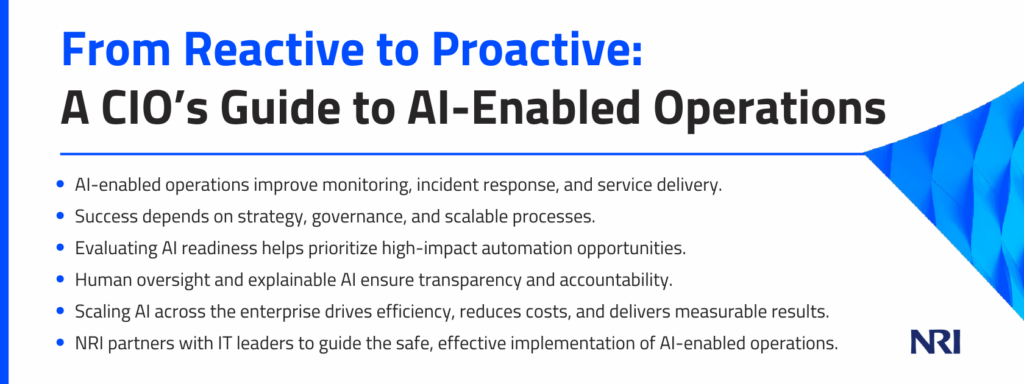
This guide provides a practical roadmap for embedding AI into IT operations with control, transparency, and measurable results.
What is an AI-Enabled IT Operations Roadmap?
An AI-enabled IT operations roadmap is a structured strategy for moving from reactive, manual troubleshooting to proactive, data-driven management powered by machine learning. It defines the embedding of AI into core workflows such as monitoring, incident management, capacity planning, and service delivery.
For years, IT operations centered on uptime. Keeping systems running and minimizing downtime was the primary measure of success. While availability remains critical, it is no longer sufficient on its own.
Today, leading organizations are building operational intelligence. That means anticipating disruptions before they occur, recognizing patterns across systems, and using data to guide real-time decisions. In this model, IT evolves from a reactive support function into a strategic capability that improves performance, resilience, and business outcomes.
As AI adoption accelerates and system complexity increases, technical debt can accumulate quickly. Without a roadmap, automation efforts become fragmented and innovation slows. A clear plan helps IT leaders modernize responsibly while protecting long-term agility and cost control.
How Can IT Leaders Evaluate AI Maturity and Readiness?
The number of tools deployed does not define AI maturity. The quality, consistency, and accessibility of operational data define it. Without reliable, standardized telemetry, even the most advanced models cannot deliver meaningful insight.
Readiness assessment requires an honest look at data architecture, monitoring practices, process standardization, and governance controls. Most organizations fall into one of three levels:
- Reactive
Data is siloed across tools and platforms. Monitoring is largely manual. Mean Time to Repair remains high because teams discover issues only after they impact users. Effort is spent resolving incidents rather than preventing them.
- Augmented
Telemetry is standardized and centralized. Machine learning enhances alerting and identifies patterns across systems. Teams respond faster and begin shifting from reactive firefighting to proactive prevention.
- Optimized
Automation operates end-to-end with human oversight. Systems predict and resolve many incidents before they escalate. IT teams focus less on routine intervention and more on strategic improvement.
Progress across these stages depends on breaking down data silos. A standardized semantic layer ensures operational data is structured consistently across systems. Without this foundation, AI initiatives remain isolated and fail to scale.
Which IT Workflows Benefit Most from AI-Driven Automation?
AI can make your IT operations faster, smarter, and less stressful. It works best in areas where data is plentiful, tasks are repetitive, and timely decisions matter.
Here are three key areas where you should focus AI automation to get the most impact:
- Priority 1: Predictive maintenance
With predictive maintenance, you can catch hardware or software issues before they cause downtime. Machine learning analyzes your logs and system data to give you early warnings so you can fix problems before your users even notice.
- Priority 2: Smart alerting and noise reduction
AI helps you cut through the noise by filtering out non-critical alerts. This lets your team focus on real issues and prevents alert fatigue from slowing down your response times.
- Priority 3: Automated service delivery
AI can handle routine service tasks, so your team doesn’t have to. From provisioning resources to managing standard security permissions, automation speeds up delivery and frees your staff to focus on higher-value work.
Starting with these workflows helps you show real improvements quickly, build confidence in AI, and lay the groundwork for smarter IT operations across your organization.
Maintaining Control and Transparency in AI Workflows
As an IT leader, you probably worry about AI acting like a “black box” where you can’t see or explain its decisions. Keeping control and accountability is critical, especially when your systems run core business operations.
To make AI safe, reliable, and accountable, you should focus on the following three key practices in your operations:
- The “Human-in-the-Loop” Model: You should let AI act as a copilot that suggests actions rather than acting on its own in critical systems. This way, you stay in control and make the final decisions when it matters most.
- Explainable AI (XAI): Every AI decision should be traceable and understandable. Using clear rules and ontologies ensures you can audit AI actions and know exactly why it suggested a particular outcome.
- Security by Design: With IT and operational technology converging, ensure AI cannot be exploited for reconnaissance or supply-chain attacks. Designing security into AI workflows from the start keeps your systems and data safe.
These practices help you use AI effectively while keeping control and ensuring transparency. They also protect your infrastructure from risks and ensure your systems remain secure and reliable.
Scaling AI Operations Across the Enterprise
Once you’ve established control, transparency, and accountability in AI workflows, the next step is scaling AI across your organization. Expanding AI from isolated pilots to enterprise-wide operations requires not just technology, but also changes in processes and people.
Here are the key areas to focus on when scaling AI operations across the enterprise:
- Adopting MLOps
To scale effectively, you need a structured approach to managing AI models throughout their lifecycle. MLOps ensures your models remain accurate over time by monitoring for drift and maintaining performance as data and systems evolve. Without this, AI can lose effectiveness and create more problems than it solves.
- Workforce transformation
As AI takes over repetitive tasks, the role of IT professionals shifts from “fixer” to “orchestrator.” Your team moves from reacting to incidents toward overseeing AI-driven workflows, managing exceptions, and optimizing systems for better outcomes. This change requires training, new skills, and a mindset focused on strategy rather than routine troubleshooting.
- Agentic AI
Looking ahead, you need to prepare for “agentic AI,” in which systems interact to resolve complex tickets without human intervention. Planning for this future means designing workflows that safely integrate autonomous AI while maintaining oversight. This ensures that scaling doesn’t compromise control, transparency, or security.
Taken together, these steps help you expand AI capabilities across your organization and drive a successful digital transformation. They make your operations more efficient, proactive, and prepared for the next generation of intelligent systems.
Partner with NRI for Smarter AI-Enabled Operations
In 2026, IT complexity continues to grow, user expectations are higher than ever, and reactive support models simply cannot keep up. AI-enabled operations enable IT leaders to anticipate issues, resolve incidents faster, and prevent disruptions before they affect the business.
Instead of constant firefighting, teams can focus on strategic priorities that drive measurable outcomes. Research shows that AI-driven predictive maintenance can reduce downtime by 20% to 50%, lowering costs while improving reliability and safety.
Navigating this transition requires careful planning and practical execution. NRI works alongside IT leaders to assess readiness, implement AI responsibly, and scale with confidence. Our approach ensures AI initiatives align with business priorities while remaining measurable, auditable, and secure.
If you are ready to strengthen your IT operations with AI,connect with NRI to start building a smarter, more resilient operational model.