
Solve operational problems, improve efficiency, and boost profitability
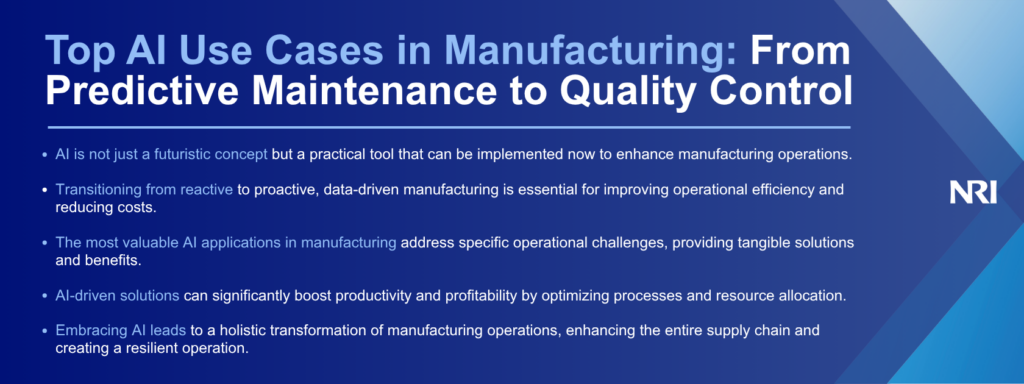
Many manufacturing executives perceive AI as a distant, futuristic luxury rather than an immediate operational tool. The shift from a reactive production floor to a proactive, data-driven manufacturing environment is possible and necessary. By embracing AI, manufacturers can shift from reacting to issues as they arise to anticipating and preventing them, improving operational efficiency and reducing costs.
Deploying AI in manufacturing is about solving clear, floor-level problems. True transformation offers practical operational value. The most valuable AI use cases in manufacturing begin with identifying clear operational problems, leveraging reliable data, and implementing practical solutions.
This article explores how AI can transform manufacturing operations by connecting AI opportunities to tangible outcomes, unlocking new levels of productivity and profitability.
AI Use Cases in Manufacturing
By focusing on practical applications, AI can turn raw data into valuable insights, driving improvements across the organization. Let’s explore how these AI-driven solutions are reshaping the manufacturing landscape.
Predictive Maintenance: Eliminating Unplanned Downtime
Predictive maintenance is one of the top AI use cases in manufacturing, offering a significant advantage by eliminating unplanned downtime. Traditional calendar-based repair schedules are often inefficient, leading to either premature maintenance or unexpected equipment failures. AI-driven predictive maintenance moves beyond these limitations by continuously analyzing machine learning models to predict equipment failures before they occur.
By analyzing sensor streams such as vibration, thermal, and acoustic, AI can flag impending equipment failures so operations teams can address issues proactively, preventing costly production halts and extending machinery lifespan. It also optimizes maintenance schedules and reduces overall operational costs. Predictive maintenance maintains a seamless production flow, enhancing productivity and profitability.
Advanced Production Scheduling
AI-powered production scheduling optimizes resource allocation and streamlines operations by creating dynamic schedules that adapt to real-time changes. Unlike traditional methods, AI continuously updates schedules, improving efficiency and responsiveness.
A technological approach enhances resource utilization, reduces excess inventory, and prevents equipment strain. It also aids decision-making by simulating different strategies and assessing their impact on performance. Adopting AI-driven scheduling is crucial for manufacturers to boost efficiency, cut costs, and enhance customer satisfaction in a competitive landscape.
Automated Quality Control: High-Speed Computer Vision
When it comes to quality control, AI offers transformative potential through high-speed computer vision. Manual inspection processes are increasingly inadequate for modern, high-velocity assembly lines. Human inspectors are limited by speed and accuracy, often missing subtle defects that can lead to product recalls and customer dissatisfaction.
AI-driven visual networks revolutionize quality control by instantly capturing surface anomalies and dimension deviations. These systems process vast amounts of visual data at speeds unattainable by human inspectors, ensuring that only products meeting the highest quality standards reach the market. By automating quality control, manufacturers can reduce waste, improve product consistency, and enhance customer satisfaction.
Unifying the Ecosystem: Dynamic Forecasting and Efficiency
AI’s impact extends beyond individual processes to the entire manufacturing ecosystem. By connecting raw machine data to broader supply chain and inventory scheduling software, manufacturers can achieve dynamic forecasting and efficiency. Integration enhances demand forecasting accuracy, allowing manufacturers to align production schedules with predictive insights.
Dynamic forecasting helps protect profit margins by reducing waste and optimizing resource allocation. By aligning production schedules with market demand, manufacturers can minimize excess inventory and avoid stockouts, ensuring that resources are used efficiently. A holistic approach to AI implementation enhances operational efficiency and strengthens the entire supply chain, creating a resilient and adaptable manufacturing operation.
Build a Resilient Operation With the Top AI Uses in Manufacturing
The journey to true digital transformation belongs to manufacturers who can turn raw operational data into rapid, automated floor decisions. By embracing AI, manufacturers can build resilient operations that are agile, efficient, and adaptable to changing market conditions. It is a practical solution for today’s manufacturing challenges.
The top AI use cases in manufacturing include predictive maintenance, automated quality control, and dynamic forecasting, which offer significant operational value by addressing clear, floor-level problems. By leveraging AI, manufacturers can transition from reactive to proactive operations, enhancing productivity, reducing costs, and improving product quality. As the manufacturing landscape continues to evolve, embracing AI is not just an option but a necessity for staying competitive and resilient in the face of future challenges.
Learn how NRI can help prioritize and implement practical AI use cases in manufacturing.NRI plays a key role in integrating traditional machinery with modern, secure cloud systems, allowing manufacturers to make the most of their industrial data. With NRI’s expertise in infrastructure and strategic planning, manufacturers can fully harness AI’s capabilities, fostering innovation and driving growth in the industry.