
Build a digital transformation governance framework that balances innovation speed, enterprise control, and long-term business alignment.
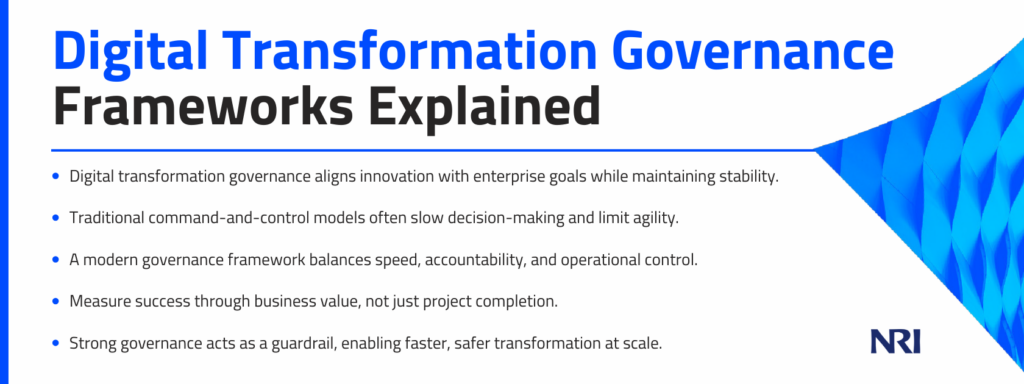
Not long ago, IT governance was mostly about control because systems changed slowly and stability mattered more than speed. Teams worked through layered approvals, long review cycles, and centralized decision-making, and that approach made sense when enterprise technology moved at a predictable pace.
However, that is not the case today, as modern transformation spans cloud, AI, cybersecurity, and data initiatives simultaneously.
Businesses expect faster execution, customer demands continue to shift, and technology changes more quickly. Traditional governance models cannot keep up. As a result, rigid approval structures often slow innovation before it delivers value.
Organizations cannot afford governance that blocks experimentation, but they also cannot allow innovation to create security gaps, compliance risks, or disconnected systems across the enterprise.
A strong digital transformation governance framework creates the structure needed to move quickly while keeping systems aligned, secure, and resilient.
Research from AIGN.Global shows that organizations with adaptive governance frameworks are 50% more likely to maintain compliance with evolving AI regulations.
More importantly, strong governance no longer acts as a brake on transformation. It gives organizations the confidence to scale innovation safely as operational complexity continues to grow.
This blog explains what digital transformation governance is, explores how to implement a modern framework, and shows how organizations can measure success beyond deployment so transformation efforts continue delivering business value over time.
What is Digital Transformation Governance?
Digital transformation governance gives you the structure to guide change without slowing progress across the enterprise. It helps align innovation with business priorities, so transformation initiatives create measurable value rather than disconnected activity across teams and systems.
Effective governance usually depends on the following three core pillars:
- Decision rights
Clear decision rights define who has the authority to act, approve, and escalate as transformation initiatives move forward. Teams execute faster when ownership remains visible, as decision bottlenecks and conflicting approvals are easier to avoid.
- Accountability
Strong accountability ensures that every transformation initiative has clear ownership and measurable outcomes. In addition, organizations build greater trust across teams when leaders remain accountable for results rather than only reacting when challenges arise.
- Performance incentives
Performance incentives encourage teams to focus on outcomes that support long-term transformation goals. Organizations create a stronger innovation culture when success metrics reward collaboration, adaptability, and measurable business impact instead of simple task completion.
Strong governance changes how organizations respond to innovation challenges. Instead of operating through a restrictive “no” culture, teams move toward an enabling “how” culture that supports progress with confidence, accountability, and control.
Implementing a Modern Framework
A digital transformation governance framework works best when it fits naturally into the systems, processes, and operational structure your organization already relies on. Strong implementation improves governance maturity without creating additional friction that slows transformation progress.
Integrating with Existing Standards
Frameworks such as ISACA’s COBIT and AXELOS’s ITIL 4 already provide strong governance foundations for enterprise IT. However, modern transformation governance builds on those standards and adapts them to support faster decision-making, continuous delivery, and cross-functional collaboration without adding unnecessary bureaucracy.
The Role of the Transformation Management Office
A Transformation Management Office (TMO) creates the structure needed to keep strategic initiatives aligned with business objectives. In addition, the TMO helps coordinate priorities, track progress, and ensure transformation efforts remain connected to measurable enterprise outcomes rather than drifting into disconnected digital activity.
Leveraging IT Advisory Consulting
External expertise becomes valuable when organizations need to align governance with both business ambition and operational reality. IT advisory and consulting help translate strategy into practical governance structures that align with organizational maturity, complexity, and risk tolerance.
Experienced advisors also help refine governance processes, improve decision-making, and remove operational friction that slows transformation efforts. More importantly, governance frameworks are easier to scale when designed around how the organization actually operates instead of forcing teams into rigid structures that no longer fit.
Successful implementation depends as much on flexibility as it does on structure. Governance works best when it supports transformation.
Measuring Success: Beyond the Deployment
Deployment is only the beginning of digital transformation. Real success depends on how effectively governance turns technical delivery into measurable business outcomes over time.
Organizations, therefore, need to move beyond project completion metrics and focus more on business value realized. Indicators such as operational efficiency, customer impact, adoption rates, and revenue contribution provide a clearer picture of whether transformation efforts are creating meaningful results.
Long-term success also depends on maintaining visibility after implementation. Ongoing performance reviews help organizations confirm that initiatives remain aligned with strategic goals.
In addition, continuous auditing keeps governance relevant as technologies, risks, and business priorities continue to evolve. Regular evaluation allows organizations to refine controls, adjust decision structures, and ensure governance maturity evolves alongside the digital landscape.
Strengthen Your Digital Transformation Governance Strategy with NRI
Governance should not slow transformation efforts down. Strong governance gives organizations the structure needed to innovate faster without losing alignment, visibility, or control as complexity increases across the enterprise.
A well-designed digital transformation governance framework helps teams move with more confidence because decision-making, accountability, and performance expectations stay clear across every initiative. Instead of creating friction, governance becomes the guardrail that keeps innovation secure, consistent, and connected to business outcomes.
Working with NRI North America helps organizations build governance frameworks that align with operational realities, organizational maturity, and long-term transformation goals. Through IT Advisory Consulting, NRI helps enterprises refine governance structures, improve strategic alignment, and create frameworks that support both agility and enterprise stability.
If your organization is reevaluating how governance supports transformation, now is the right time to strengthen the foundation behind future growth. Contact NRI today to discuss your governance strategy and build a framework that supports faster, safer, and more scalable innovation.