
Master long-term agility by synchronizing leadership, data, and infrastructure into a unified operating model.
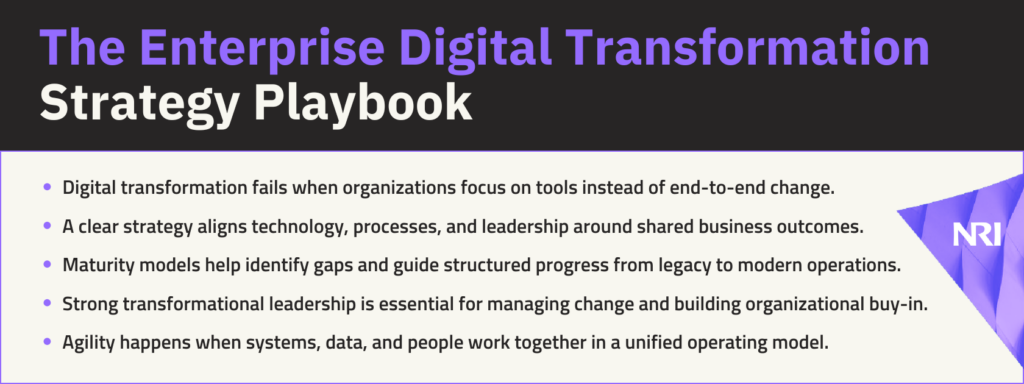
For over a decade, digital transformation has dominated the executive agenda, yet roughly 70% of these efforts fail to reach their full potential according to McKinsey research. High failure rates often stem from a fundamental misunderstanding: digitizing an existing, broken process is not the same as a digital transformation.
Many organizations invest in modern tools while maintaining legacy workflows and rigid decision layers. Surface-level upgrades like these create a scenario in which systems appear current, but the underlying speed, agility, and decision quality remain stagnant. The cost of inaction eventually becomes unavoidable as agile, data-driven competitors begin to capture market share.
Closing the gap requires aligning technology adoption with structural and cultural shifts. Without synchronization, digitization only improves efficiency at the edges, leaving the core business model vulnerable.
Continue reading to identify the specific operational components your blueprint requires and how to measure progress using a structured maturity model.
The Blueprint: What Does an Enterprise Include?
A resilient strategy starts with absolute clarity on purpose. It ensures that every technology investment serves a long-term business outcome rather than a temporary operational fix. A successful blueprint integrates three core pillars:
- Strategic intent: Definitive purpose drives every move. Before selecting solutions, you must identify the specific business problem you aim to solve. Focusing on outcomes, whether growth, efficiency, or client experience, prevents transformation from drifting into a series of disconnected projects.
- Modern infrastructure: Agility requires flexible, scalable foundations built on cloud-native and hybrid models. Scaling becomes easier with a base that enables faster deployment and gives the organization the resilience to adapt as market demands fluctuate.
- Data empowerment: Empowerment turns fragmented information silos into a unified, enterprise-wide asset. Accessible, governed data allows your teams to make informed decisions based on real-time insights rather than intuition or isolated reports.
Aligning these pillars ensures that change delivers a measurable impact across the entire organization.
Measuring Progress: The Maturity Model Approach
Transformation is a progression of capability, not a single milestone. Using a digital transformation maturity model provides a structured framework for assessing your current state and identifying the specific hurdles limiting your speed.
The assessment typically begins by identifying where your organization sits on the spectrum. “Digital Laggards” rely on manual processes and reactive decision-making, while “Digital Natives” operate with automated workflows and continuous optimization. Diagnostic tools like this model help leaders prioritize investments based on business impact rather than technical convenience.
Once you identify your stage, you can build a phased roadmap to bridge the gap between legacy systems and future goals. Early phases often focus on stabilizing infrastructure and improving data visibility. Later stages shift toward enterprise-wide integration and advanced analytics.
A phased approach reduces execution risk and ensures that your legacy systems evolve into a modern digital ecosystem.
The Human Element: Transformation Leadership
Digital transformation does not succeed on technology alone. It succeeds or fails based on how people understand, accept, and adopt change across the organization.
Even the most advanced systems will underperform if teams are resistant, unclear about priorities, or overwhelmed by constant change. This is why leadership plays a central role in shaping both direction and momentum.
Managing change fatigue and fostering a “culture of experimentation.”
Continuous change without visible progress or support leads to fatigue and disengagement. CIOs must foster a “culture of experimentation” where teams test ideas and learn from outcomes without fear of failure.
When experimentation becomes a daily habit, the organization views transformation as progress rather than disruption.
Creating an environment where teams can learn and improve processes prevents the burnout that often stalls large-scale initiatives.
Why unlocking organizational value requires buy-in from the boardroom to the front line
Unlocking organizational value requires alignment at every level. While the boardroom sets the vision, the frontline determines the success of the implementation.
Without boardroom commitment, initiatives lose direction; without frontline buy-in, strategies fail during implementation. This unified front turns the friction of change into a collective drive for innovation.
Start Your Next Phase of Digital Transformation with NRI
Agility is the outcome of a well-executed strategy. When you align your systems, data, and people, your organization becomes more resilient and confident in its ability to navigate a changing market. The long-term perspective is what separates industry leaders from those merely trying to keep up.
At NRI, we understand that transformation is rarely just about technology. It is about aligning strategy, systems, and people to deliver lasting business value. We work with enterprises to close the gap between vision and execution by helping them design scalable digital strategies, modernize legacy environments, and build the capabilities needed for sustained growth.
If you are looking to move beyond incremental digitization and achieve meaningful transformation, our advisors can help you define the right path forward.
Schedule a meeting with an NRI transformation advisor to start your journey toward a more agile, future-ready enterprise.