
IT/OT alignment bridges data gaps, improves decision-making, and increases competitiveness
In modern manufacturing, the ability to make informed, timely decisions is crucial to maintain a competitive edge. However, the disconnect between Information Technology (IT) and Operational Technology (OT) systems presents a significant challenge to informed, rapid decision-making. This is because traditionally, these systems have operated in silos, each with its own priorities and objectives.
IT systems focus on data management, security, and compliance, while OT systems prioritize the continuous operation and efficiency of machinery and production processes. This separation results in plant-level data isolation, preventing critical insights from reaching decision-makers when they need them.
The consequences of this disconnect? Production, maintenance, quality, and inventory insights remain trapped within their respective domains, failing to inform enterprise-level strategies. The result? Corporate strategy teams are frequently forced to make decisions based on outdated or incomplete information, such as week-old factory spreadsheets. This lag in data flow leads to inefficiencies, missed opportunities, and lower profitability.
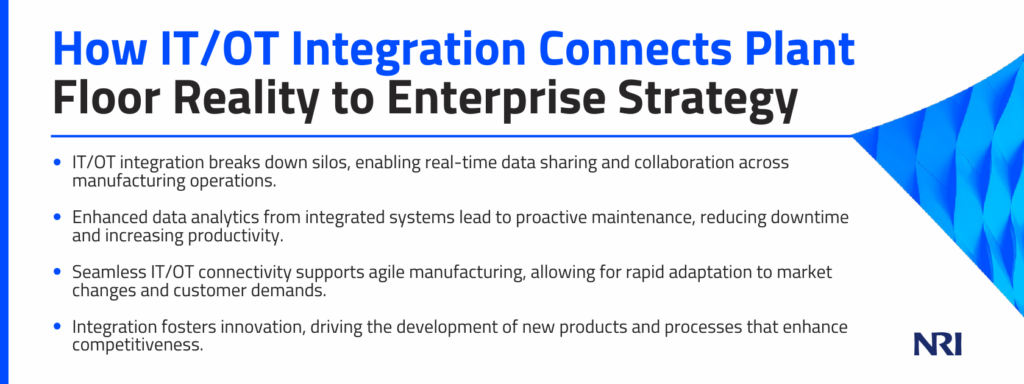
Manufacturers must redefine the integration of IT and OT from a basic network patching project to an essential business acceleration imperative. IT/OT integration serves as a critical bridge, transforming factory-floor metrics into strategic assets that drive faster, more profitable business decisions. By creating a unified data architecture that connects plant operations with business strategy, organizations can unlock the full potential of their data, enabling real-time insights and more agile decision-making.
This article explores the importance of IT/OT integration in bridging the gap between plant floor reality and enterprise strategy. We will examine the structural divide between IT and OT systems, the technical infrastructure required to build an effective data bridge, and the real-time strategic payoffs of a unified approach in a data-driven world.
The Structural Divide: Understanding the IT-OT Friction
The divide between IT and OT systems is rooted in fundamentally different priorities and operational languages. IT departments are primarily concerned with data confidentiality, integrity, and security. Their focus is on protecting sensitive information and ensuring compliance with regulatory standards. OT teams prioritize the continuous operation of machinery and equipment. Their primary concern is uptime, as any disruption can lead to costly production halts.
This misalignment creates a significant barrier to effective communication and data sharing. The linguistic barrier between raw, unstructured time-series machine data and the structured data formats required by enterprise systems like ERP further complicates matters. As a result, valuable insights from production, maintenance, and quality metrics remain trapped within silos, failing to reach the teams that need them most. This delay in information flow directly impacts enterprise profitability, as decisions are made based on outdated or incomplete data
The Technical Infrastructure: Building the Data Bridge
To effectively bridge the gap between IT and OT, manufacturers must adopt a modern, standardized data framework that facilitates seamless data flow and integration. One of the key components of this framework is edge-to-cloud data flows. By gathering high-velocity sensor metrics directly from machinery at the edge, manufacturers can ensure that data is collected in real-time and transmitted securely to cloud data lakehouses. This approach improves data accessibility as well as the speed and accuracy of decision-making.
Industrial data hubs, such as the Unified Namespace, play a crucial role in this integration process. These hubs convert mismatched machine protocols into standardized, universally legible operational metrics, enabling seamless communication between disparate, siloed systems. By implementing unified governance frameworks, manufacturers can establish strict perimeter controls to protect vulnerable industrial controllers from external cybersecurity threats. This ensures that the data bridge remains secure and reliable, safeguarding the integrity of the information flow.
From the Shop Floor to the Balance Sheet: The Real-Time Strategic Payoff
Integrating IT and OT systems offers significant strategic benefits, transforming reactive processes into proactive, data-driven strategies.
Reduce Machine Downtime and Maintenance Expenses
By leveraging IT systems to monitor the condition of OT machinery and equipment continuously, manufacturers can adopt a predictive maintenance approach. This strategy involves performing repairs only when data indicates a potential issue, rather than adhering to a fixed schedule. Predictive maintenance reduces both downtime and maintenance costs compared to traditional preventive maintenance, which often involves unnecessary repairs regardless of the equipment’s condition.
Rapid Response to Breakdowns and Managing Costs
Real-time monitoring through IT systems means immediate alerts when OT equipment experiences malfunctions. This enables swift responses, including automatic remote shutdowns if necessary, to prevent further damage. Promptly detecting mechanical failures can avert financial losses through quick repairs and minimize disruptions to factory operations.
Enhance Productivity and Safety
IT systems gather valuable data on machine performance, identifying bottlenecks, overheating, and other inefficiencies in the production process. With this information, OT systems can be optimized to increase efficiency, improve safety, and reduce energy consumption. Automation of certain tasks allows machines to operate independently, freeing human workers to focus on more complex responsibilities.
Improves Cybersecurity
As OT systems increasingly connect to the internet, IT systems play a crucial role in safeguarding factory floor data and processes from cyber threats. By implementing robust security measures, manufacturers can protect their operations from potential cyberattacks, ensuring the integrity and confidentiality of their data.
Moreover, real-time factory product yield and scrap rates can be directly linked to executive supply chain planning and demand scheduling. A seamless flow of information allows organizations to adjust production schedules in response to changing market demands, optimizing inventory levels and reducing waste. By connecting plant-floor reality to enterprise strategy, manufacturers can make informed decisions quickly, enhancing their strategic agility and competitive edge.
Unlock Unified Operations
Industry dominance belongs to organizations that can instantly see, contextually understand, and strategically act on their data. By unifying IT and OT infrastructure, manufacturers can bridge the gap between plant-floor reality and enterprise strategy, transforming disconnected, time-sensitive factory-floor metrics into a strategic executive asset. This integration is not merely a technical adjustment; it is a critical business alignment tool that enables faster, more confident decision-making.
Partner with NRI North America to unify your IT/OT infrastructure and bridge the gap between plant-floor reality and enterprise strategy today. By leveraging cutting-edge technologies and expertise, NRI North America can help your organization achieve true industrial agility and maintain a competitive edge in the dynamic manufacturing landscape.