
Build scalable AI outcomes by using a data governance maturity model to strengthen data quality and reduce manual overhead.
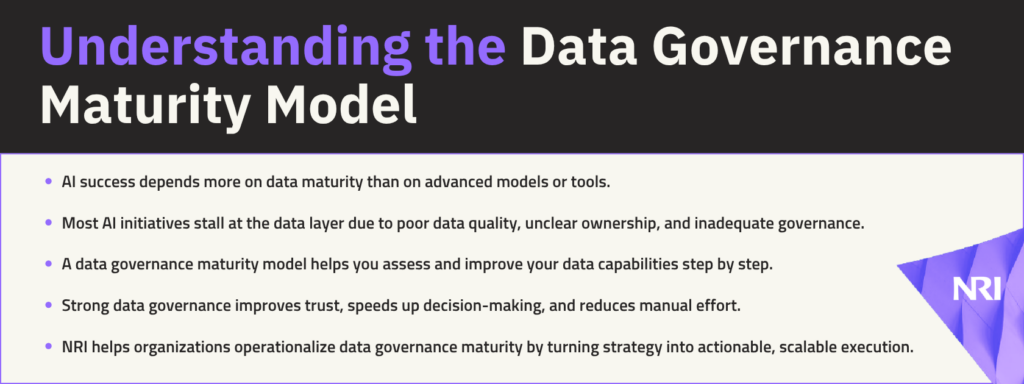
As a data leader, you are expected to deliver AI outcomes, not just ideas. Yet the path to being “AI-ready” often becomes unclear the moment you move from strategy into execution, where expectations rise, but the foundation is not always in place.
You invest in tools, platforms, and advanced capabilities, but results fall short because the underlying data cannot support what the technology promises. This is an “AI-ready” mirage, where ambition outpaces your data environment’s realistic capacity.
A widely cited MIT study found that 95% of AI initiatives never move beyond the pilot stage. Most of these efforts stall at the data layer, where gaps in quality, ownership, and consistency create friction that slows progress and increases manual effort.
The issue is not a lack of innovation or investment. It is data maturity. Without a strong governance model, every new use case feels like starting from scratch instead of building on a reliable foundation.
As data maturity improves, execution becomes more predictable. Teams align more easily, processes become repeatable, and data-driven decisions can be trusted across the organization.
That is where competitive advantage begins to take shape, not through isolated AI experiments, but through scalable practices that deliver consistent results over time.
This guide focuses on how a data governance maturity model helps you move from fragmented efforts to a structured, repeatable approach that supports real AI outcomes.
What is a Data Governance Maturity Model?
Governance is the engine of AI. You cannot have a high-performing AI strategy without a high-maturity data governance model.
A data governance maturity model is a framework for assessing and improving how data is managed across the organization over time. It provides a structured path from inconsistent, reactive practices to a more controlled, reliable, and value-driven approach.
Most models follow five progressive stages:
- Initial: Data is managed in an ad hoc way, with teams reacting to issues as they arise, and little formal governance is in place
- Repeatable: Basic processes begin to take shape, but consistency depends on individual effort rather than shared standards
- Defined: Clear policies, roles, and governance structures are established to guide how data is managed across teams
- Managed: Data quality and governance performance are actively measured, improving visibility, control, and accountability
- Optimized: Governance becomes proactive, with automation and continuous improvement driving enterprise-wide data stewardship
A strong enterprise data management strategy treats governance as a business-enabling function, not an IT checklist. As maturity improves, organizations move from reactive firefighting to a more structured and reliable approach to managing data.
The Pillar of Enterprise Data Management Strategy
Three core capabilities support an effective enterprise data management and ensure data remains accurate, traceable, and compliant across the organization:
- Data quality & integrity: Establishing “golden records” so teams operate from a single, trusted version of the truth
- Metadata & lineage: Understanding where data comes from, how it moves, and who owns it, improving transparency and accountability
- Compliance & privacy: Automating governance guardrails to meet requirements such as GDPR, CCPA, and industry-specific mandates without slowing operations
Together, these capabilities create a trusted data foundation that supports consistent decision-making and scalable governance.
Bridging the Gap: From Strategy to Execution
Moving from strategy to execution starts with being honest about where your organization stands today. Progress is difficult when the current state is unclear, which is why the first step is to assess your data governance reality without assumptions, filling in the gaps.
That honest assessment means looking closely at how data is managed across teams, where ownership is unclear, and where quality issues continue to surface. The goal is not to chase a perfect score. It is to identify the friction points that make it harder to achieve reliable data outcomes.
Once that baseline is clear, the next step is resisting the urge to fix everything at once. A more effective approach is to focus on high-impact, low-complexity data domains where improvements can be made quickly and where the value is easier to see.
Those early wins matter because they show progress without overwhelming teams or stretching resources too thin. They also help build stakeholder confidence and create a clear link between stronger governance and better business outcomes.
From there, execution becomes more practical. Instead of operating in theory, your organization starts building confidence one step at a time, using real results to guide what comes next.
FAQ / Key Questions
How long does it typically take to move up a maturity level?
It depends on your starting point, data complexity, and organizational alignment. In most enterprises, advancing one maturity level can take several months to a few years because it involves both technical improvements and cultural change, not just tooling upgrades.
Can we skip levels if we implement modern DataOps tools?
Tools can accelerate progress, but they do not replace maturity building. Even with advanced DataOps platforms, strong governance, clear ownership, and consistent data practices need to be in place before advancing to higher levels.
Fast-Track Data Governance Maturity with NRI
Data governance maturity is a long-term effort, not a quick fix. Building the right foundation requires sustained progress across processes, ownership, and culture. Strong governance goes beyond compliance by improving alignment, accelerating decision-making, and enabling scalable AI and analytics.
NRI helps organizations assess their current maturity, identify gaps, and design practical roadmaps that turn strategy into execution. The focus is on moving from fragmented data practices to a structured, enterprise-wide governance model that works in practice.
Download our governance assessment checklist to evaluate your current maturity level and identify the next steps toward scalable data and AI outcomes.
Contact us today to request and download a governance assessment checklist.