
AI and cloud workloads are pushing modern data centers beyond the limits of legacy design. A data center modernization strategy provides the power, cooling, and flexibility needed to scale an AI-ready infrastructure.
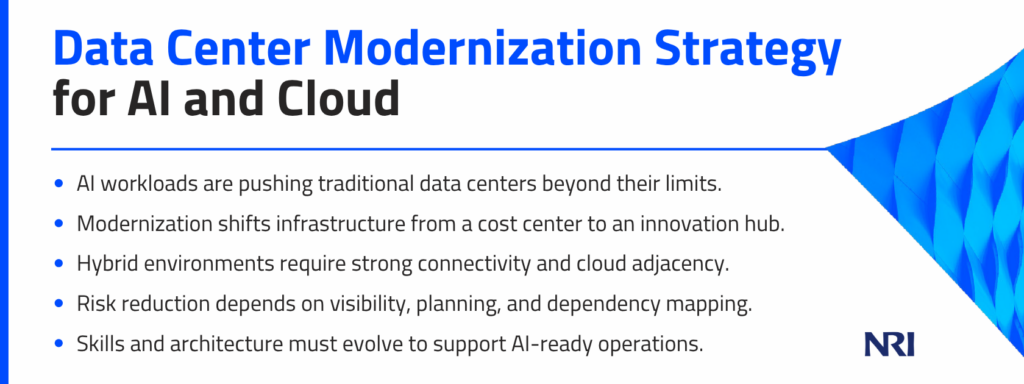
According to the International Energy Agency, data center electricity consumption could surpass 1,000 TWh by 2026, with AI workloads driving much of that growth. These workloads demand higher compute density and generate heat levels that traditional environments don’t support.
Consequently, many organizations are now hitting a clear performance ceiling as legacy data center designs struggle under these pressures. Systems that once supported predictable workloads are now under constant strain from high-density processing demands.
Expectations have also shifted. Infrastructure is no longer just about maintaining uptime. It plays a direct role in enabling business-critical applications, real-time insights, and scalable growth.
A structured data center modernization strategy helps address this gap. This masterpiece outlines how to build an AI-ready foundation, support hybrid connectivity, and manage risk during the transition.
Modernization strategy: building the AI-ready foundation
AI-ready infrastructure starts with a foundation that can support high-density workloads without performance bottlenecks. Without that foundation, scaling AI becomes difficult and expensive.
A strong approach focuses on three core areas:
- High-density cooling and power
GPU-intensive workloads require a different approach to power delivery and thermal management. Higher rack densities increase heat output, making advanced cooling strategies essential.
Efficient cooling and power systems allow infrastructure to scale without sacrificing reliability or performance.
- Software-defined infrastructure
Manual provisioning slows down operations and introduces unnecessary complexity. Moving toward software-defined infrastructure enables automation, faster scaling, and more efficient resource utilization.
Automation also improves consistency across environments, reducing errors and operational overhead.
- Edge integration
Having computers closer to data generation locations supports real-time processing and reduces latency. Proximity is especially important for AI use cases that rely on immediate insights.
Edge integration also reduces the load on centralized systems and improves overall responsiveness.
A well-designed foundation ensures infrastructure can support both current workloads and future AI growth.
The hybrid reality: connectivity and adjacency
Hybrid environments now define how modern infrastructure operates. Workloads need to move seamlessly between on-premises systems and cloud platforms without performance gaps or operational friction.
Low-latency connectivity becomes critical in this model. Strong “bridges” between on-premises assets and cloud services allow workloads to shift based on demand, cost, and performance requirements.
Data gravity adds another layer of complexity. Large datasets tend to anchor workloads in place, increasing dependency on specific environments and driving up egress costs if not managed carefully.
Effective IT infrastructure modernization enables better workload mobility by balancing performance, cost, and control. Strong architecture planning ensures data moves efficiently while maintaining flexibility.
Risk mitigation: navigating the transition
Modernization introduces both opportunity and risk. Infrastructure becomes more agile and scalable, but the transition must be managed carefully to avoid disruption.
Success depends on visibility, planning, and execution across both technical and operational areas.
- Decoupling legacy application dependencies
Legacy systems often create hidden dependencies that limit flexibility. Mapping these relationships allows workloads to be separated and modernized safely.
Decoupling reduces complexity and lowers the risk of unexpected failures during migration.
- Comprehensive data center assessment
A thorough assessment provides a clear baseline of current infrastructure, workload placement, and modernization gaps.
Without this step, organizations risk “migration stall,” where progress slows due to unknown dependencies or misaligned priorities. A structured assessment ensures the transition remains controlled and continuous.
- Addressing the talent gap
Modern infrastructure requires different skills than traditional environments. The shift toward automation, cloud integration, and systems thinking means teams must evolve alongside the technology.
Building these capabilities is essential for sustaining long-term modernization efforts.
A controlled transition depends on aligning strategy, visibility, and skills. When those elements come together, modernization becomes a steady progression rather than a disruptive shift.
Build an AI-ready data center strategy with NRI
Infrastructure is no longer just a support function. It plays a direct role in enabling innovation, speed, and scalability across the business.
Turning the data center into a strategic asset starts with understanding its current state. A comprehensive data center assessment provides the clarity needed to identify gaps, reduce risk, and define the right path forward.
NRI North America helps organizations translate that insight into action. The focus is on assessing infrastructure, mapping dependencies, and building a practical roadmap that supports AI and hybrid workloads at scale.
If you are ready to modernize with confidence, contact us to request an infrastructure modernization assessment and take the next step toward an AI-ready data center.