
A well-crafted communication plan can reduce disruption, improve adoption, and ensure business continuity.
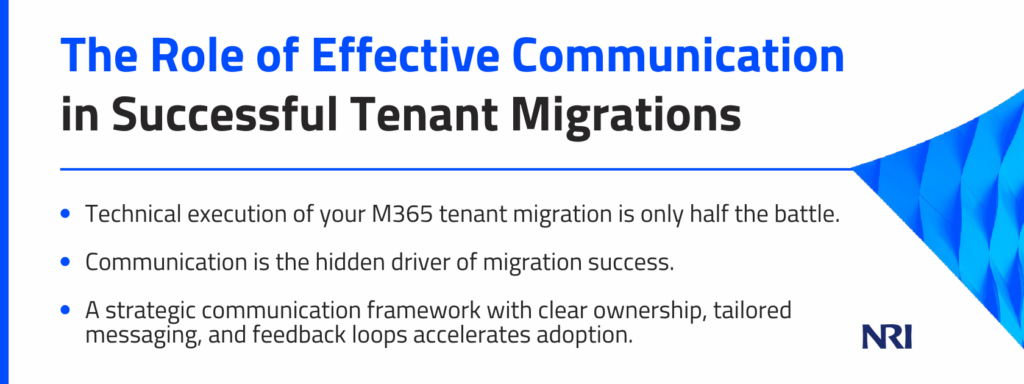
Organizations often execute their Microsoft 365 (M365) tenant migrations with technical precision. IT gets the platform, tools, and timelines right. Yet still watch productivity nosedive and support costs inflate.
When this happens, the underlying issue is often one of omission. In other words, the organization channelled most or all of its resources to the technical aspects of the change, while neglecting the human element.
As pointed out in a previous change management article, almost always, the most challenging part isn’t implementing a new technology; it’s getting people to use it. And that takes well-orchestrated communication.
For a truly successful tenant migration, CIOs must lead with clarity and confidence, communicating every step so people feel prepared rather than blindsided.
Here’s all you need to know.
Why Communication Is the Hidden Driver of Migration Success
Microsoft 365 tenant migrations rarely fail due to the technical elements. It’s often because people don’t know enough about how to make a successful transition.
When communication breaks down, a predictable set of issues follows:
- Employees don’t understand why the migration is happening.
- Users hear about changes too late (or not at all).
- Expectations don’t match reality on cutover day.
The result is almost always resistance, workarounds, and lost trust.
Clear communication does the opposite. It builds trust. It reduces anxiety. And it turns change from something that happens to employees into something that happens with them.
That’s why organizational change management links closely with successful migrations. When users understand what’s changing, when it’s changing, and how it affects their day-to-day work, adoption accelerates instead of stalling.
Get Your Free Download: Change Management Essentials For IT Leaders
Mapping Stakeholders Across the Migration Journey
So, who needs to hear what, and when? And, more importantly, what happens if they don’t?
Stakeholders impacted by the M365 tenant migration care about different things. Therefore, you should do role-based communication planning to ensure each audience receives tailored messaging that resonates.
Here are things to keep in mind:
- Executives want clarity on business impact, risk, and outcomes. They need assurance that operations won’t stall and that the investment makes sense.
- IT teams need concrete technical details, such as migration waves, dependencies, access changes, and contingencies.
- End users want something far simpler: “What’s changing for me, and how do I keep working?”
- Meanwhile, external partners may need advance notice of changes to shared files, calendars, or tenant access.
So, tailor the message accordingly.
Additionally, the communication should map every stakeholder to the technical phases of the migration. Early-stage messaging should set context and intent. Pre-migration messaging should prepare users for what’s coming. Cutover communications should focus on immediacy and action. Post-migration updates should reinforce stability and next steps. This alignment is vital because when communication is out of sync with technical milestones, confusion follows. But when it’s aligned, users feel guided with clarity.
Related: An Executive’s Guide to Data-Driven Transformation.
Building a Strategic Communication Framework
Here’s more on how to make communication work for you:
1. Start With Clear Ownership
Commission a small, cross-functional team, made up of IT, business, communications, and change management teams, to own the narrative. Their work is to coordinate messaging, keep it consistent, and ensure it lands at the right time.
2. Align Messaging with the Migration Lifecycle
Break it down into four phases:
- Awareness: Explain why the migration matters and the outcomes it supports.
- Readiness: Show what will change, when, and what users need to do.
- Cutover: Keep instructions short, actionable, and reassuring.
- Reinforcement: Confirm stability, address early issues, and encourage adoption.
3. Decide Which Communication Channels To Use
Not every message deserves the same channel.
A strategic framework defines where different types of communication live:
For instance, use:
- Email for critical updates
- Intranet or SharePoint for detailed guidance
- Teams for timely reminders
- Town halls for visibility and Q&A
Or anything else that works for your organization.
4. Keep the Conversation Two-Way
Give people a way to ask questions, share concerns, and provide feedback.
This might include:
- Live Q&A sessions
- Dedicated Teams channels for migration questions
- Surveys or pulse checks after key milestones
By keeping the conversation two-way, you not only discover ways to efficiently support your team through the change, but also signal that their voices and involvement matter, which reduces potential resistance.
Driving Adoption Through Clarity and Consistency
To successfully drive adoption, ensure every end user knows exactly how their favorite apps will behave post-migration. For example, what changes should they expect to their outlook profile, or how they access OneDrive and Teams? What steps should they take to ensure the cutover applies cleanly? By spelling out these details well in advance, the actual switch becomes almost routine.
To reinforce messages, empower champions in each department. These are the go-to power users who understand the ins and outs of the change and help answer peer questions in person or via the dedicated communication channels.
Finally, keep the information flowing. Publish FAQs addressing potential issues like “Why can’t I see my old OneDrive folder?” or “How do I update my Teams meeting links?” Send ongoing status updates via email. And keep feedback loops open.
Need more insights to create a bullet-proof communication strategy?
Watch our on-demand webinar, “Why Strategy Fails,” to learn more about aligning your IT initiative with long-term vision.
Leading the Conversation (Next Steps for IT Leaders)
If an M365 tenant migration is approaching, communication readiness is imperative.
As discussed, stakeholders must understand what’s changing and why. And messaging must be tailored to specific audiences and align with technical milestones. Additionally, you must engage stakeholders early and often to build momentum and accelerate adoption.
Remember, your next M365 tenant migration doesn’t need to be disruptive. With clear, consistent communication and an expert partner, you can support continuity, strengthen adoption, and deliver meaningful transformation to your organization.
That said, if you decide to work with a partner in your M365 migration, ensure they understand that a successful tenant migration is measured not only by technical execution but by end-user experience and business continuity.
NRI’s tenant migration services drive long-term value by prioritizing communication, adoption, and user experience alongside technical execution.
For more insights on NRI’s methodology, read our eBook, “The Executive’s Guide to Organizational Change Management and Adoption.”
Alternatively, schedule a briefing with a tenant migration expert.