
It may be more than you think. Discover the real financial and operational impact of poor data quality and a practical framework for assessing and improving data health across your organization.
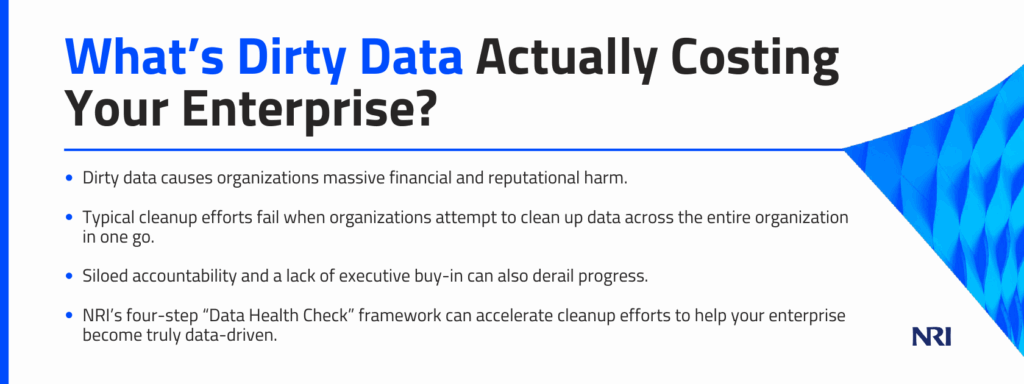
Consider this stunning figure: $12.9 million per year. That’s how much businesses across the U.S. lose due to dirty data, according to Gartner.
Every day, data scientists, knowledge workers, managers, decision-makers, and other employees in organizations must accommodate dirty data in their work by seeking confirmation from other sources and correcting errors, which is both expensive and time-consuming. And even then, errors can still slip through the cracks. For example, suppose a financial analyst corrects a revenue figure in a report but fails to alert the data owner to correct it at the source. In that case, that same incorrect number might later be used to justify budget cuts or hiring freezes. These decisions, made in good faith, would be based on flawed data.
If such unreliability persists, users may come to expect it and be reluctant to leverage your organization’s data in the future. Among other issues, this may cause the adoption of artificial intelligence (AI), machine learning (ML), automation, analytics, and other digital initiatives to stall. Therefore, CIOs must develop a comprehensive program to eliminate the root causes of data quality issues if their enterprises are to become truly data-driven.
In this article, we break down the real financial and strategic impact of poor data hygiene, uncover why most cleanup projects fail, and provide a pragmatic, four-step “Data Health Check” framework for better results. Keep reading.
The True Cost of Dirty Data
When data is incorrect, poorly defined, or incomplete, there are immediate consequences: wasted time, frustrated customers, and increased complexity in executing strategy. You know the sound bites: “Garbage in, garbage out.” Or, more commonly used, “Decisions are only as good as the information they’re based on.” But do you know the actual cost of dirty data to your enterprise?
- Operational Overhead: Data users waste up to 50% of their time on data hunting, identifying potential errors, and seeking confirmatory sources to correct them, according to Harvard Business Review.
- Financial Ripples: Dirty data leads to inaccurate billing, misallocations, and revenue losses of up to $12.9 million annually.
- Strategic and Competitive Risk: Decision paralysis or missteps due to flawed business intelligence (BI) are a real possibility. Picture this: Your marketing team builds a customer segmentation strategy on dirty data and ends up targeting the wrong people with the wrong message. Meanwhile, your competitors leverage clean data to market more effectively and make more informed decisions.
- Regulatory Exposure: GDPR, CCPA, and other data regulations require organizations to maintain accurate and up-to-date customer information. Missing or outdated consent records, misfiled customer requests, or incorrect personal details can attract severe fines.
- Reputational Harm: Credibility with customers and other stakeholders within your ecosystem can also be compromised. For example, in 2022, Equifax issued inaccurate credit scores for 300,000 individuals due to a coding error that introduced dirty data. This led to denied loans for qualified consumers and a subsequent class-action lawsuit. The incident caused Equifax’s stock price to drop by approximately 5% and further eroded public confidence, especially since it followed closely on the heels of a massive breach in 2017.
All this evidence points to one thing: Dirty data is costly. And it raises a critical question: Why does it persist despite organizations attempting to fix it?
Why Typical Cleanup Projects Fail
Most cleanup efforts don’t take off due to the following reasons:
- The “Big Bang” Trap
Organizations often try to “boil the ocean” with a one-time, massive data blitz. Aiming for data quality everywhere, all at once, isn’t the best strategy since not all data is equally valuable. This approach is more likely to create scope creep, stakeholder fatigue, and budget overruns, rather than deliver business benefits.
- Siloed Accountability
Messy handoffs between IT, Ops, and business owners are another hindrance plaguing enterprises that attempt to clean up dirty data. For example, there may be a consensus that quality data matters, but a vague understanding about who owns the data and how it relates to broader enterprise outcomes. Collaboration on, and responsibility for data quality, requires multiple stakeholders for success.
- Lack of Executive Sponsorship
All too often, companies underinvest in executive buy-in for their cleanup efforts. That’s a big mistake. Without leadership support and a clear ROI story, data initiatives usually fail to receive the necessary resources and are easily abandoned when something goes wrong.
NRI 4-Step “Data Health Check” Framework
This lightweight audit can help you jumpstart data quality improvements across fragmented systems.
Step 1: Inventory and Impact Mapping
Catalog your key systems (e.g., CRM, ERP, billing, HRIS) and identify critical data entities (e.g., customers, vendors, assets) and fields (e.g., names, IDs, addresses, contact information). Then assess the basic data health by sampling a few thousand records per system to measure completeness, consistency, and duplication rates. Finally, map everything out in the context of value and risk. Which business use cases face severe risks from dirty data, but can create high value from clean data? Prioritize those.
Step 2: Quantify the Business Cost
According to Gartner, 59% of enterprises don’t measure data quality. This makes it difficult to quantify the actual cost of dirty data and determine the extent of improvement their cleanup exercises deliver.
What gets measured gets improved. Tie each data issue to a concrete business metric. For example, how often do delivery delays occur because of bad addresses? How many customer complaints or refunds stem from incorrect profiles? Work with Finance to estimate revenue leakage, wasted labor, and compliance risk for each problem. Finally, create an internal “cost of inaccuracy” scorecard to elevate urgency with executive stakeholders.
Step 3: Start with Tactical Remediation
Leverage the tools and platforms you already have, like Salesforce, Dynamics, or SAP, to run deduplication, mandatory field enforcement, and validation rules. The key is to get early wins by tackling the low-hanging fruit. You don’t need a perfect data governance framework yet, just visible improvements that build confidence and support.
Step 4: Build Long-Term Stewardship
Establish data stewards within your business and IT functions from the start to make the initiative a shared responsibility. Ensure that remediation goals align with departmental KPIs, such as marketing conversion rates and collections rates. Create clear workflows for escalating issues and implement quarterly health reviews to ensure your data quality program consistently delivers results.
Start Today, Not Someday
You cannot afford to treat data hygiene as an afterthought. AI, ML, customer 360 initiatives, and all your other data applications require clean inputs. As such, data Quality must move left. It must be baked into design, entry, and automation layers from day one.
And here’s the good news. It doesn’t have to be complex. You don’t need to overhaul your entire data estate to make meaningful progress.
Get started with these simple steps:
- Audit a critical system this week. Sample the data. Find the issues.
- Engage your line-of-business leaders in defining what “trusted data” means for their operations.
- Establish a simple monthly data quality dashboard to track the top three to five data quality metrics. Visibility will help drive ownership.
- Partner with an expert to accelerate your path to success.
NRI helps leading companies assess their current data health and explore practical ways to improve data practices. We’d love to do the same for you. Schedule a 30-minute call to learn how our data modernization accelerators can help you embed clean data practices into your digital infrastructure.