
Reports show what happened. Insights reveal why it happened and what to do next. Transform your data into a decision-making machine
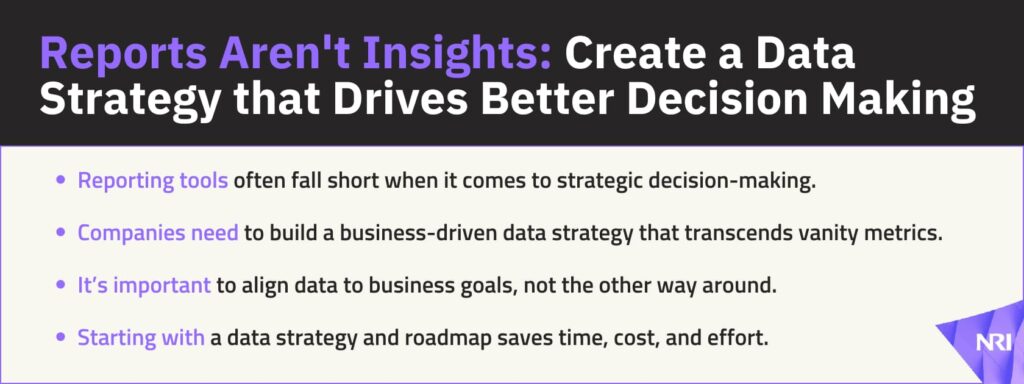
Data reports are full of information, but information alone is not enough. They may tell you what happened, but they rarely explain why it happened or what actions to take next.
The trouble is, many IT executives confuse dashboards and KPIs with strategic insight, so their decision-making is often reactive, siloed, and misaligned with business objectives.
Yes, a new approach is required to build a business-driven data strategy that focuses on unlocking enterprise value and avoids the pitfall of vanity metrics. Here’s how you can move from mere reporting to true insight generation. It’s time to shift the conversation from “what’s the metric?” to “what’s the move?”
When it comes to finding the right moves, this is where NRI comes in. Our data insights can help organizations obtain fast, accurate, and actionable business insights from a single, AI-driven environment. You will be able to unlock operational efficiencies, improve customer satisfaction, and implement the strategy that drives it all.
The Illusion of Insight: Why Reports Aren’t Enough
Data reports only show what happened, while the insights derived from the data, if you leverage them properly, can show why it happened, and, more critically, what to do next. Traditional business intelligence (BI) reports often focus on the past and are frequently disconnected from strategic objectives.
A call center company might track call center efficiency but miss the systemic cause for churn. For example, metrics such as first-call resolution (FCR) and average handle time (AHT) may focus on the call center process while overlooking the underlying reasons for problems. Calls could be addressed in a timely and effective manner, but the real frustration for customers might lie with a poorly designed product that constantly needs fixing.
If a business merely reacts to calls, it misses the opportunity to identify and address systemic problems that cause unacceptably high customer losses. If a particular system error message is causing customers problems, then the company should correct the issue rather than just train agents on how to deal with unhappy customers.
Analyzing customer feedback data can help organizations identify problem patterns and recurring issues, enabling them to prioritize the factors causing the greatest churn.
Understanding the Gap: Reporting vs. Decision Intelligence
Reports are data presentations, while true insights come from action-oriented interpretations of the results. The business impacts of data misalignment can include:
- A constant state of emergency caused by reactive decision-making
- Losing time for strategic thinking because of the need to always put out fires
- Poor customer experiences
- High error rates and inconsistent service
- High staff turnover rates
- Financial losses associated with lost opportunities
Why a Data Strategy Is the Only Way Forward
A well-defined data strategy entails having a clear vision, effective governance, well-defined priorities, and a change enablement process in place.
It involves a detailed plan to leverage data to enhance decision-making, optimize business processes, and achieve your corporate objectives. According to IBM: “A successful data strategy can help a business identify market opportunities, improve products and services, increase customer satisfaction and gain a competitive advantage. . . . [It] provides a step-by-step blueprint of the policies and processes for generating business value from all of [its] data assets.”
NRI believes in the importance of creating strategic roadmaps rather than relying on simple tactical checklists. We strive to align data with customer business goals, not the other way around. We provide expert strategy and planning, and never settle for surface-level fixes.
We help clients grow and transform, thoughtfully aligning technology with purpose. We go beyond merely implementing the latest technology to focus on what matters most: achieving impactful, long-term business goals.
For example, we have collaborated with hospitals and other major healthcare providers to utilize real-time analytics, enhancing patient care and engagement, while also improving operational efficiency.
Creating a Data Strategy
To create a data strategy for better decision-making, it helps to start with a three-lens framework, always remembering that tools should take a backseat to clarity of purpose:
- Lens 1: Business Outcomes First — Decide what you are trying to change, achieve, or improve
- Lens 2: Cross-functional Context — Look at the interdependencies among people, processes, technology, and data
- Lens 3: Data as Infrastructure — Your foundation matters, providing the backbone for a data-driven approach that supports everything from basic storage to advanced analytics.
To assess your readiness to use and implement data, it’s useful to ask yourself five questions at the outset:
- Do you know what insights you need before building dashboards?
- Are your metrics directly tied to business KPIs?
- Can your teams trust the data quality across systems?
- Is your analytics process proactive or reactive?
- Do you have a cross-functional roadmap for data use?
At the same time as you decide how to effectively use data, you must also identify the pitfalls that you should avoid so you don’t waste time and money, and dilute or derail your efforts. For example, avoid falling into the trap of overengineering tools because you don’t have a clear purpose. While technologies that incorporate artificial intelligence and machine learning are highly appealing these days, pursuing them without a solid data foundation is a significant mistake. Also, ensure that there are no misaligned incentives surrounding KPIs, and that your IT, business, and analytics teams don’t operate in unproductive silos.
Case in Point: What Happens When You Get It Right
Laura McCoy, Senior Business Architect for the NRI Strategic Services group, points out the concrete benefits of having a well-scoped data strategy in place in her blog post on using AI to deliver smarter business solutions.
When it comes to insurance claim management, technology can be used to optimize processes by automating the detection of inefficiencies. For example, if the system has a requirement that claims exceeding $500 must be reviewed by a manager, it might cause a bottleneck if, say, 75% of claims meet this criterion.
“AI can identify this inefficiency and analyze fraud data to provide better insights,” explains McCoy. “For example, if 90% of fraudulent claims involve amounts over $1,000, but only 5% of total claims fall into that range, the current rule is unnecessarily delaying most claims.”
By leveraging AI effectively, companies can enhance risk management and significantly expedite claims processing.
Reframe Your Data Investment
As an IT executive or professional, you must ask whether it makes more sense to invest in just information or real intelligence. Should you consider a dashboard or insight velocity more important?
Putting your money where your business strategy is, is always the wise move — and one that NRI is expertly positioned to help you with. Contact us to discover how we can reframe your data investment with a strategy and roadmap that will help you save time and money, boost productivity, and take your business to where it needs to be.