
Discover how cloud-native foundations help you build a sustainable infrastructure ready for what comes next.
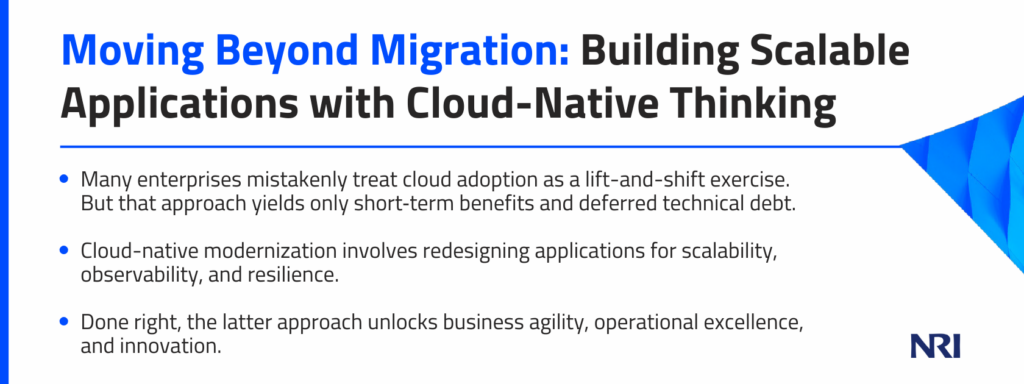
Over the past decade, cloud migration has shifted from an early-adopter initiative to a baseline expectation. Most large enterprises have already moved (or are actively moving) significant portions of their application portfolios to public or hybrid cloud platforms. Yet the anticipated gains in speed, scalability, and innovation have often failed to materialize.
The root cause is increasingly clear: many initiatives focus on infrastructure relocation rather than application and operating-model transformation. Lift-and-shift migration reduces data-center dependency, but it rarely alters how applications scale, how teams deploy changes, or how technology supports business strategy.
Cloud-native thinking addresses this gap. It reframes cloud adoption as a redesign of applications and delivery models, not merely a change in hosting location. As outlined in our Cloud-Native Modernization Guide, organizations that apply cloud-native principles consistently achieve better outcomes in agility, resilience, and cost efficiency. Here’s why smart CIOs are using this approach.
- Scalability Over Stability
Are you lifting and shifting technical debt, or lifting and reinventing our architecture?
For years, many IT leaders have prioritized optimizing for stability. Predictable systems. Fixed capacity. Carefully gated change. Today, that model only delivers short-term comfort. If you want long-term business value, you need a cloud-native architecture built for scalability.
In a cloud-native model, applications are decomposed into microservices, packaged into containers, and orchestrated to scale dynamically. This allows you to expand or contract capacity in real time based on demand, significantly improving cost efficiency and system responsiveness.
In industries such as gaming and hospitality, where demand spikes are frequent and unpredictable, an agile, cloud-native architecture allows organizations to maintain service quality without overprovisioning. In education and government, it allows rapid scaling of digital services during enrollment periods or public events, without compromising performance or security.
Lift-and-shift migrations rarely unlock these benefits. Without architectural redesign, applications often fail to take advantage of native cloud capabilities, limiting both scalability and return on investment.
- Observability as a Value Multiplier
As your architecture becomes more distributed, operational visibility becomes a first-order concern.
Your new environment generates vast amounts of telemetry across services, containers, and platforms, which means you need a robust observability strategy to unify logs, metrics, and traces and gain end-to-end visibility across your distributed systems. Unified telemetry lets you see not only when or where an error occurs, but why. This leads to faster root-cause analysis and issue resolution, as well as more informed decision-making.
Read our article, Implementing Observability: Best Practices for Modern Enterprises, to discover the real benefits of holistic visibility for distributed systems.
- Automation as a Force Multiplier
Cloud-native modernization also redefines how software moves from idea to production.
Automation through CI/CD pipelines and infrastructure as code standardizes delivery, reduces manual error, and enables frequent, low-risk releases. More importantly, it changes the risk profile of change itself.
Instead of large, infrequent deployments, teams deliver small, incremental updates (each observable, testable, and reversible). This means you can build, test, and deploy code hundreds of times more rapidly than you could under old waterfall practices.
What Cloud-Native Really Unlocks
As you can begin to appreciate, cloud-native is not just about moving workloads; it’s about building applications and operating models designed for the cloud from day one. And that creates many advantages for your organization. Let’s break them down:
- Business Agility
Because cloud-native design enables rapid provisioning of environments, automated scalability, and seamless deployment pipelines, your team can experiment safely, release updates continuously, and respond to market or operational spikes in real time.
- Operational Excellence
Because cloud-native applications are observable, automated, and resilient, there’s improved system reliability as well as reduced operational risk. You can surface issues in real-time, run a quick root-cause analysis, and seamlessly implement a solution. The mean time to detection (MTTD) and mean time to resolution (MTTR) are both significantly reduced, freeing your team to focus on more strategic initiatives.
- Strategic Enablement
Cloud-native applications streamline the software development lifecycle and accelerate time-to-market. AI/ML integration, event-driven innovation, and reusable microservices are seamlessly deployed, while cloud connectivity empowers remote teams and enables global access. By shifting hardware and infrastructure management to the cloud, organizations reduce development costs and free teams to focus on innovation rather than maintenance.
NRI’s cloud-native modernization guide highlights how these strategies transform traditional infrastructure into AI-ready, agile systems helping organizations modernize with confidence and build a foundation for continuous innovation.
A Practical Path Forward to Cloud-Native Transformation
So how can you get started? Here’s a deliberate, outcome-focused approach that CIOs and senior IT decision-makers can use to maximize the value of cloud modernisation:
- Assess Cloud-Native Readiness: Evaluate current workloads, dependencies, and goals before any lift-and-shift. Assess not just which applications can move, but which must change to support future business models.
- Reimagine Architecture: Transform monoliths into microservices and containerized apps. Adopt Kubernetes, service meshes, and hybrid cloud so platforms can elastically scale.
- Invest in Observability and Automation: Treat these as core governance capabilities. Embed telemetry and automated pipelines. Use unified dashboards and alerts to drive down MTTD and MTTR, and automate testing and deployment for rapid, reliable releases.
- Build a Strategic Roadmap: Define phased, measurable milestones. Start with customer-facing or high‑risk systems, then progressively modernize core infrastructure. Use Agile governance to iterate and learn.
- Partner with Experts: Engage NRI’s modernization teams to guide architecture design, tool selection, and change management. We can help bridge the skills gap and ensure your cloud-native journey delivers real ROI.
Get Help With Cloud-Native Modernization
Make no mistake: the enterprises that thrive over the next decade will not be those that moved to the cloud fastest, but those that reimagined how technology enables scale, resilience, and continuous evolution. The real question is, will you lead or follow?
Explore how NRI North America’s cloud-native modernization approach can help you unlock value beyond migration and build platforms ready for what’s next.