
Leverage focused change management, practical training, and clear communication to turn technically successful IT projects into fully adopted, value-driven outcomes.
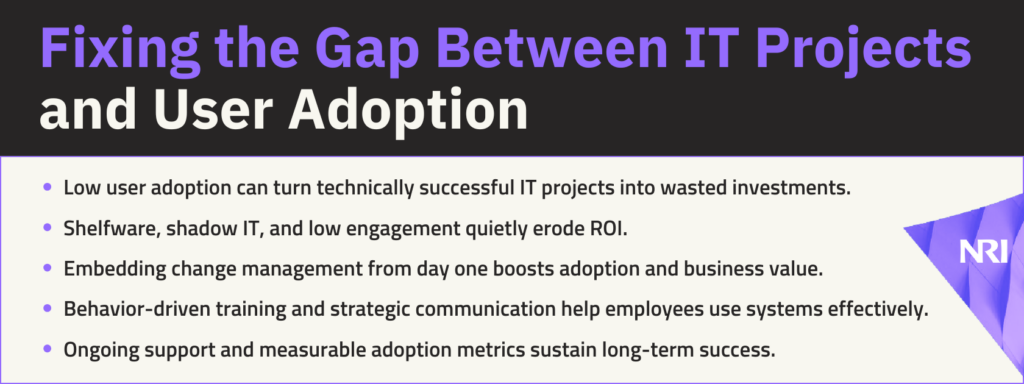
Have you ever delivered an IT project on time and within scope, only to find months later that employees are still relying on old tools and manual workarounds? Resistance to change is a common problem in many organizations.
According to McKinsey & Company research, nearly 70% of digital transformation initiatives fail due to employee resistance and low adoption rates, rather than technical flaws. The biggest risk to your IT investment is often not the system itself, but how well your users embrace it.
If you want your IT investments to truly make a difference, a successful launch alone won’t cut it. You need strong leadership support, clear communication, practical training, and a change management plan that helps people feel confident using the new system in their daily work.
Discover in this blog how to close the gap between project delivery and real-world adoption, so your IT investments translate into measurable business value.
The Hidden Cost of the Adoption Gap
The “adoption gap” is the difference between delivering a working IT system and seeing it used consistently in day-to-day operations. Many projects meet their technical objectives but fall short in real-world use.
Usually, this happens because most of the attention goes into building and launching the system, and far less into preparing people to work differently once it is live.
The adoption gap carries several hidden costs that can quietly undermine your IT investment:
- Shelfware: software that is purchased but rarely used. It ties up budget without delivering any real value, so you end up paying for tools that don’t improve workflows or outcomes.
- Shadow IT: When official systems are hard to use or don’t meet real needs, employees often turn to unofficial tools and workarounds. While it may solve immediate problems, it creates security risks, fragmented data, and inconsistent processes.
- Low engagement: Minimal user interest, training fatigue, or unclear communication means employees don’t fully adopt the new system. The lack of engagement reduces efficiency, weakens ROI, and prevents your IT project from achieving its intended business impact.
The issue is not technical quality. It is the gap between delivery and everyday use. A smooth rollout does not guarantee business value. Adoption is part of the project itself, not something addressed after launch.
Designing for Adoption from Day One
If you want your IT projects to succeed, you need to shift your mindset from simply completing a project to realizing real business value. Adoption shouldn’t be an afterthought; bake it into your planning from day one.
To ensure your IT projects deliver real value, focus on three key actions:
- Embed change management early
Integrate change management into your project planning and governance, and ensure that communication, training, and user support are part of the process alongside technical development. Planning for adoption from the start avoids leaving these critical steps until after launch.
- Align stakeholders from the beginning
Bring IT, business units, and executive leadership together early in the project. When everyone understands their roles and expectations from the start, you reduce surprises and create shared accountability for adoption outcomes.
- Define measurable adoption goals
Set clear adoption metrics along with your technical milestones. Track indicators such as active user engagement, task completion rates, and process improvements. Measuring adoption ensures that you are delivering real value, not just implementing technology.
When change management, stakeholder alignment, and measurable adoption are part of the plan, your IT investments deliver real, lasting business value. Focusing on these steps helps turn a technically successful project into one that people actually use and benefit from.
Behavior-Driven Training That Drives Real Usage
Training is most effective when it focuses on how people actually work, not just on the features of a system. To make training stick, you need to design it around real behaviors and tasks that employees perform every day.
Here are four key approaches to behavior-driven training:
- Role-based enablement
Move beyond generic feature walkthroughs and tailor training to each role. Show employees how the system applies to their specific responsibilities so they understand the direct impact on their work.
- Workflow-focused learning
Focus on executing the real task rather than just the tool’s functionality. Help users practice the steps they will take daily, so they gain confidence in completing actual workflows inside the system.
- Phased learning and micro-training
Reinforce new habits with short, phased learning sessions. Breaking training into smaller, digestible modules prevents overload and encourages employees to adopt changes gradually and sustainably.
- Measure proficiency, not just attendance
Track whether employees can successfully perform tasks, not just whether they attended a training session. Measuring skill mastery ensures that your training translates into real usage and improved business outcomes.
Behavior-driven training turns knowledge into action and helps employees embrace new systems with confidence. When training aligns with roles, workflows, and measurable outcomes, adoption rates improve, and your IT investments deliver true value.
Communication as a Strategic Lever
Clear and strategic communication can make or break adoption. You need to move beyond simple announcements and position your messaging as a tool to drive understanding, engagement, and alignment.
To make communication truly effective, focus on the following four key practices that guide how, when, and to whom you deliver your messages.
- Build a clear narrative
Explain why the change matters and what success looks like. Help employees connect the new system to business goals and their day-to-day work, so they see the value in adopting it.
- Tailor messaging for different audiences
Adjust your communication for executives, managers, and end users. Each group has different priorities and responsibilities, so customizing messages ensures relevance and improves engagement.
- Reinforce messages consistently
Deliver consistent messaging before, during, and after launch. Repetition builds familiarity, reduces confusion, and keeps adoption top of mind for employees.
- Position IT as a business partner
Show that IT is a partner in achieving business outcomes, not just a service provider fixing problems. When employees see IT as aligned with their goals, they are more likely to embrace new systems and processes.
Strategic communication turns IT projects into shared business initiatives. When your messaging is clear, consistent, and audience-focused, you increase adoption and help your organization realize the full value of its technology investments.
Sustaining Momentum Through Integrated Support
Adoption doesn’t end at launch. To keep employees engaged and confident, you need ongoing support that reinforces learning, resolves issues quickly, and continuously improves the user experience.
Here are some key strategies to sustain momentum and ensure long-term success:
- Establish feedback loops
Collect user feedback to identify friction points and areas where the system is difficult to use. Acting on this feedback helps improve usability and keeps employees engaged with the new technology.
- Align support teams with adoption goals
Ensure your service desk, knowledge bases, and support staff are aligned with adoption objectives. When support teams understand how the system should be used, they can guide employees toward best practices and reinforce desired behaviors.
- Track adoption metrics
Measure usage depth, frequency, and the impact on business processes. Monitoring these metrics lets you see how well employees are adopting the system and whether it is delivering the expected value.
- Continuously optimize
Use the data and insights you gather to refine training, communication, and support. Adjust processes as business needs evolve to maintain momentum and ensure long-term adoption success.
Sustained adoption requires more than a one-time effort. Integrated support, ongoing feedback, and data-driven optimization keep users engaged and ensure your IT investments deliver lasting business value.
Turn IT Projects into Value with NRI
The adoption gap doesn’t have to undermine the success of your IT projects. When you treat adoption as a priority from day one and use the right strategies, you can turn technology rollouts into tools that employees actually use and that drive real business value.
At NRI, we know that technology alone isn’t enough. Real value comes when people use systems effectively and consistently. That’s why we position ourselves as a strategic partner, working alongside IT teams to embed organizational change management, design behavior-driven training, and provide integrated support that keeps adoption high.
Contact NRI today to close the adoption gap and drive lasting results.