
Your digital transformation roadmap deserves measurable progress, not another document on the shelf. NRI can help you build the governance and ownership needed to keep execution moving.
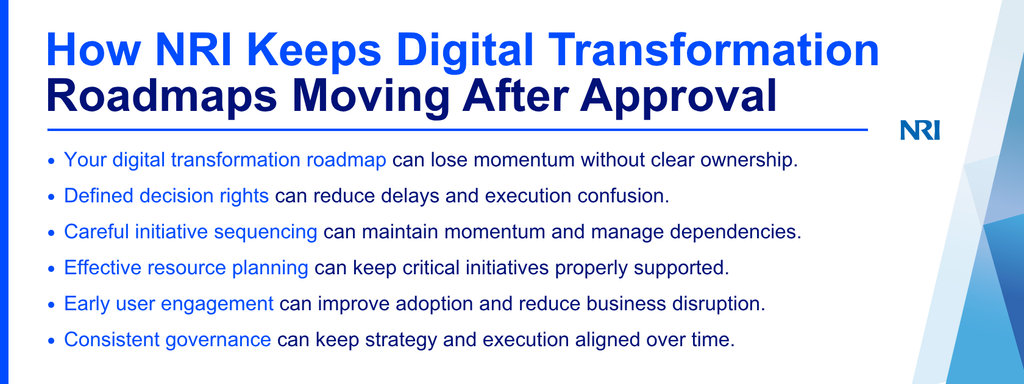
Getting your digital transformation roadmap approved can take months of planning, stakeholder alignment, and budget discussions. Yet approval is only the starting point. Many organizations struggle to maintain momentum once execution begins.
You may have executive support and an agreed technology direction, yet execution can still lose momentum. Ownership becomes unclear, resources get pulled elsewhere, decisions take longer, and employees may resist new ways of working.
User adoption is often where otherwise promising initiatives stall. When employees don’t understand the reason for change or how new tools affect their work, even well-designed technology investments can underdeliver. According to Prosci, 88% of projects with excellent change management met or exceeded objectives, compared with 13% of projects with poor change management.
Fortunately, you can prevent an approved roadmap from becoming another strategy document that never reaches its potential. Clear governance, accountable ownership, thoughtful sequencing, and proactive change management can help you keep priorities moving from approval through execution.
Continue reading to learn how to keep your digital transformation roadmap moving after approval.
Roadmap Execution Framework: How to Turn a Digital Transformation Roadmap Into Operational Momentum
Once your roadmap is approved, your attention needs to shift from planning to coordinated execution. Without clear accountability, priorities can compete for resources while important decisions wait for the right owner.
An effective execution framework gives your teams the structure needed to maintain momentum. Four practical disciplines can help you turn strategic priorities into coordinated action:
- Establish clear governance and decision rights
Unclear decision rights can leave important choices sitting between teams, executives, and project leaders. Named initiative owners should have clear authority to make decisions, resolve roadblocks, manage dependencies, and report progress against defined business outcomes.
Steering committees can also provide a clear escalation path when issues cross departments or affect strategic priorities. As a result, your teams can resolve problems without repeatedly waiting for executive intervention.
- Sequence initiatives around business value
Trying to execute every roadmap initiative at once can stretch your resources and weaken focus. Instead, sequence initiatives around business value, dependencies, organizational readiness, and available execution resources.
Phased milestones also give your teams opportunities to demonstrate progress while supporting longer-term objectives. Early results can reinforce executive support and maintain confidence as larger transformation initiatives continue. They also create opportunities to demonstrate measurable outcomes such as reduced manual effort, improved user adoption, faster reporting, or lower operational risk.
- Align resources and capacity with priorities
Even well-planned initiatives can stall when your people, budget, and external expertise aren’t aligned with execution needs. Resource planning helps you identify capacity gaps before they begin affecting critical dependencies or delivery timelines.
You can then determine where internal expertise is sufficient and where external support makes sense. Clear resource allocation also reduces competition between initiatives that depend on the same people or capabilities.
- Establish an operating cadence for course correction
Your roadmap shouldn’t remain fixed while your business priorities, risks, and technology needs continue changing. Regular operational reviews give your teams a consistent opportunity to assess progress, dependencies, risks, and upcoming decisions.
Executive steering reviews can then address issues that require higher-level direction or priority changes. With that cadence in place, you can adjust execution without losing sight of your broader transformation goals.
By combining these disciplines, your digital transformation roadmap becomes an active execution framework instead of a static strategy document.
Human-Centric Adoption: Ensuring Technology Drives Real Change
Successful digital transformation depends on how effectively your people adopt the technology supporting your roadmap. New systems can meet every technical requirement and still underperform when users don’t understand or embrace them.
Fortunately, proactive change management can help you address those concerns before they begin slowing adoption. NRI’s Adoption & Change Management approach focuses on executive sponsorship, communication, role-based training, feedback, reinforcement, and adoption metrics.
Those activities can support adoption in several practical ways:
- Engage users throughout the transformation
Early communication helps employees understand why changes are happening and how their roles may be affected. Ongoing feedback also gives teams opportunities to address concerns before resistance affects adoption.
- Prepare employees for new ways of working
Role-based training can help employees understand how new systems and processes fit their daily responsibilities. As a result, users can build confidence before technology changes become part of normal operations.
- Reduce disruption during implementation
Change management gives your teams a structured way to prepare employees before major technology changes occur. Clear communication and ongoing support can reduce confusion while helping operations continue during implementation.
- Measure adoption after deployment
Go-live doesn’t automatically mean users have successfully adopted the technology. Adoption metrics such as active usage, process completion rates, support-ticket trends, and employee feedback can show where employees need additional training, reinforcement, or support after implementation.
When your people understand the change and receive consistent support, technology has a clearer path toward sustained adoption.
The NRI Execution Model: Connecting Strategy, Architecture, and Operations
Your transformation roadmap needs a clear connection between strategic priorities and the work required to execute them. Otherwise, planning, implementation, and ongoing operations can become disconnected as initiatives move through different teams.
NRI connects that lifecycle through three core pillars: Strategize & Advise, Build & Transform, and Protect & Manage, creating continuity from planning through implementation and ongoing operations. Each pillar supports a different stage while keeping business objectives aligned with technology execution.
- Strategize & advise
Your roadmap needs clear priorities before teams can execute it effectively. NRI’s IT Advisory & Consulting services align people, processes, data, and technology around actionable roadmaps and business objectives.
NRI also uses prioritization frameworks to help organizations focus on critical objectives and practical execution. That guidance can help you align technology decisions with budgets, timelines, organizational readiness, and delivery risks.
- Build & transform
Once priorities are established, your organization needs to translate strategy into technology that supports business objectives. NRI’s Build & Transform capabilities cover intelligent data and AI, modern applications, business platforms, and end-user technology.
Connecting implementation to the original strategy helps your teams stay aligned as individual initiatives move forward. Your roadmap can then remain connected to business priorities instead of becoming separated from day-to-day delivery.
- Protect & manage
Transformation continues after new technology enters operation because systems still require security, governance, resilience, and ongoing management. NRI’s Protect & Manage capabilities address business resiliency, governance and compliance, cybersecurity, and managed services.
Ongoing management also gives your organization opportunities to respond as priorities and operational requirements change. As a result, technology investments can continue supporting the objectives established within your original roadmap.
By connecting these three pillars, NRI helps you maintain continuity from strategic planning through implementation and ongoing operations.
Common Signs Your Roadmap is Losing Momentum
- Initiative owners are unclear or frequently changing.
- Projects compete for the same resources.
- Executive reviews focus on status updates rather than decisions.
- Adoption lags behind deployment.
- Teams struggle to connect project work to business outcomes.
If any of these challenges sound familiar, it may be time to revisit your execution framework before delays create larger delivery risks.
Put Your Digital Transformation Roadmap Into Motion With NRI
Approved roadmaps can quickly lose momentum when ownership, governance, resources, and user adoption remain unclear. A practical execution framework can turn those priorities into coordinated action while keeping your teams accountable and aligned.
If you’re looking to move in that direction, NRI can help. Our IT Advisory & Consulting services help connect strategy with practical roadmaps, prioritization, organizational readiness, and execution.
Ready to move from planning to execution? Schedule a roadmap activation and governance workshop with NRI to clarify ownership, prioritize initiatives, identify execution risks, and establish the operating cadence needed to keep transformation efforts moving.