
Traditional change management can no longer keep pace with modern transformation. Discover how adoption design empowers IT leaders to create lasting change by aligning culture, behavior, and business outcomes.
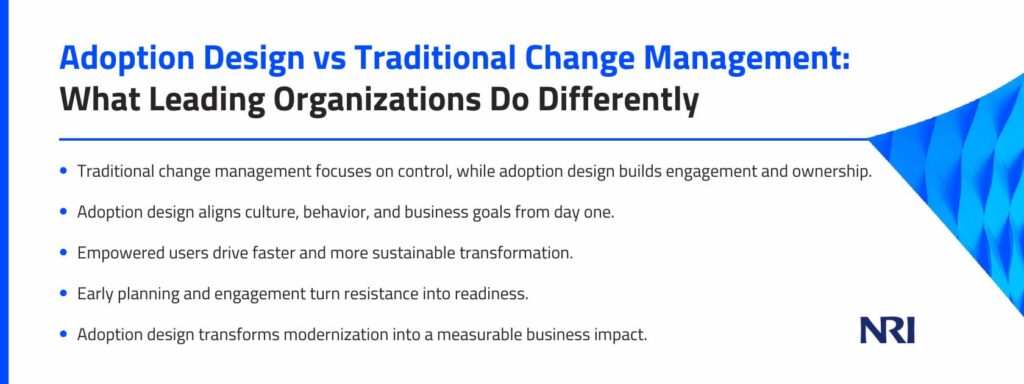
For years, traditional change management has served as the safety net of transformation. Every major initiative came with plans, checkpoints, and communications meant to keep disruption under control. It worked when change was rare and predictable. But the rules have changed.
In today’s digital landscape, transformation is constant. New technologies, cloud migrations, and AI-enabled systems are transforming the way teams work and make decisions. Managing change is no longer enough. Success now depends on how well organizations design change from the start.
A Bain & Company study found that 88% of business transformations fail to meet their original goals, and it is rarely the technology to blame. The real challenges lie in culture, behavior, and organizational readiness, areas that determine whether people truly adopt change or resist it.
Adoption design represents this shift. It creates conditions that help people embrace change by building processes, cultures, and outcomes around them. This article explains how adoption design moves beyond traditional change management, why it matters for modern IT leaders, and how it helps organizations turn transformation into measurable, lasting progress.
Why traditional change management falls short
Traditional change management centered on a world that valued predictability over adaptability. Its decades-old frameworks supported linear, one-time changes, such as new system deployments or process rollouts. That approach made sense when transformation happened occasionally and could be tightly controlled. However, today’s digital transformation is ongoing, fast-paced, and interconnected, and the old playbook can no longer keep pace.
A core weakness of traditional change management lies in its reactive nature. It often enters the project late in the lifecycle, usually right before launch. By that time, resistance has already formed, communication feels rushed, and employees become passive recipients instead of active contributors. This reactive stance overlooks the value of engagement and focuses too heavily on compliance rather than commitment.
Traditional programs also tend to emphasize control instead of empowerment. They rely on top-down communication, checklist-style training, and rigid timelines. While this may reduce short-term disruption, it rarely inspires ownership or lasting adoption.
For IT Directors and VPs driving modernization, the impact of this outdated approach is evident everywhere: underused platforms, shadow IT workarounds, disengaged teams, and missed investment returns.
What adoption design brings to the table
Adoption design approaches change from a completely different perspective. Instead of trying to control it, this model is designed for it, placing people at the center of transformation. It aligns behavior, culture, and business outcomes well before any technology goes live, ensuring that change is not only introduced but embraced.
Where traditional models step in late, adoption design is proactive. Planning begins during strategic alignment and solution design, not after implementation. Employees engage as co-creators and active participants rather than as recipients of change.
Three core strengths define adoption design:
- Human-centered: It prioritizes employees’ real needs, motivations, and behaviors. Communication and engagement strategies resonate with specific roles and contexts, rather than trying to fit everyone into one message.
- Behavior-driven: Instead of relying solely on training sessions, adoption design creates systems for continuous reinforcement, peer advocacy, and visible leadership support.
- Outcome-focused: Success is measured by tangible business impact—improved productivity, higher platform usage, and faster realization of return on investment.
| Traditional Change Management | Adoption Design |
| Minimizes disruption | Maximizes adoption |
| Reactive communication | Proactive engagement |
| Training and comms as an afterthought | Behavior design from the start |
| Top-down directives | Co-creation with champions |
| One-time push | Iterative, measurable improvement |
For IT leaders, this approach aligns modernization with how people actually work. It encourages investment in future-ready IT systems that not only function as intended but also fit naturally into the organization’s rhythm and culture.
Key differences in practice
The distinction between traditional change management and adoption design becomes especially clear in execution.
While traditional methods aim to prevent resistance, adoption design aims to inspire people to champion change. Take cloud migration as an example. In a traditional approach, training modules are typically introduced only a few weeks before launch, far too late to build genuine engagement or confidence.
Adoption design takes a different route. It involves power users from the start, builds trust gradually, and turns them into credible advocates who help onboard their peers. This early inclusion not only accelerates adoption but also strengthens the organization’s readiness for future transformations, fostering a culture of confidence and adaptability.
Practical playbooks for IT leaders
Making adoption design actionable requires structured yet flexible playbooks. These are not theoretical frameworks; they are practical guides that help IT leaders drive engagement, alignment, and measurable results.
- Start the adoption strategy early in modernization initiatives.
Build adoption into the plan rather than adding it at the end. Map out who will be affected, which behaviors need to change, and how the culture can support those changes as soon as a project is scoped. Early alignment prevents adoption from becoming a last-minute effort. - Embed adoption in AI-enabled application rollouts.
AI adoption changes how decision-making and how work gets done. Adoption design helps employees build trust in these systems through transparency and accountability. It ensures users understand how AI enhances their work rather than replaces it. - Align identity migrations with user experience.
Identity and access migrations often create friction when reliability is prioritized over usability. Adoption design prioritizes the user experience by maintaining clear communication, transparent expectations, and visible support throughout the transition. - Build change champions and communities.
Empowering internal champions, especially peer influencers, creates momentum from within. These champions personalize communication, share feedback in real-time, and model the behaviors necessary for successful transformation. Their involvement accelerates adoption across the organization.
Moving toward adoption design
Transitioning from traditional change management to adoption design does not mean discarding existing structures. It means evolving them to meet the needs of modern transformation.
- Audit change maturity
Evaluate how your organization currently approaches change. Is adoption part of the strategy or an afterthought? Do employees trust leadership communications? Maturity assessments reveal gaps and clarify where to begin. - Design adoption frameworks
Create playbooks that align with your culture. Identify the critical behaviors, key influencers, and communication strategies that will ensure sustainable adoption. Integrate this design directly into your IT strategy rather than running it separately. - Pilot in priority initiatives
Start with high-visibility projects such as cloud migrations, AI implementations, or identity modernization. Early wins build momentum and create internal advocates for scaling adoption design. - Define and track meaningful metrics.
Traditional change programs often track completion rates. Adoption design focuses on adoption levels, engagement, productivity, and ROI from transformation—metrics that reflect true business value. - Reinforce and scale
Adoption is not a one-time milestone. Build feedback loops, reinforce positive behaviors, and continuously refine your approach as your organization matures on its modernization journey.
Shift from resistance to designing adoption as a business enabler.
In today’s rapidly evolving technology landscape, success depends on more than just managing resistance. The real goal is to design for adoption. IT leaders who make this shift position their organizations to thrive in a constantly changing environment and turn transformation into a lasting competitive advantage. Adoption design creates change that endures, inspires, and delivers measurable results.NRI helps organizations embed adoption design into their digital transformation strategies. With global experience, proven expertise, and a focus on delivering practical results, we partner with clients to achieve transformation that is both sustainable and strategic. Contact us today to learn how our playbooks can help your organization turn change into an opportunity for growth.