
A Flexera 2026 report found that 78% struggle with software license management, and your organization could be one of them. Use this guide to align Microsoft and Cisco, strengthen governance, and control costs.
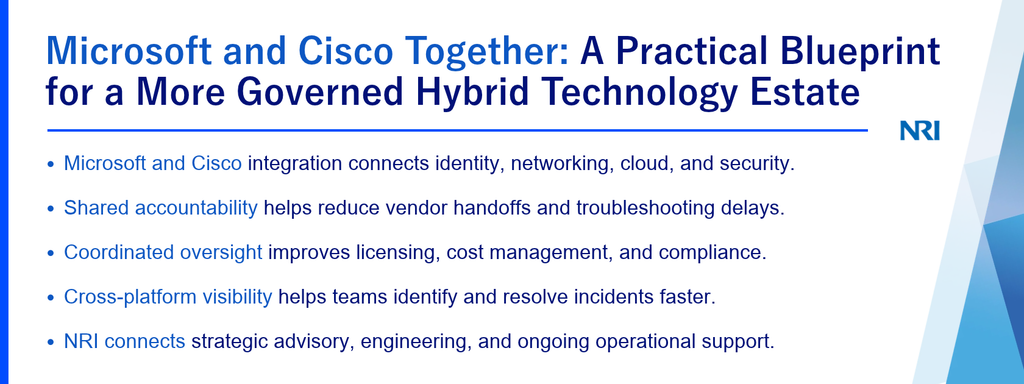
Managing Microsoft cloud applications and Cisco network infrastructure separately can create unnecessary work for your IT team. When a performance issue or security incident involves both platforms, your teams may spend valuable time coordinating vendor handoffs instead of resolving the problem.
The challenge extends beyond troubleshooting. Separate tools, workflows, and governance policies can increase costs, limit visibility, and complicate modernization.
According to Flexera’s 2026 report, 78% of respondents struggled with software license management. That finding highlights the importance of coordinated oversight when managing complex technology investments.
A unified hybrid infrastructure strategy connects Microsoft and Cisco capabilities through shared architecture, security policies, and operational responsibilities. Your teams can manage identity, connectivity, and cloud services with clearer accountability rather than treating each platform independently.
Keep reading to see how Microsoft and Cisco work together and how NRI can support your integration strategy.
Where Microsoft and Cisco Connect: The Core Architectural Touchpoints
Your Microsoft and Cisco investments already support many of the same employees and applications. The opportunity is to connect the controls and support processes around them, so a change in one system doesn’t create an unexpected problem in another.
Start with four key integration areas..
1. Identity and Access
Microsoft Entra ID manages identities and cloud access, while Cisco Identity Services Engine (ISE) controls network access. Cisco Secure Access can extend protection for supported access scenarios. Together, these technologies may support coordinated policies, but the exact integrations depend on your setup.
Consider what happens when an employee changes roles. Can your team update the person’s cloud and network permissions without leaving unnecessary access behind?
Ask for an access-policy diagram showing who approves changes, where controls apply, and how access is revoked.
2. Cloud and networking
If your branches use Cisco SD-WAN and your applications run in Azure, connectivity decisions affect both teams. Azure ExpressRoute offers private connectivity to Microsoft cloud services, while Cisco SD-WAN helps manage traffic between locations.
Rather than assuming the combination will improve performance, have your engineers trace a critical application’s route and test failover.
You need to know what happens when a connection fails and who restores service.
3. Operations and observability
Your security team may work in Microsoft Defender and Microsoft Sentinel while network specialists rely on Cisco ThousandEyes and application teams use AppDynamics.
Each tool offers a different view, which can slow investigations when teams don’t share information.
Identify which alerts and telemetry can be connected, then ask for a sample incident workflow. It should show how your teams recognize the issue, establish business impact, and agree on the next action.
4. Modern work and collaboration
Microsoft 365 and Teams depend on reliable connectivity and secure access. Cisco networking and wireless infrastructure can support those services across offices and branches, but routing and security policies still need careful configuration.
When employees report poor call quality, can support staff distinguish a network problem from a device or Microsoft service issue?
That ability is a useful test of how well your monitoring and escalation processes work together.
The Business Value of a Single Alignment Partner
Having Microsoft and Cisco under one coordinated plan should simplifymake daily IT operations easier, not add another management layer.
When you compare partners, look at how they will handle incidents, spending, and governance across both platforms.
1. Reduce vendor handoffs and resolve issues faster
A slow application shouldn’t leave your cloud and network providers debating who owns the ticket.
Ask a prospective partner to show how an incident moves from detection to resolution, including who coordinates specialists and when escalation occurs.
Compare mean time to resolution (MTTR) and repeated handoffs to see whether support improves.
2. Streamline cloud costs and infrastructure management
Your Microsoft licenses, Azure consumption, Cisco maintenance contracts, and hardware refresh plans may be managed separately.
Reviewing them together can expose underused subscriptions, overlapping services, and renewals that could be better coordinated.
Request a cost baseline and a three-year view of proposed changes, including implementation and support. NRI’s cloud modernization guidance can help frame those investment decisions.
3. Maintain governance and compliance
A consistent security policy is difficult to maintain when access reviews, network changes, and audit reporting sit with different owners.
For example, when someone leaves the company, who verifies that both cloud and network permissions have been removed?
Ask for a responsibility matrix covering access approvals, configuration changes, incident reporting, and audit evidence. It should make clear who decides, who acts, and who confirms completion.
The NRI Execution Model: Unified Advisory, Delivery, and Operations
A coordinated architecture needs people who can connect cloud decisions with network performance and security requirements.
NRI North America brings strategic planning, engineering, and operational support together through its technology capabilities and three core pillars.
1. Strategize & advise: align technology with business goals
Before making changes, NRI helps you assess your existing Microsoft and Cisco investments, identify governance gaps, and set priorities.
That work can shape a roadmap around the applications, controls, and business outcomes that matter most.
2. Build & transform: design an integrated architecture
NRI’s engineering capabilities support cloud, network, and infrastructure modernization.
Our teams can help evaluate supported integrations and design changes around your existing systems, rather than assuming every product combination is appropriate.
NRI’s Azure VMware Solution article offers additional context for hybrid cloud planning.
3. Protect & manage: maintain performance and control
Once the architecture is in place, your teams still need monitoring, security oversight, and clear incident ownership.
NRI’s Protect & Manage services support those ongoing responsibilities so integration doesn’t end at deployment.
Together, these capabilities connect the roadmap, technical delivery, and day-to-day support under a coordinated approach.
Build a Governed, High-Performance Hybrid Estate With NRI
Getting Microsoft and Cisco to work together requires a clear strategy for connecting your cloud, network, and security operations. When these technologies are properly aligned, your IT team can resolve issues faster, maintain consistent controls, and make better decisions about infrastructure spending.
But achieving that alignment takes careful planning, technical expertise, and ongoing support. That’s where NRI comes in. Through our advisory, engineering, and managed services capabilities, we help you connect your Microsoft and Cisco investments while addressing the governance gaps and operational challenges that may be holding your business back.
Talk to NRI about your Microsoft and Cisco infrastructure challenges and how we can help you build a more connected, secure, and manageable hybrid technology estate.