Avoid relying on security tools alone with a managed security strategy that reduces business risk.
You can invest in the best available firewalls, endpoint protection, identity platforms, and cloud security tools. However, those investments only deliver real value when someone continuously monitors alerts, investigates suspicious activity, and responds before threats disrupt the business.
And that’s where many organizations struggle. Security tools generate thousands of alerts, but alerts alone don’t reduce risk. Without clear ownership, defined response processes, and continuous oversight, important threats can remain unnoticed while internal teams manage competing priorities.
According to IBM’s Cost of a Data Breach Report 2025, organizations that use AI and automation extensively across security operations save an average of $1.9 million per breach. However, those savings don’t come from technology alone. They come from combining security tools with experienced people, structured processes, and consistent execution.
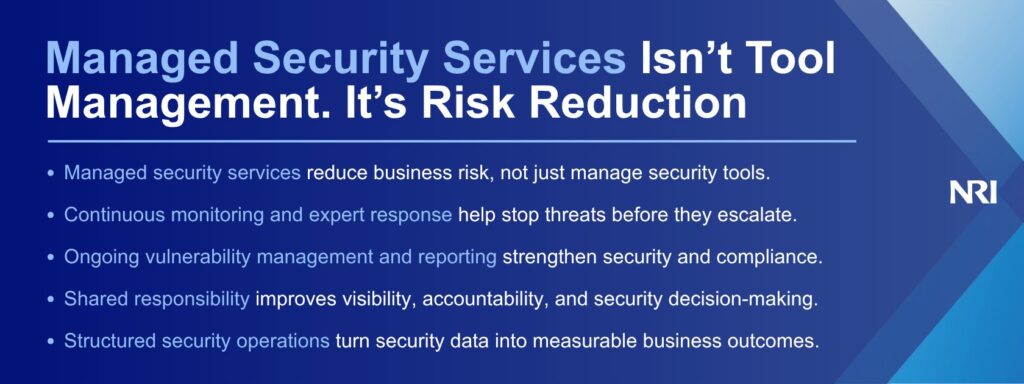
For this reason, managed security services shouldn’t be viewed as another way to maintain security tools. Instead, they provide an operational framework that helps your organization detect threats sooner, respond faster, strengthen compliance, and reduce business risk before smaller issues become costly incidents.
Continue reading to understand how managed security services turn security data into measurable risk reduction while giving leadership greater visibility, accountability, and confidence.
The Difference Between Security Tools and Security Outcomes
Security tools detect threats, collect data, and enforce controls. While those capabilities are essential, they’re only the starting point of an effective cybersecurity strategy. Risk reduction begins when someone reviews the information, determines its meaning, and takes action before a threat affects your business.
Unfortunately, many organizations assume generating alerts is the same as improving security. However, alerts don’t investigate themselves, vulnerabilities don’t remediate themselves, and incidents don’t disappear without clear ownership.
Managed security services bridge that operational gap by combining technology with experienced analysts, defined processes, and continuous oversight. Rather than only monitoring dashboards, they help ensure security events receive the attention they need before becoming costly business problems.
Managed security services support stronger outcomes through:
- Continuous monitoring: Security events are reviewed consistently, not only during normal business hours.
- Alert investigation and validation: Analysts separate genuine threats from false positives and routine system activity.
- Threat escalation: Confirmed threats are quickly directed to the appropriate technical and business stakeholders.
- Remediation guidance: Internal teams receive support for containing incidents, resolving weaknesses, and preventing recurrence.
- Compliance and executive reporting: Leadership receives clear information about risk, response performance, and security priorities.
- Ongoing security reviews: Regular assessments help improve controls, processes, and response readiness over time.
The distinction is clear. Security tools show you what’s happening, while managed security services help your organization decide what to do next. That’s the difference between maintaining technology and actively reducing business risk.
What Kinds of Security Risk Do Businesses Carry Internally?
Your organization can carry significant cybersecurity risk even when the right security tools are already in place. Unfortunately, those risks often grow unnoticed when internal teams are stretched, security operations lack structure, or critical responsibilities fall between teams.
Some of the most common risks include:
- Cyber incident risk: Ransomware, phishing, malware, and unauthorized access can disrupt operations and expose sensitive business data.
- After-hours visibility gaps: Threats don’t stop outside business hours. Without continuous monitoring, suspicious activity may remain unnoticed until it has already escalated.
- Compliance risk: Missing controls, incomplete documentation, or inconsistent monitoring can create regulatory and audit challenges.
- Cloud and identity exposure: Misconfigured cloud resources and weak identity controls increase the risk of unauthorized access.
- Tool sprawl: Too many disconnected security tools create fragmented visibility and make investigations more difficult.
- Alert fatigue: Large alert volumes can overwhelm internal teams, causing genuine threats to be delayed or overlooked.
- Backup and recovery uncertainty: Limited testing and poor recovery visibility can extend downtime after a security incident.
- Limited incident response readiness: Without documented procedures and experienced responders, incidents often take longer to contain and recover from.
Managed security services help reduce these risks through continuous monitoring, expert oversight, and structured security operations, strengthening your overall security posture.
How Managed Security Services Reduce Risk
Reducing risk isn’t about adding more security tools. It’s about ensuring that the right people, processes, and technology work together to detect threats early, respond quickly, and prevent similar issues from recurring.
Managed security services create that operational structure through several core capabilities:
- Defined responsibilities: Clear ownership ensures every security task has someone accountable for monitoring, escalation, remediation, and follow-up.
- Continuous monitoring: Around-the-clock oversight helps identify suspicious activity before it develops into a larger security incident.
- Managed detection and response: Experienced analysts investigate alerts, validate threats, and coordinate timely action to reduce business impact.
- Vulnerability management: Regular assessments identify weaknesses, prioritize risks, and support remediation before attackers can exploit them.
- Remediation tracking: Corrective actions are monitored until identified risks are resolved rather than left open indefinitely.
- Regular security reporting: Executive-ready reports provide visibility into trends, incident response, unresolved risks, and improvement priorities.
Risk reduction doesn’t happen through technology alone. It comes from combining continuous oversight with structured security operations that help your organization stay ahead of evolving threats.
Why Risk Reduction Matters to CFOs, CIOs, CISOs, and COOs
Risk reduction supports both security and business performance by helping leaders make informed decisions and avoid costly disruptions.
- For CFOs: Reducing risk helps limit financial exposure, control unexpected remediation costs, and demonstrate stronger security practices to insurers and stakeholders.
- For CIOs: Greater visibility across the security program strengthens governance, improves oversight, and supports better technology management.
- For CISOs: Mature monitoring, incident response, and reporting help ensure that risks are consistently identified, prioritized, and addressed.
- For COOs: Stronger security operations reduce downtime, support business continuity, and improve operational resilience during incidents.
Risk reduction allows leadership to manage cybersecurity as a business priority rather than treating it only as an IT responsibility.
Compliance Confidence Requires Ongoing Management
Compliance is an ongoing operational discipline, not a once-a-year exercise before an audit. Managed security services support continuous audit readiness by helping organizations maintain:
- Vulnerability tracking and remediation
- Consistent patch management
- Regular security posture reporting
- Documented security controls and activities
- Recurring security reviews and recommendations
Continuous security management makes compliance easier to maintain while reducing the likelihood of gaps in documentation, controls, or remediation during audits.
The Role of Reporting in Security Accountability
Security reporting gives leadership clear visibility into the organization’s security performance and overall risk posture.
Effective reporting commonly includes:
- Executive dashboards
- Security posture trends
- Remediation tracking
- Vulnerability status
- Incident summaries
- Stakeholder-specific reporting
Consistent reporting strengthens accountability by helping leaders measure progress, prioritize investments, and determine whether security risk is actually decreasing over time.
What Managed Security Services Does Not Mean
Choosing a managed security services provider doesn’t mean giving up control of your security program. Instead, it gives internal teams the support they need to manage risk effectively while retaining ownership of business priorities and strategic decisions.
A successful managed security model is based on shared responsibility. Your organization continues setting security priorities and business objectives, while the provider delivers continuous monitoring, expert guidance, structured response, and ongoing operational support.
The goal isn’t to replace internal security capabilities. It’s to strengthen them with the expertise, processes, and visibility needed to manage evolving threats more confidently.
The Real Question Is Who Is Reducing the Risk
Every organization carries cybersecurity risk. The real question is whether that risk is managed through reactive efforts by stretched internal teams or through a structured operating model with continuous monitoring, expert oversight, and clear accountability.
Managed security services help your organization move beyond reacting to individual security events. They create a repeatable approach to risk reduction through continuous monitoring, faster incident response, improved visibility, and ongoing operational improvement.
At NRI North America, we help organizations strengthen the operational side of cybersecurity by combining expert support with proven processes and measurable outcomes. The result is a resilient security program that protects your business while maximizing the value of your existing security investments.
Talk with our team to identify where your organization may be exposing itself to avoidable security risks and to understand how managed security services can strengthen your overall security strategy.