
Break down manufacturing data silos and achieve operational visibility by connecting systems, standardizing data, and turning information into faster operational decisions.
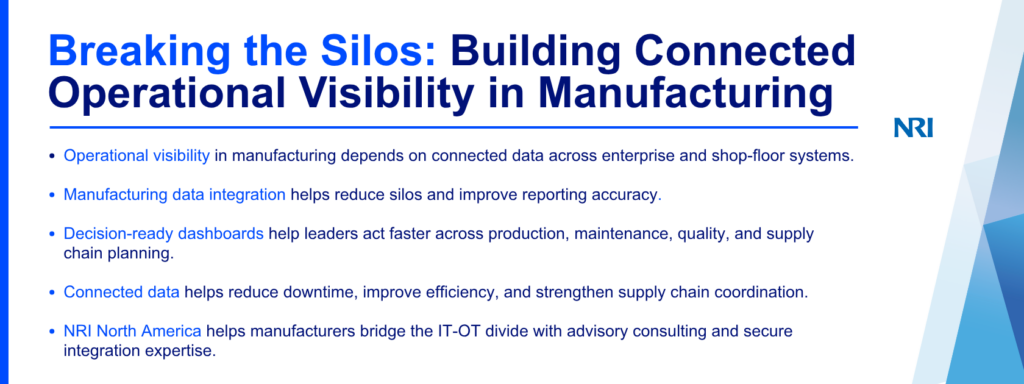
Manufacturers have never had more operational data available than they do today. Every machine, production line, sensor, maintenance activity, and supply chain process generates valuable information throughout the day.
However, collecting data has never been the real challenge. Manufacturers often struggle because critical information remains scattered across ERP platforms, MES, SCADA systems, maintenance tools, spreadsheets, and plant-level applications. As a result, leaders spend valuable time piecing information together instead of acting on it.
Historical reports can explain what happened yesterday, but they rarely help teams respond to what is happening right now. Operational visibility in manufacturing closes that gap by connecting systems, standardizing information, and delivering live insights that support faster decisions across the business.
The business value is already becoming clear. According to industry research, manufacturers using smart manufacturing reported up to 20% higher production output, 20% higher employee productivity, and 15% additional unlocked capacity. AI is quickly becoming a core manufacturing capability rather than an experimental technology. Rockwell Automation’s latest State of Smart Manufacturing report found that most manufacturers are already investing in AI and expect it to improve operational performance, quality, and resilience over the next five years.
Keep reading to learn how manufacturers can connect fragmented data and build real-time operational visibility.
The Hidden Architecture: Where Manufacturing Data Gets Trapped
Manufacturers rarely struggle because they lack data. However, they struggle because every department collects, stores, and uses information differently. Production, maintenance, quality, inventory, procurement, and finance may all have access to valuable insights, yet very little of that information flows seamlessly across the business.
The disconnect often begins with the systems themselves. ERP platforms such as SAP, Oracle, and Microsoft Dynamics manage inventory, procurement, finance, and planning. At the same time, MES and SCADA systems capture machine performance, production activity, and process data on the shop floor. Since these platforms were built for different purposes, they rarely communicate without deliberate integration.
Many manufacturers still rely on spreadsheets, emails, and manual reporting to bridge those gaps. Unfortunately, that approach slows reporting cycles, introduces unnecessary errors, and leaves teams working with information that may already be outdated by the time decisions are made.
Disconnected data also means different teams see different versions of the same operation. Production managers may focus on throughput, maintenance teams monitor equipment health, while supply chain leaders track inventory and material availability. However, no one sees how those activities influence one another across the entire operation.
Operational visibility in manufacturing begins when those barriers disappear. Once enterprise and shop-floor systems work together, leaders gain a connected view of operations instead of relying on fragmented reports from individual departments.
The Blueprint: Moving From Fragmented Silos to Connected Operational Visibility
Disconnected data won’t deliver the visibility manufacturers need to run efficient operations. Organizations also need consistent data, connected systems, and easier access to operational insights so every team can make decisions with confidence.
Building that foundation starts with the following capabilities:
- System Integration
Manufacturing data integration connects ERP platforms, maintenance tools, MES, SCADA, and other plant-level applications through unified data pipelines. Instead of moving information manually between departments, your teams gain a single connected view that supports production, planning, maintenance, and supply chain decisions.
- Data Standardization
Different departments often define the same metrics differently, making reports difficult to compare. Standardizing data definitions helps every team work from the same trusted information, whether they operate across shifts, plants, or business functions.
- Decision-Ready Access
Connected data creates value only when people can use it quickly. Centralized dashboards bring together live production, maintenance, inventory, quality, and OEE data, giving leaders the visibility they need to identify issues early and respond faster.
By combining these capabilities, your organization can transform fragmented data into connected operational visibility, enabling faster decisions across every manufacturing operation.
The Domino Effect: Why Connected Data Solves Your Greatest Manufacturing Hurdles
Connected operational visibility doesn’t stop at helping teams see what’s happening across operations. Once your systems begin sharing trusted data, every department can respond faster, collaborate more effectively, and make decisions with greater confidence.
Some of the biggest improvements include the following:
- Eliminate unplanned downtime with real-time maintenance insights
Maintenance teams can identify equipment issues earlier when machine data moves freely across connected systems. In fact, studies show that predictive maintenance can reduce machine downtime by 30% to 50% while extending machine life by 20% to 40%.
- Synchronize production output with supply chain planning
Production, inventory, procurement, and logistics teams make better decisions when they work from the same operational data. As a result, your organization can respond faster to changing demand, improve inventory accuracy, and strengthen production planning.
- Improve process efficiency and product quality across multiple facilities
Standardized operational data makes it easier to compare performance across plants and identify opportunities for improvement. Meanwhile, teams can detect bottlenecks earlier, replicate successful practices, and maintain consistent quality across all facilities.
By connecting operational data across the business, your organization can reduce disruptions, improve coordination, and create the visibility needed to support continuous operational improvement.
Unlock Real-Time Operational Visibility With NRI North America
Disconnected systems continue to slow operational decisions, even when manufacturers have access to enormous amounts of data. Connected operational visibility solves that challenge by bringing systems, data, and teams together so your organization can respond faster and operate with greater confidence.
If you’re looking to move in that direction, partnering with NRI can help you get there with confidence. With our IT advisory service capabilities, we help manufacturers bridge the IT-OT divide, improve manufacturing data integration, and build secure data foundations that support long-term operational performance.
Ready to eliminate data silos and unlock real-time operational visibility? Talk to our team today and discover how connected operational visibility can help your organization make faster, smarter manufacturing decisions.