
Transforming scattered information into actionable insights with unstructured data analytics.
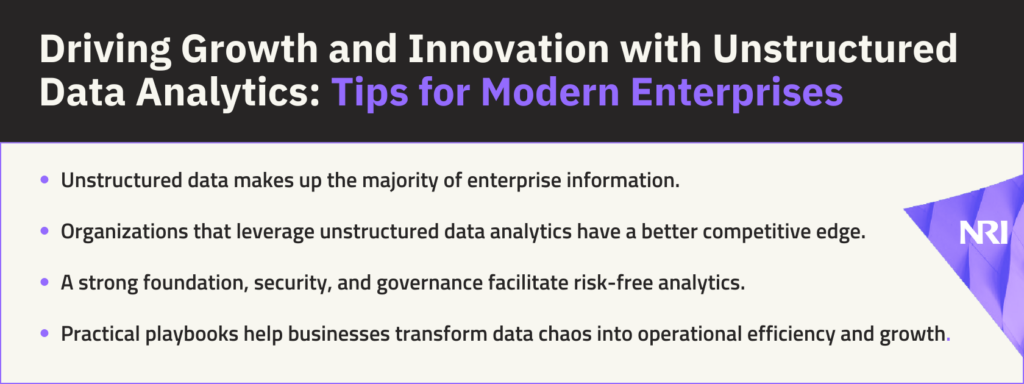
Today, organizations receive vast amounts of data from many sources. Sensors, reports, emails, logs, and customer interactions generate a constant flow of information across every department. However, according to MIT, 80 to 90% of this data is unstructured and rarely analyzed. It resides in disconnected systems, stored in multiple formats, and is often left unused.
This untapped data represents enormous potential. Hidden within it are insights that can improve grid reliability, predict maintenance issues, and strengthen customer engagement. The challenge is not collecting data but turning it into something meaningful and actionable.
With unstructured data analytics, IT leaders can begin to extract value from this data. By applying the right tools, architectures, and governance models, enterprises can move from data overload to data intelligence, transforming unused information into a powerful competitive advantage.
This article outlines how IT directors can build the systems and strategies needed to unlock measurable business outcomes from the unstructured data they already have.
Why traditional approaches fall short
Unstructured data is a treasure chest, but unlocking its value is not easy. Many organizations struggle because they lack the right tools and architecture. They still rely on relational databases and legacy business intelligence systems that were not designed for the complexity of unstructured data. These systems handle structured information well, fitting neatly into rows and columns, but they fall short when dealing with emails, documents, logs, and other free-form content.
The challenge deepens when unstructured data is scattered across departments, systems, and formats. Traditional methods cannot easily connect or interpret information from HR emails, customer feedback, and operational sensor logs simultaneously. The result is fragmented insights, duplicated efforts, and missed opportunities to uncover valuable patterns.
Without the right foundation, data quickly becomes a burden instead of a business advantage. The cost is not only inefficiency but also lost potential. Enterprises that fail to modernize their approach to unstructured data analytics miss out on opportunities for predictive maintenance, richer customer insights, and the ability to make faster and smarter decisions. In today’s competitive landscape, leaving that kind of value untapped is no longer a sustainable option.
Building the right foundation for unstructured data
Turning unstructured information into business value starts with a solid foundation. A well-built data framework ensures that information is collected consistently, stored securely, and readily available for analysis when and where needed. For IT leaders, this is where the transformation from raw data to actionable insight begins.
Every modern data architecture should adhere to a few core principles that enable scalable, reliable, and effective unstructured data analytics.
- Unified data platforms: Cloud-native data lakes or lakehouses consolidate information from multiple sources into a single location. They enable the coexistence of structured and unstructured data, creating a unified environment where teams can perform analysis more easily and comprehensively.
- Metadata and cataloging for discoverability: Data delivers value only when it can be found and understood. Metadata management and cataloging provide clarity and transparency, helping teams quickly locate, interpret, and apply critical unstructured information across departments.
- Integration with structured datasets for full context: Unstructured data alone tells only part of the story. When combined with structured datasets, it provides the context needed to connect operations, systems, and customer experiences, producing richer and more accurate insights.
- Tools and technologies for scale: The volume and complexity of unstructured data can easily exceed the limits of legacy tools. Modern architectures should incorporate AI and machine learning pipelines, real-time streaming analytics, and indexing systems that can efficiently and securely handle massive data flows.
NRI helps enterprises design these modern, vendor-agnostic architectures to ensure flexibility and scalability. Our approach allows IT teams to integrate new technologies, expand analytic capabilities, and future-proof their data environments without being limited by a single platform.
From data chaos to actionable insights
Ensuring your organization has the right foundation is only the first step. As an IT director, you also need to position your enterprise to transform unstructured information into actionable insights that optimize operations, guide decisions, and produce measurable business outcomes.
Here are a few practical ways to get started:
- Optimize operations with sensor and log data: Utilize operational data to forecast demand, identify inefficiencies, and enhance system reliability. These insights help reduce costs, boost efficiency, and ensure that resources are allocated where they deliver the most impact.
- Leverage machine data for predictive maintenance: Analyze patterns from machine and equipment data to predict failures before they occur. This approach minimizes downtime, lowers repair expenses, and extends equipment lifespan while improving overall reliability.
- Enhance customer operations with text and email insights: Information from text and email communication provides valuable visibility into customer needs and preferences. It can highlight service bottlenecks, reveal emerging trends, and improve response times through more personalized and timely engagement.
The key to unlocking the full potential of unstructured data analytics lies in execution. Insights only create value when they are put into action. By transforming unstructured information into clear, data-driven actions, IT leaders can turn what was once overlooked data into a true strategic asset that drives performance and innovation.
Managing risk, compliance, and security
Unstructured data carries inherent risks. Emails, documents, and logs often contain sensitive information that can be targeted or exposed if not properly managed and protected. To transform this data into a trusted asset, IT leaders must emphasize strong governance, consistent compliance, and robust security frameworks. A Zero Trust approach to data flows is crucial for mitigating vulnerabilities and ensuring that only verified users and systems can access sensitive information.
When addressing compliance, focus on optimizing auditability, retention policies, and data residency requirements to ensure effective management. These measures protect both organizational integrity and customer confidence.
Governance should not be viewed as a limitation. Although many governance frameworks involve detailed rules, standards, and workflows, they also create consistency and transparency. When implemented effectively, governance becomes a competitive advantage that enables trust, accountability, and innovation throughout the data ecosystem.
Turning data into a strategic asset
Ready to turn unstructured data into a true performance driver? Start by identifying your key unstructured data sources, running small pilot projects, and tracking early wins. Measure improvements in efficiency, customer satisfaction, and reduced downtime before scaling your initiatives. To maximize the benefits of unstructured data analytics, foster collaboration across teams. Involve IT, operations, compliance, and customer service to ensure every function contributes to insight generation and execution.
With the right playbooks and practices, enterprises can transform unstructured data into a competitive advantage. A strong architecture and foundation remain essential for preventing data chaos from slowing progress. Embedding trust, governance, and compliance into every process ensures that innovation can scale without compromising reputation.
Contact NRI today to discover how we can help your organization transform unstructured data into actionable insights. Together, we can create insights that improve decision-making, strengthen operational performance, and drive long-term growth.