
Enhance Business Continuity with Comprehensive Resilience Strategies
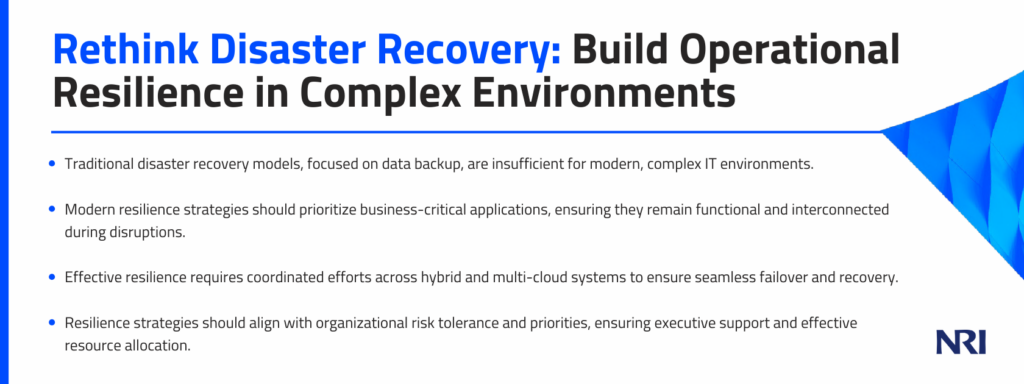
In today’s digital landscape, Disaster Recovery as a Service (DRaaS) is no longer sufficient to ensure business continuity. As organizations increasingly rely on a mix of Software as a Service (SaaS), Infrastructure as a Service (IaaS), and hybrid environments, traditional backup-centric disaster recovery models fall short
Modern resilience requires a comprehensive approach. This article explores a new paradigm in operational resilience, focusing on failover orchestration, app-aware continuity, cyber recovery, and the pivotal role of automation in maintaining business-critical uptime across complex infrastructures.
Why Traditional DRaaS Falls Short in Modern Environments
Historically, disaster recovery focused on creating recovery points and maintaining backups to restore systems after an incident. This approach is no longer sufficient.
The Limits of Backup-Centric Disaster Recovery Models
Traditional disaster recovery models have long relied on the principle of creating recovery points and maintaining backups to restore systems after an incident. The primary limitation of backup-centric models is their focus on data instead of applications. In modern environments, where applications are distributed across various platforms, simply restoring data does not guarantee that applications will function correctly or that business operations will resume smoothly.
Application Sprawl Across SaaS, IaaS, and Hybrid Infrastructure
The digital transformation has led to an explosion of applications across SaaS, IaaS, and hybrid environments. Each platform has its own set of tools, configurations, and dependencies, making it difficult to create a unified recovery strategy. The complexity of managing these diverse environments often leads to fragmented recovery efforts, with some applications restored while others remain offline, disrupting business operations.
Why Recovery Point Objectives Alone Do Not Guarantee Business Continuity
Recovery Point Objectives (RPOs) sometimes define the maximum acceptable amount of data loss in the event of a disaster. However, RPOs alone do not guarantee business continuity. They focus solely on data recovery, neglecting the broader context of application interdependencies and business processes. In modern environments, where applications are interconnected and rely on real-time data, achieving business continuity requires a holistic approach that considers the entire application ecosystems and their interactions.
The Shift from Recovery Planning to Operational Resilience
Given the limitations of traditional disaster recovery models, organizations must shift their focus from recovery planning to operational resilience. Operational resilience encompasses not only data recovery but also the seamless functioning of applications and business processes. By adopting a resilience-focused approach, organizations can better prepare for and respond to the complexities of modern IT environments.
Redefine Resilience Around Business-Critical Applications
Not all applications are created equal; some are mission-critical, while others may be less essential. By categorizing applications by their importance, organizations can prioritize their continuity strategies accordingly.
Identify and Tier Applications Based on Business Impact
The first step in redefining resilience is to identify and tier applications based on their impact on business operations. This involves conducting a thorough assessment of all applications to determine their criticality. Applications that are essential to core business functions, such as customer-facing services or financial systems, should be prioritized for resilience efforts.
Design Continuity Strategies That Account for Interdependencies
Modern applications are often interconnected, relying on data and services from multiple sources. Designing continuity strategies requires a deep understanding of these interdependencies. Map out the relationships between applications and identify potential points of failure to develop a comprehensive continuity strategy that ensures restoration of all system components, minimizing downtime and disruption.
Move from Infrastructure Recovery to App-Aware Recovery Models
Traditional disaster recovery models focus on restoring infrastructure, such as servers and storage, without considering the specific needs of applications. In contrast, app-aware recovery models prioritize restoring applications and their associated data. This approach recognizes that applications are the lifeblood of business operations and ensures restoration while maintaining functionality and performance.
Align Resilience Priorities with Executive Risk Tolerance
Aligning resilience priorities with executive risk tolerance is crucial to ensure the organization’s disaster recovery strategy conforms with its overall risk management objectives. This involves engaging with executive leadership to understand their risk appetite and the potential impact of application downtime on business operations. Align resilience efforts with executive priorities to support strategies at the highest levels, and ensure that resource allocation protects the most critical applications.
Conduct a tabletop exercise, a guided, discussion-driven simulation. Key leaders from across the organization come together, either in person or virtually, to navigate their response to a hypothetical crisis. A facilitator introduces a scenario, such as a cyberattack or a natural disaster, and the team collaboratively explores the steps they would take based on existing strategies.
Failover Orchestration Across Hybrid and Multi-Cloud Systems
When applications and data are distributed across hybrid and multi-cloud environments, coordinating failover processes is crucial. Failover orchestration involves managing the transition of workloads from a primary site to a secondary site. This requires a coordinated effort across distributed platforms and vendors so that all system components are restored in a synchronized manner.
Coordinate Failover Across Distributed Platforms and Vendors
Organizations must work closely with their cloud vendors and service providers to ensure that failover processes are aligned and that all parties understand their roles and responsibilities. This coordination is essential to ensure that failover occurs smoothly and that all system components are restored promptly.
Automate Dependency Mapping to Prevent Partial Outages
One of the key challenges in failover orchestration is managing dependencies across applications and systems. Automating dependency mapping allows organizations to identify and document these relationships, ensuring restoration of all necessary components during a failover.
Test Failover Procedures Regularly to Ensure Reliability
Regular testing of failover procedures is critical to ensure their reliability and effectiveness. Conduct regular failover drills to validate processes and identify potential issues. These tests provide valuable insights into the performance of failover procedures, enabling necessary adjustments to enhance resilience.
Reduce Manual Intervention to Accelerate Restoration
Manual intervention during failover processes can introduce delays and increase the risk of human error. Automating failover procedures eliminates the need for manual intervention and accelerates restoration timelines. Automation ensures that failover processes execute consistently and efficiently, minimizing downtime and restoring business operations as quickly as possible.
Cyber Recovery in the Age of Ransomware
The rise of ransomware and other cyber threats has added a new dimension to disaster recovery. Triple extortion represents an advanced evolution in ransomware tactics. Initially, ransomware attacks focused on encrypting a victim’s data and demanding payment for the decryption key. Double extortion added another layer, in which attackers also exfiltrated data to a different location and threatened to release it unless a ransom was paid. Triple extortion takes this a step further by threatening additional attacks if ransom demands are not paid.
For example, groups like the Vice Society ransomware gang have employed this method, as seen in their 2023 attack on the San Francisco Bay Area Rapid Transit system. As these extortion techniques become more sophisticated, attackers are increasingly using precise negotiation tactics to pressure victims.
Isolate Immutable Backups and Clean Recovery Environments
Immutable backups, which cannot be altered or deleted, provide a secure foundation for recovery efforts. Establish clean recovery environments that are isolated from the primary network to prevent reinfection during the restoration process.
Integrate Threat Detection with Recovery Workflows
By incorporating security tools and practices into their recovery strategies, organizations can detect and respond to threats in real time, minimizing the risk of further damage and ensuring recovery efforts align with the organization’s overall cybersecurity strategy.
- Ensure Identity Integrity During Recovery: Implement robust identity and access management (IAM) practices to verify user and system authenticity during recovery.
- Minimize Dwell Time and Prevent Reinfection During Restoration: Implement rapid detection and response measures to quickly identify and mitigate threats.
- The Role of Automation in Sustained Uptime: By leveraging automation, organizations can continuously monitor system health and trigger predefined response actions in real time to detect potential issues early and implement corrective measures swiftly.
- Continuously Monitor System Health: Automation tools can provide real-time insights into system performance, enabling detection of potential issues before they impact business operations.
- Trigger Predefined Response Actions in Real Time: When a potential issue is detected, automated systems can initiate corrective measures immediately, reducing the time it takes to address problems and minimizing the impact on business operations.
- Integrate Observability Tools with Resilience Frameworks: Observability tools collect and analyze data from various sources to offer insights into system performance, application behavior, and potential vulnerabilities. By integrating these tools with resilience frameworks, you can detect, diagnose, and resolve issues early, ensuring that their systems remain resilient in the face of disruptions.
Create adaptive systems that respond to evolving threats and failures. Automation plays a key role in creating adaptive systems that respond to changes in real time. By leveraging machine learning and artificial intelligence, organizations can develop systems that learn from past incidents and adjust their behavior to prevent future disruptions.
It’s Time to Rethink Disaster Recovery
The changing IT landscape requires a new approach to disaster recovery and operational resilience. Traditional DRaaS models are inadequate for today’s complexities. By focusing on business-critical applications, coordinating failover across hybrid and multi-cloud systems, implementing strong cyber recovery strategies, and utilizing automation, organizations can maintain uptime and business continuity. Adopting these strategies is essential for staying competitive and safeguarding operations against disruptions.
Assess your current disaster recovery strategies and connect with us to develop a comprehensive approach to operational resilience.