Discover how cities are integrating advanced technologies to enhance urban living.
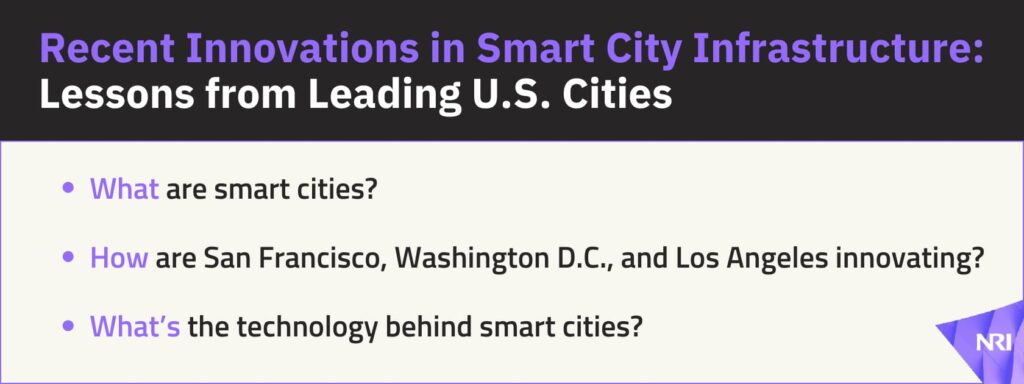
By 2030, 60% of people will reside in cities, per the United Nations Department of Economic and Social Affairs. That figure will rise to 70% by 2050. This urban population growth has the potential to exert more pressure on already-strained services and resource availability in major cities worldwide. So, there’s a need for more efficient solutions to accommodate and better serve new and existing residents. It is on this backdrop that the concept of “smart cities” is gaining traction.
So, what is a smart city? The Smart Cities Council defines it as: “A city that uses information and communication technology to enhance its livability, workability, and sustainability.” Other scholars have replaced “information and communication technology” in this definition with other terms like digital technology, smart technology, or Internet of Things (IoT). And they measure the impact of these technologies through the quality of life of citizens, performance of urban services, and environmental sustainability.
Essentially, a smart city is an urban area that leverages data and modern technology to enhance every aspect of city living. It integrates AI, big data analytics, and IoT to create a seamlessly connected environment where everything, from public services to utilities, operates more efficiently. This results in municipalities that are more resilient, livable, and ready to handle challenges like climate change and population growth.
In this article, we will explore some of the cities leading the smart city movement and discuss how government IT leaders can embrace this new era of urban infrastructure. Let’s dive in!
Spotlight on Innovation (Case Studies from U.S. Leaders)
San Francisco
Traffic congestion in San Francisco has long been a challenge for commuters. For instance, the road stretching from Cesar Chavez to Treasure Island is notorious for slow-moving traffic during morning and evening rush hours. Congestion on this choke point trickles down to the Bay Area, increasing delays for commuters, as well as the total amount of pollution. Other areas, like Downtown SoMa, have also long experienced the same fate. In recent years, the rise of ride-hail vehicles, in addition to the already dense fleet on roads, threatened to intensify congestion.
In response, San Francisco has turned to AI-driven traffic and mobility solutions. The smart city’s traffic management system collects data from over 30,000 IoT sensors mounted on streetlights, traffic signals, and public transit vehicles. It then analyses that data using machine learning (ML) to predict congestion patterns and dynamically adjust signal timings. This strategy has helped improve San Francisco’s transit system’s on-time performance from 72% to 94%.
Washington, D.C.
In Washington, D.C., the Pennsylvania Avenue 2040 (PA 2040) initiative is an excellent example of IoT-enabled public services. Partnering with the Golden Triangle BID and the National Capital Planning Commission, the District has transformed existing streetlight infrastructure into an IoT fabric, embedding environmental sensors, crowd-density monitors, and digital kiosks along America’s Main Street. This network feeds a centralized operations center, where AI models analyze air quality, pedestrian flow, and emergency call data to expedite public safety responses and optimize resource deployment.
Los Angeles
Los Angeles uses digital twin technology to manage the temperature of its urban heat island. ML algorithms process data on vegetation cover, building density, and land use to help Los Angeles city planners predict areas of the city likely to become warmer. This allows them to implement effective cooling interventions, such as installing green roofs, planting trees, and preserving land for public green spaces.
The Tech Behind the Transformation
Behind every smart city lies an intricate web of technologies and devices. The most consequential include:
- IoT Sensors: These devices form the foundational data collection layer in smart cities. They are strategically deployed throughout smart cities to capture real-time data on parameters such as vehicle flow, congestion patterns, water and air quality, structural integrity of bridges, leaks in water pipes, and so on.
- 5G Networks: This is what supports the connectivity of IoT devices. 5G technology allows for the massive amounts of data coming from sensors to be transmitted at lightning-fast speeds.
- Edge Computing: This technology brings computational power closer to where data is generated. It considerably reduces latency and is an essential component of what makes instant decision-making a reality in smart cities.
- AI and ML: Algorithms process and analyze data from sensors to find patterns, make predictions, and accelerate time to insight. AI also automates some aspects of smart city infrastructure.
- Cloud Platforms: These offer scalable storage and on-demand compute for the massive data streams generated by smart-city systems.
- Data Lakes: This technology allows city planners to store data from multiple streams in a single repository for unified analytics and cross-functional insights.
Scaling Smart Cities with Strategic Partnerships
When it comes to transforming cities into more intelligent, more resilient, and citizen-centered environments, the right partnership is essential. Across North America and Europe, forward-thinking municipalities have teamed up with global technology leaders to pilot and scale smart infrastructure projects. Let’s look at two examples.
Kansas City x Cisco
In 2014, Kansas City worked with Cisco to build one of the nation’s first “smart corridors.” This 2.2-mile zone featured:
- Smart LED streetlights with motion sensors
- Public Wi-Fi across commercial zones
- Digital kiosks for real-time transit, safety alerts, and civic engagement
- IoT sensors tracking traffic, environment, and foot traffic
- A unified Cisco Kinetic-based dashboard for multi-agency monitoring
This project redefined cross-agency collaboration, showing how lighting, transit, policing, and economic development can operate on a shared digital backbone. The city also gained visibility into data streams that were previously siloed.
Charlotte x Microsoft
In 2019, the City of Charlotte launched a three-year strategic alliance with Microsoft aimed at advancing its smart city vision with a strong focus on equity, mobility, and sustainability. The partnership centered on the North End Smart District, one of Charlotte’s historically underserved areas.
Microsoft helped Charlotte set up:
- Free public Wi-Fi on buses and in transit centers to bridge digital access gaps
- Smart street lighting to improve safety and energy efficiency
- Real-time data-sharing across first responders and municipal departments
In addition to infrastructure, the initiative prioritized digital inclusion and workforce development, offering community members access to digital skills training powered by Microsoft technologies.
Build Secure, Scalable Foundations With NRI
As cities become more connected, the attack surface expands dramatically. A breach in one domain can easily trickle down to another. Baking Zero Trust principles into the infrastructure can mitigate several risks. Rigorous identity and access management, encrypted data flows, ongoing vulnerability assessments, and robust governance can further fortify the security posture.
Equally critical is future-proofing through modular, interoperable infrastructure design. As technologies evolve, cities must be able to integrate new tools and partners without re-architecting entire systems. Smart cities that build on cloud-native platforms, containerized environments, and open data standards position themselves to scale quickly, securely, and sustainably.
Let’s talk about securely and sustainably bringing your smart city to life.