
A strategy-first M&A IT approach aligns technology with business intent, turning integration into transformation and complexity into long-term value.
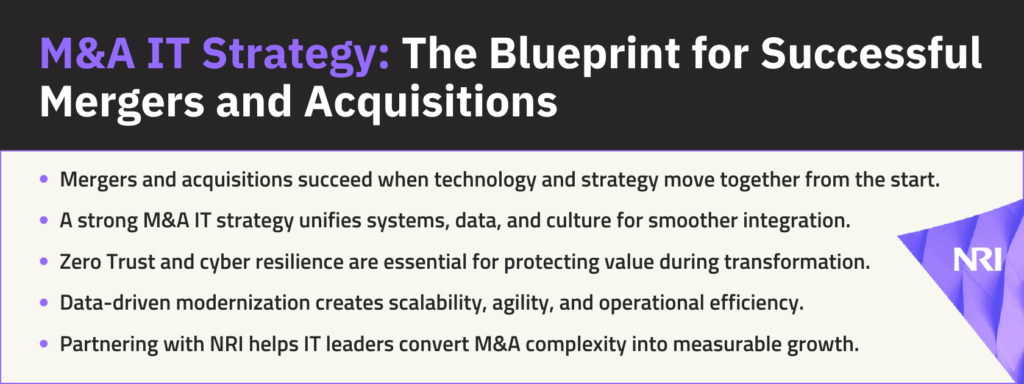
In any merger or acquisition, cost reduction has traditionally been considered the primary driver of success. However, financial outcomes alone are no longer enough in today’s digital and data-driven world. To unlock an M&A’s full potential, organizations must also achieve digital, cultural, and operational alignment. These two components are what enable IT to transition from a supporting role to a strategic one.
The true engine for M&A success is the holistic alignment of People, Process, Data, and Technology (PPDT). The right M&A IT strategy ensures systems integrate smoothly, data flows seamlessly, and business operations continue without disruption.
A strategy-first mindset allows IT leaders to align every integration decision with the organization’s broader business goals. Instead of reacting to technical complexity, they can use M&A as a launchpad for modernization, efficiency, and long-term transformation.
This article examines how IT executives can transform complex integrations into opportunities for innovation, enhance business continuity, and establish a foundation for sustained value creation.
M&A IT Strategy: Aligning technology with business vision
Mergers and acquisitions often start with bold promises: efficiency, scale, and innovation. But to deliver on those promises, you must do more than focus on financial metrics and technology assets. Success begins by aligning technology with the new organization’s vision right from the start. When technology and strategic intent are aligned, plans become measurable results that deliver real business value.
Before any deal takes shape, clarify your goals. Know exactly why this merger is happening and what it aims to achieve. With clearly defined drivers, you can make smarter decisions about which systems to integrate, retire, or modernize. Once the vision is set, that vision must drive the desired behaviors and operating model, which will determine the technology needed for enablement. This could involve modernizing core systems, scaling cloud infrastructure, or improving the customer experience.
After defining your objectives, create an integration roadmap that delivers value consistently and early. Keep it focused on initiatives that move the business forward quickly and efficiently. Without that focus, it becomes easy to spread resources too thin, disrupt operations, and lose long-term value.
Managing complexity: legacy, cloud, and culture
No merger or acquisition is ever simple. Behind every deal lies a network of legacy systems, data silos, and cloud platforms that must function together without disrupting daily operations. True success comes not from eliminating complexity overnight but from managing it intelligently and deliberately.
- Addressing cultural integration to support operational change
Technology integration tells only half the story. The other half focuses on people, culture, and the processes by which they collaborate. When teams with different values and working styles come together, alignment can be difficult and systems struggle to bring those processes, and the people working in them, value. A clear and inspiring vision must first define the new operating model and behaviors required for success. This new structure is what drives the subsequent evaluation and adjustment of technology and tools to effectively enable these strategic plans. Encouraging input and recognizing the cultural strengths from both organizations is crucial for fostering a new, blended identity that drives sustainable success.
- Navigating system sprawl, redundant applications, and fragmented data
Each organization brings its own technologies and processes into a merger or acquisition, often creating overlap and inefficiency. Start with a unified technology vision supporting the combined business’s goals. A holistic review that prioritizes process and team operating models ensures that the subsequent IT assessment identifies systems not just by their complexity, but by their ability to enable the best future approach for the combined business, guiding decisions on consolidation, modernization, or retirement. Strong data governance frameworks ensure consistency by eliminating fragmented data, defining ownership, and maintaining accuracy across platforms. - Bridging old and new technologies without slowing the business
Technology maturity levels between merging entities are rarely equal. One organization may rely heavily on hybrid infrastructure, while the other still depends on legacy environments. Such differences often cause friction during integration. Progressive modernization offers the most effective path forward. Gradually introducing new systems while maintaining existing functionality allows transitions to unfold steadily, protecting uptime and reducing risk.
Security and resilience as non-negotiables
Mergers and acquisitions rank among the most vulnerable periods for organizations when it comes to cyber threats. According to IBM, one in three companies experiences a data breach directly tied to M&A integration. A strong M&A IT strategy must treat security and resilience as foundational, not optional. Even minor configuration gaps or mismatched security protocols can create hidden vulnerabilities as two IT environments converge. Cybercriminals actively monitor these transitions and exploit vulnerabilities to infiltrate networks, steal sensitive data, and disrupt critical operations.
The impact extends beyond financial loss. A single breach during integration can erode stakeholder confidence and stall progress across the entire transformation effort. Therefore, cybersecurity cannot sit on the sidelines; it must be embedded into every stage of the merger process.
Begin by establishing a solid security foundation that prioritizes Zero Trust. This framework adheres to one essential yet straightforward rule: never trust, always verify. Every user, device, and transaction undergoes continuous validation, ensuring consistent protection across legacy and cloud environments during integration.
Cyber resilience and compliance should also remain top priorities. M&A activity often stretches infrastructure and increases exposure, making rapid recovery a critical capability. Planning for the swift restoration of systems and operations helps maintain business continuity in the face of disruptions. At the same time, all actions must align with data privacy and regulatory standards to prevent costly penalties and reputational damage.
The success of any merger depends on operational efficiency and the ability to safeguard data, uphold trust, and maintain uninterrupted operations throughout transformation.
Turning integration into innovation
Mergers and acquisitions should not simply replicate old systems under a new name. Each transaction presents an opportunity to rethink how the organization operates and competes. Using M&A as a platform for innovation can help reshape the business around modern, scalable, and data-driven infrastructure.
Transformation must begin with the people and process elements, which drive data requirements; technology is then strategically chosen to enable these plans. For example, shifting to a cloud-based architecture enables greater agility, while AI and automation streamline processes, enhance accuracy, and lower operating costs. Once these tools are fully integrated, and the people are on board with processes that make it possible, the organization becomes faster, more resilient, and better equipped to adapt to market change.
Partnership also plays a crucial role in realizing this vision. From the beginning, NRI helps organizations design and execute clear M&A IT strategies that align technology with business purpose. Our experts guide clients through every step of integration, from post-merger alignment to long-term digital transformation.Complexity is inevitable during any merger, but with a strategy-first approach, it becomes an opportunity to innovate, accelerate, and build sustainable value. Connect with NRI today to discover how a well-defined M&A IT strategy can turn your next integration into lasting growth.