
Learn how to avoid common M365 migration mistakes 80% of organizations make.
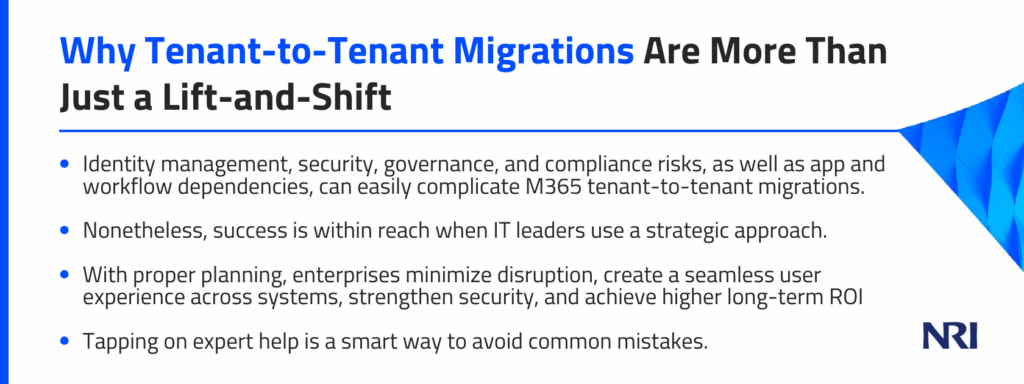
When a merger, acquisition, or restructuring requires consolidating Microsoft 365 (M365) tenants, the request is usually straightforward: “Move users, mailboxes, and files, then shut down the old tenant.”
But it’s rarely that simple.
Nearly 80% of enterprise projects fail due to poor planning and underestimating complexity, according to CIO. Migrations are no exception.
Because a M365 tenant-to-tenant migration touches identity, security, compliance, collaboration, and business-critical workflows, treating it as a basic lift-and-shift can expose your organization to data loss, productivity gaps, security exposure, and other costly downstream consequences. That’s why it’s critical to apply a proven strategy and get expert help if necessary.
Did you know? NRI is hosting a free one-hour webinar on strategic M365 migrations on in January 2026. Learn more.
The Hidden Complexity in M365 Tenant-To-Tenant Migration
Here are the aspects that really make the move challenging:
1. Cross-Tenant Identity Management
Everything in M365 depends on identity. When a user moves from one tenant to another, their identity does not transfer. The new tenant creates a new object with a different ID, requiring you to rebuild all permissions, memberships, and workflow connections.
A new object means the Teams they belonged to, the SharePoint sites they accessed, the flows they owned, and the apps they authenticated against all reference an identity that no longer exists. Even subtle mismatches in identity strategy can cascade into broken access, missing files, and workflows that simply stop running.
Microsoft emphasizes identity alignment as a critical phase of tenant-to-tenant migrations.
2. Security and Compliance Risks
Security is tenant-scoped, and no two organizations enforce security the same way. When you merge tenants, you temporarily operate under two different security models: two sets of conditional access rules, two sets of multi-factor authentication (MFA) experiences, two sets of data loss prevention (DLP) configurations, and two sets of retention policies.
Having multiple security models creates a window of increased risk unless security alignment begins early. Many organizations don’t realize this until after the migration, when users suddenly encounter inconsistent protections or unexpected authentication failures.
3. Governance Alignment
Tenants rarely share identical governance models. Merging two organizations means reconciling who owns what, how data is classified, and which compliance obligations carry over; otherwise, you create blind spots that turn into headaches later during audits.
4. App and Workflow Dependencies
Teams, SharePoint, Power Platform, and third-party integrations all rely on embedded identity and permission structures. Moving only the data while ignoring the relationships leads to broken links and, ultimately, lost access to workflows for your users.
Get the support you need for your M365 migration.
A Strategic Approach Creates Better Outcomes
Because of the aforementioned complexities and the evolving nature of Microsoft 365 environments, technical precision in your tenant-to-tenant migration is critical to success. IT leaders who invest the time to plan their tenant-to-tenant migration properly see better outcomes across the board. Not just during cutover, but long after the project ends.
Minimized Disruption
A migration grounded in discovery, sequencing, and coexistence planning enables teams to keep operations running while the environment evolves behind the scenes. This reduces the pressure of a single “big bang” moment and ensures that each workload moves with intention rather than just speed.
A More Secure End State
Migrations create the perfect opportunity to clean up legacy permissions, retire unused accounts, and move toward modern, unified access policies. With the right approach, your new tenant not only consolidates everything but also strengthens the security posture.
Mature Governance
When governance alignment happens early, the destination tenant becomes easier to maintain and scale. Instead of inheriting two sets of rules, organizations emerge with a unified model that better supports the business and makes collaboration more predictable.
Higher Long-Term ROI
Finally, combining tenants intentionally allows organizations to:
- Eliminate duplicate services
- Streamline licensing
- Standardize governance
- Improve manageability
Those efficiencies compound over time, creating a more predictable, resilient cloud environment.
Treat Your Migration Like a Transformation
Tenant-to-tenant migrations are not simple lift-and-shift events. They’re foundational transformations that impact identity, security, governance, and the workflows employees rely on every day. When approached strategically with disciplined planning and architectural precision, they strengthen the organization rather than disrupt it.
That said, the most successful ones all begin with clarity: an understanding of what exists, how it is connected, and what must change for the destination environment to function at its best.
Therefore, if your organization is approaching a tenant-to-tenant migration, the most important step is to slow down and assess before you move. Start by mapping the following across both tenants:
- Identities and access controls
- Security and compliance policies
- Governance models
- Application and workflow dependencies across
Once done, evaluate the business-critical timelines and risk thresholds, then build the migration strategy around that reality, not the other way around.
Remember, technical execution is only half of the project; the communication and change management around it determine whether employees support or resist the migration, and by extension, whether it becomes successful.
Expert Execution Makes the Difference
If your organization is preparing for a merger, acquisition, or restructuring, the most valuable step you can take today is to begin with a structured discovery and migration roadmap. The sooner you understand the complexity, the more effectively you can navigate it.
The next most valuable step is to seek help from someone who has travelled the journey before.
Experienced teams know where most migrations break down and how to avoid those pitfalls. They bring structured planning, change management, stakeholder alignment, and proven playbooks that keep projects on track. This is especially important for global enterprises or environments with customized workflows, compliance requirements, or legacy configurations. The more moving parts you have, the more valuable expertise becomes.
Don’t let a rushed migration derail your transformation goals.
Get in touch with NRI experts to learn how to assess, architect, and execute your tenant-to-tenant migration with precision.
Or join our one-hourMicrosoft 365 migration webinar in January.