
Assess whether your hybrid cloud strategy is truly ready to support business goals and drive enterprise transformation.
According to Flexera, more than 80% of organizations now operate in hybrid or multi-cloud environments. As a result, hybrid cloud has become the operating model of choice for organizations balancing agility, regulatory requirements, and cost control.
However, adoption alone does not ensure alignment. Many hybrid environments develop incrementally, driven by individual projects rather than a clear enterprise strategy. Over time, this leads to fragmentation, including inconsistent tooling, uneven security controls, and unclear ownership across platforms.
Without a deliberate hybrid cloud strategy, flexibility quickly turns into sprawl. Teams spend more time managing complexity than delivering new capabilities, and innovation slows as operational overhead grows.
This article examines how IT leaders can evaluate whether their hybrid environments are truly future-ready and outlines practical steps to take when they are not.
Why readiness matters now
Cloud adoption has raised expectations across the business. Teams expect faster delivery, predictable costs, stronger security, and resilience that can be measured rather than assumed. When managed with discipline, hybrid cloud supports these demands. Otherwise, the same flexibility that enables growth can introduce risk.
Several pressures are converging and forcing the issue:
- Compliance audits that require consistent visibility and control across on-premises and cloud environments
- Rising cloud costs with fragmented ownership and limited financial accountability
- Security models that differ by platform, creating gaps that attackers can exploit
- Cloud repatriation discussions driven by cost optimization, performance concerns, or governance requirements
These challenges show that hybrid cloud is not just an infrastructure decision. It is a foundation for digital transformation and business resilience. CIOs who succeed in moving ahead treat readiness as a strategic capability, aligning hybrid cloud strategy with enterprise priorities rather than reacting to issues that disrupt operations.
The CIO’s readiness checklist
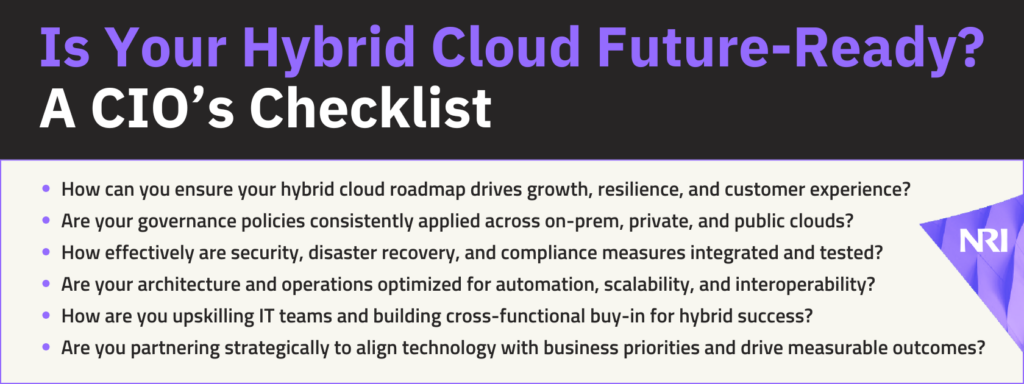
Here’s a checklist to help you assess whether your hybrid cloud strategy is ready to support business goals.
- Strategy & governance
Your hybrid cloud environment can only be future-ready if you start with clarity. Strategy and governance determine whether your technology investments help you achieve business goals or create hidden obstacles. Without a clear framework, your hybrid cloud may drift into fragmentation, adding complexity and slowing innovation. Here’s a checklist to guide you:
- Strategic alignment: Is your hybrid cloud roadmap tied to outcomes like growth, resilience, or better customer experience?
- Governance frameworks: Are identity, access, and data policies applied consistently across your on-premises, private, and public cloud environments?
- Vendor strategy: Does your approach keep your options flexible, or does it lock you into specific platforms that limit future choices?
- Cost visibility: Can you clearly track cloud spending and assign accountability across all platforms?
Good governance isn’t about control for its own sake; it gives you the structure to scale innovation while keeping risk under control.
- Security & resilience
As hybrid cloud environments expand, there are simply more places for things to go wrong. Security becomes more complicated to manage, not because controls do not exist, but because they are used differently across platforms. Closing those gaps requires attention to a few critical areas that determine whether a hybrid environment stays secure and resilient.
- Zero-trust integration: Have you embedded security across all workloads, regardless of where they run?
- Disaster recovery and continuity: Are your recovery plans tested across hybrid platforms, not just assumed to work?
- Compliance readiness: Can you demonstrate adherence to regulatory and industry frameworks at any time?
- AI and automation: Are you leveraging intelligent monitoring and automated responses to handle scale and complexity?
Remember, resilience is not measured by how much you avoid incidents entirely, but more about how quickly and confidently you can respond when they occur.
- Architecture & operations
Your architecture and day-to-day operations directly impact performance, reliability, and scalability. To make your environment future-ready, focus on these key areas:
- Modernization roadmap: Have you clearly decided which legacy workloads to modernize, migrate, or keep on-premises?
- Data strategy: Are you providing unified access to structured and unstructured data across all environments for analytics, collaboration, and operational efficiency?
- Operational efficiency: Have you implemented automation pipelines for provisioning, monitoring, scaling, and remediation, reducing the reliance on manual processes?
- Integration: Can your hybrid systems interoperate seamlessly with SaaS applications, edge devices, and IoT/OT systems where required?
Hybrid cloud environments perform best when operations are predictable, repeatable, and scalable. By establishing these foundations, you reduce risk, increase agility, and free your teams to focus on innovation rather than firefighting routine tasks.
Culture and change management for hybrid success
Hybrid cloud transformation is more than a technical initiative; your people and organizational culture determine whether it delivers sustained value. Even the best tools and platforms will underperform if organizations do not equip teams to use them and if cross-functional stakeholders do not align around common goals.
As hybrid environments grow more complex, the need for new skills becomes urgent. According to a hybrid cloud survey, 62% of IT professionals report that cloud management skill gaps are a barrier to growth.
This trend highlights the importance of readiness and upskilling in hybrid environments, especially in adopting cloud-native practices, embracing shared responsibility models, and adopting an automation-first mindset to keep pace with evolving demands.
Equally important is building cross-functional buy-in. Finance, risk, compliance, and business unit leaders all influence hybrid outcomes; cost decisions, audit readiness, data governance, and risk profiles are shaped far beyond IT alone.
Success hinges on people, not just tech. NRI differentiates itself by pairing infrastructure modernization with adoption and change management, helping you align technology decisions with how teams actually work and how the business operates.
Making the hybrid cloud future-ready
A future-ready hybrid cloud begins with a readiness assessment that exposes gaps in strategy, governance, and operations. This clarifies where the environment misaligns and what teams must fix first.
For instance, immediate improvements should focus on reducing friction and stabilizing day-to-day operations while setting a foundation for longer-term changes. At the same time, governance must be clearly defined across all platforms, including ownership, security controls, and operating standards. Without this clarity, hybrid environments become more complex to manage and more expensive to run.
It is also essential to track progress using metrics that matter to leadership, such as cost control, security risk, and deployment speed. These indicators show whether the hybrid environment is improving in practice or simply becoming more complex to operate.
NRI supports organizations through this process by aligning hybrid cloud architecture, security, and modernization with real adoption and change management. With NRI, hybrid environments stay aligned with business priorities and support faster, more reliable execution. Contact NRI to move from fragmented hybrid operations to a setup that delivers measurable results.