
Closing the AI talent gap shouldn’t drain your budget. Learn how CIOs can build an effective AI talent strategy by developing the right skills, leveraging external expertise, and empowering teams for sustainable AI adoption.
AI adoption is no longer a question of when. The real focus now is on how to use it most smartly and effectively. Every industry is moving forward with AI, yet the talent needed to build, manage, and guide these systems has not kept up. Skilled data scientists, AI engineers, and governance specialists are harder to find than ever, putting real pressure on IT leaders.
The Nash Squared and Harvey Nash 2025 Digital Leadership Report even shows that 51% of global technology leaders are facing an AI skills shortage, the largest rise in any tech skill gap in more than 15 years.
This shifts the conversation entirely. Instead of simply asking, “Where can I hire AI experts?” many CIOs are trying to figure out, “How do I build the right capabilities without overspending?” The challenge grows as AI tools and techniques evolve so quickly that even well-trained professionals can see their skills age fast.
Hiring alone is not a long-term solution. It often becomes expensive and does not always give you the traction you need. A better path is a mix of upskilling your current crew, bringing in targeted outside support, and using tools that make AI easier for more people to adopt.
In this article, you will find out how CIOs can blend these approaches into a talent strategy that keeps the organization competitive, supports the AI roadmap, and stays within budget.
Why AI talent is so scarce (and expensive)
Finding the right AI talent strategy is difficult and often expensive, and there are a few clear reasons why. Most of the top AI skills are concentrated in large tech companies and fast-growing AI startups that can offer top-tier salaries. This puts many organizations at a disadvantage and leaves CIOs struggling to attract and keep the expertise they need.
The pace of AI innovation creates even more pressure. Skills in areas like model development, natural language processing, and AI governance can quickly become outdated, requiring teams to keep learning almost constantly. Very few organizations are set up for that level of ongoing training. On top of that, highly specialized skills, such as identity-first design and advanced AI governance, are rare and costly.
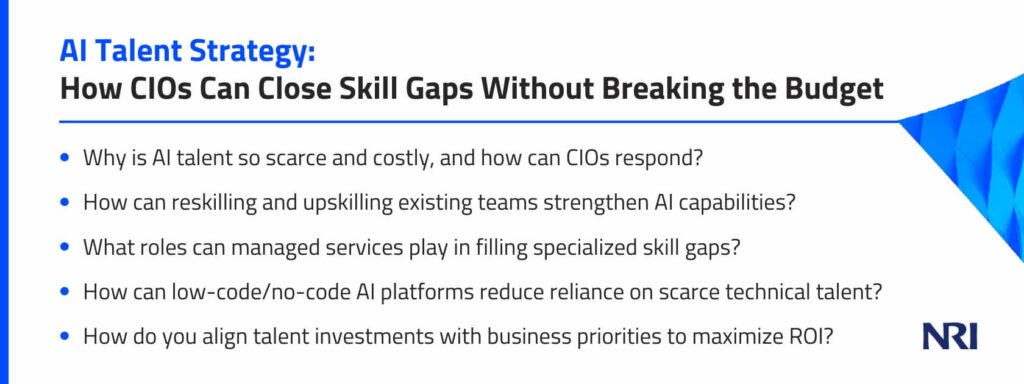
For CIOs, the takeaway is clear. Traditional hiring alone will not close these gaps. A more effective approach is to think creatively about how to grow and support your workforce. This includes:
- Reskilling and upskilling your current crew to build AI literacy and modernization skills
- Using partners and managed services to access deeper expertise without overspending
- Bringing in low code and no code AI tools so more people across the business can contribute
- Making sure skill building aligns directly with business priorities and expected ROI
The focus shifts from simply filling positions to building a capable, adaptable, and ready workforce to support both today’s AI initiatives and those that will come next.
Reskilling and upskilling your existing teams
One of the most effective ways to address AI talent shortages is to invest in the people you already have. By reskilling your current crew, you give them the chance to build AI literacy while strengthening skills in modernization, identity management, and security.
Continuous learning can take many forms. Some organizations rely on online courses and certification paths, while others build internal mentorship programs or run focused bootcamps. Many CIOs also find value in hands-on learning through real projects tied to modernization work. Blending these approaches often yields the strongest results because it provides people with practical experience rather than just theory. It also helps with retention, as employees can clearly see how their growth fits into the organization’s future.
A good example is training your security and infrastructure teams in identity-first design. This ensures your AI adoption is grounded in strong governance practices, giving you a reliable foundation for long-term transformation.
NRI brings a unique advantage in this space. Our workforce transformation playbooks guide CIOs through reskilling strategies aligned with business objectives. Instead of relying on generic training programs, the focus is on practical, measurable outcomes that deliver real value. This helps ensure every investment in talent translates into meaningful progress on your AI roadmap.
Leveraging managed services to fill gaps
Even the strongest internal teams cannot cover every specialized need that comes with AI adoption. This is where managed services become especially valuable. They give you access to advanced expertise without the long-term cost and commitment of hiring highly specialized roles. This is particularly useful in areas such as AI governance, model management, and complex data workflows where the required skills are both rare and expensive.
By handing off these high complexity functions to a trusted partner, you can maintain full strategic oversight while giving your internal crew the space to focus on the work that matters most to the business. Managed services also offer predictable costs, scalable support, and deep technical knowledge that would be difficult or costly to build in-house.
A practical example is the deployment and monitoring of AI models across multiple environments. A managed service provider can handle this end-to-end, while your teams concentrate on integrating those insights into applications, workflows, and decision-making. This approach speeds up adoption, reduces operational risk, and expands your overall AI capabilities without placing additional strain on internal resources.
Democratizing AI through low-code/no-code platforms
Low-code and no-code AI platforms are changing how organizations bring AI into their operations. By allowing both IT and business users to build AI-driven solutions without deep coding skills, these tools reduce dependence on scarce technical talent and help teams move faster.
What makes these platforms so useful is that they open the door to broader participation. Teams can automate customer insights, build predictive analytics, or set up compliance checks without waiting for a data science backlog to clear. When AI becomes accessible to more people, it naturally spreads throughout the organization and becomes part of everyday work rather than something handled by a small, specialized group.
This also benefits highly skilled data scientists and engineers, who can shift their focus to higher-value initiatives like advanced modeling, AI strategy, and innovation projects. In other words, low-code and no-code platforms help you get more out of the workforce you already have. They make AI adoption more scalable, more efficient, and more cost-effective across the entire business.
Aligning talent investment with business priorities
Research shows that not all AI skills carry the same weight, and this is an important point for CIOs to keep in mind. Every investment in talent should connect directly to your business priorities so you can see real returns. When hiring or training occurs without a clear plan, it can lead to wasted resources, uneven capabilities, and teams that are not fully aligned with the organization’s needs.
A practical way to avoid this is to map your skill-building efforts to your AI roadmap. Review the competencies required for your pilots, modernization work, and governance goals. Prioritize the areas that will deliver measurable outcomes, whether that is better productivity, faster delivery, or stronger customer experiences.
The most effective path is a blended workforce strategy. This brings together your internal experts, managed services for specialized skills, and wider adoption through low code and no code AI tools. When these elements work together, you get a flexible, cost-aware, and ready-for-the-future workforce. It also creates a strong foundation for sustaining AI initiatives over the long term.
The CIO’s roadmap for closing talent gaps
Closing AI talent gaps requires a clear and focused plan. Instead of reacting to skill shortages, CIOs benefit from a simple roadmap that shows where the team stands today, what to improve, and which actions will deliver the most value. This keeps investments targeted, reduces unnecessary hiring, and ensures your AI strategy stays aligned with business goals.
Here’s a practical roadmap to move forward:
- Audit current skills – Assess your team’s AI literacy, modernization readiness, and governance expertise to identify gaps.
- Prioritize upskilling – Invest in targeted learning programs that support your most valuable initiatives.
- Evaluate managed service partners – Choose partners who can fill specialized roles while offering predictable costs.
- Pilot low code AI initiatives – Enable IT and business teams to use AI quickly without adding headcount.
Tracking metrics such as skill adoption, project delivery speed, cost-to-value ratio, and ROI helps ensure your talent strategy becomes a true competitive advantage.
A practical path toward sustainable AI adoption
Buying talent on its own is not a long-term strategy. The most sustainable approach is to build and blend your workforce, strengthening identity first and AI modernization skills as the core of your transformation. Managed services and low code or no code platforms help make AI adoption both achievable and cost effective by giving your teams access to the right expertise and tools at the right time.
NRI brings deep experience in AI consulting, workforce transformation, and managed services. Our frameworks and playbooks help CIOs close talent gaps efficiently by combining internal development, targeted external support, and accessible AI tools. This balanced approach accelerates adoption, keeps costs under control, and leads to measurable business results.
If you are ready to turn your AI talent strategy into a competitive advantage, NRI can help. Contact us to explore tailored playbooks designed to reskill teams, tap into managed services, and implement AI solutions that create real business impact.