
Complex workflows and administrative tasks often overwhelm healthcare teams, diverting time from patient care. This guide empowers caregivers with AI and integrated tools that streamline operations and deliver more human-centered services.
According to industry estimates, the healthcare sector generates nearly 30% of the world’s data, and that dependence on information continues to grow as clinical systems become more digital. As a result, caregivers must manage increasing volumes of data while keeping pace with documentation, coordination, and decision-making requirements.
As this reliance on data expands, technology has become more deeply embedded in daily clinical work. Often introduced to meet operational or reporting needs, many systems don’t support how caregivers actually work. Over time, this has led to fragmented workflows, duplicated efforts, and growing administrative pressure that sits alongside already demanding responsibilities.
Another challenge is access. Advanced capabilities such as analytics, automation, and insights are often centralized within IT functions or locked behind complex interfaces. When caregivers cannot easily access or act on information themselves, work slows down, workarounds increase, and the value of existing platforms is never fully realized.
This is where democratizing technology becomes critical. Empowering caregivers with AI means making intelligence and self-service capabilities available directly within the tools they already use. When AI and data-driven platforms are accessible, intuitive, and aligned with real workflows, they reduce manual effort, support better decisions, and allow caregivers to focus on higher-value tasks.
This article explores how healthcare organizations can apply AI and machine learning to democratize technology in practical ways. It focuses on enabling caregivers through accessible tools, clearer data use, and workflow-aligned platforms that strengthen both performance and experience.
The Dual Burden: Digital Demands Meet Workforce Burnout
Healthcare organizations today face a dual challenge as digital expectations continue to rise while workforce strain intensifies. Hospitals and clinics are under constant pressure to adopt advanced technologies to meet patient expectations, satisfy regulatory requirements, and improve operational efficiency.
At the same time, the people responsible for delivering healthcare services are feeling the impact of this acceleration. Clinicians, nurses, and support staff are navigating more complex workflows, switching between multiple platforms, and managing expanding administrative responsibilities alongside their clinical duties.
As these demands converge, the gap between what technology promises and what it delivers becomes more visible. Without tools designed around real workflows, increasing digital requirements amplify stress rather than relieving it, creating an imbalance that affects performance, morale, and sustainability across healthcare organizations.
Empowering Caregivers with Tools That Transform Workflows and Patient Care
Without tools that streamline processes and support caregivers, digital transformation can easily become a source of frustration rather than a solution. To avoid this, healthcare organizations must implement technologies that not only advance care delivery but also reduce cognitive load, restore workflow simplicity, and give caregivers the space to focus on patients.
Here are examples of integrated tools that can reshape the healthcare experience by reducing administrative burden:
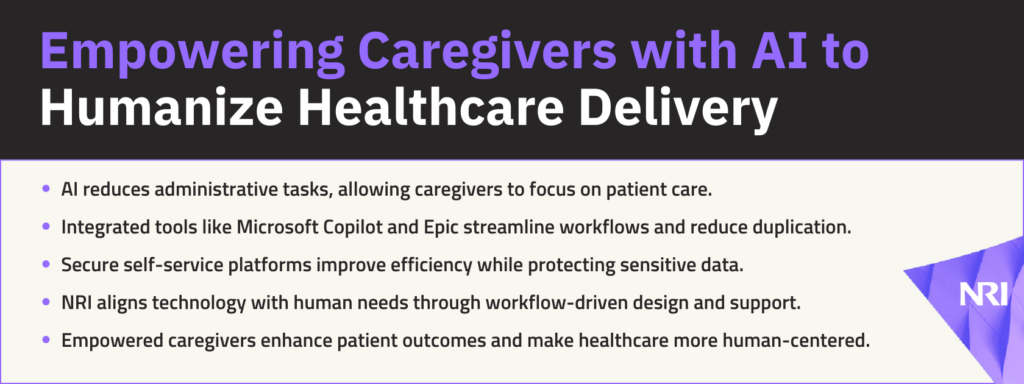
- Microsoft 365 Copilot leverages AI to assist with drafting notes, summarizing patient records, and automating documentation. Reducing repetitive administrative work allows clinicians to spend more time on direct patient interaction.
- Epic integrations connect patient data across systems, providing real-time insights that streamline coordination and reduce the friction of switching between multiple applications. This helps ensure decisions are informed and timely.
- Secure self-service platforms enable caregivers to access, update, and share critical patient information safely without relying on IT support, improving workflow efficiency while maintaining compliance and data security.
These tools do more than simplify individual tasks. When implemented together, they empower caregivers to work with greater clarity and focus, turning digital transformation into a practical enabler of more attentive, human-centered healthcare delivery.
NRI’s Unique Approach to Bridging IT Excellence and Frontline Realities
At NRI, we bring together deep expertise in healthcare technology and an understanding of clinical operations to help healthcare organizations achieve measurable results in platform use and adoption. Our approach focuses on practical execution, ensuring technology supports day-to-day work rather than creating additional complexity. We concentrate on three key areas to deliver this value.
- Reducing shadow IT: We work with healthcare organizations to identify unauthorized or unsupported tools and replace them with secure, approved platforms. By establishing clear policies, offering guidance on safe alternatives, and ensuring caregivers have access to the tools they need, we reduce the reliance on workarounds that bypass IT controls. This strengthens security, protects patient data, and aligns technology use with organizational standards.
- Improving adoption: We support adoption by designing intuitive experiences, delivering structured training, and providing ongoing support that aligns with clinical workflows. This approach helps caregivers use platforms confidently and effectively, reducing resistance while increasing satisfaction and consistency in day-to-day use.
- Ensuring ROI on platform investments: We help healthcare organizations maximize the value of their technology investments by monitoring usage, analyzing outcomes, and refining workflows as needed. By aligning platform capabilities with operational goals, we ensure technology delivers measurable benefits, improves efficiency, and reduces wasted effort.
Through this approach, technology moves beyond a collection of tools and becomes a strategic asset that strengthens operations while supporting the people who rely on it every day.
AI-Enhanced Care for Better Patient Outcomes
AI-supported workflows allow clinical staff to spend less time on documentation and system management, and more time interacting directly with patients. Integrating Microsoft 365 Copilot with Epic workflows streamlines workflows, reduces duplication, and improves collaboration across clinical roles.
Strong integration also improves how information moves between systems, making it easier for caregivers to access what they need without switching tools or re-entering data. This supports faster decisions and reduces delays caused by fragmented systems.
Key benefits include:
- Lower administrative workload: AI assists with documentation, record summaries, and data entry that would otherwise be handled manually.
- More efficient workflows: Integration between Microsoft Copilot and Epic reduces redundant tasks and maintains consistent information across platforms.
- Stronger collaboration: Clinical teams can securely share updates and insights in real time, improving coordination.
- Better decision support: AI highlights relevant information and alerts that support clinical judgment.
NRI works as a healthcare transformation partner, not simply a technology provider. Through people-first analysis, secure deployment, and workflow-driven design, we align platforms with how clinicians actually work.
This approach goes beyond tools. By removing friction created by disconnected systems and limited data access, organizations can support caregivers with clarity and focus, allowing more attention to be directed where it matters most: patients.
Partner With NRI to Streamline Your Technology and Clinical Processes
Empowering caregivers with AI plays a critical role in restoring focus to the work that matters most by reducing administrative pressure and allowing clinicians to spend more time with patients.
NRI’s healthcare transformation model brings together technology, workflow design, and people-first analysis to deliver solutions that improve efficiency, strengthen collaboration, and support better outcomes. Rather than introducing tools in isolation, the model aligns AI capabilities with how clinical work actually happens.
By integrating tools such as Microsoft 365 Copilot and Epic workflows around real operational needs, digital transformation becomes practical and usable, not theoretical. The result is technology that supports clinicians instead of competing for their attention.
Download the Frederick Health and Kroger Health case studies to see how AI and workflow integration work in real healthcare settings.
Schedule a strategy session with NRI to evaluate AI readiness, refine workflows, and equip caregivers with tools that truly support their work.