
Streamline your application portfolio with strategic assessments and change management to safeguard critical business operations.
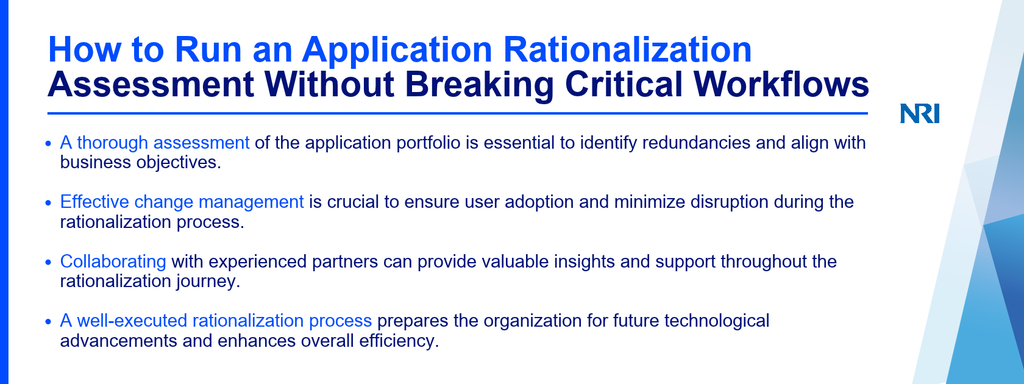
IT leaders face the demanding task of managing extensive application portfolios. These portfolios often become bloated with redundant, outdated applications, driving inefficiencies and higher costs. However, the fear of disrupting mission-critical workflows often deters organizations from undertaking application rationalization.
Application rationalization doesn’t have to put critical workflows at risk. Start with a complete application inventory, identify owners and dependencies, evaluate business value, cost, usage, data, and security, then sequence changes based on risk. The goal isn’t simply to reduce applications. It’s to reduce cost and complexity while protecting operational continuity.
The Danger of Consolidating in the Dark
The biggest risk in application rationalization isn’t retiring an application. It’s retiring one without understanding what depends on it. An application that appears redundant may support an integration, data flow, business process, or user group that isn’t obvious from the application inventory alone. That makes dependency mapping and business-owner input essential before consolidation begins.
To address these challenges, organizations must shift from a reactive approach to a structured, risk-managed rationalization strategy. This involves comprehensively evaluating the application portfolio, identifying redundancies, and aligning applications with business objectives. Organizations can streamline their application portfolios, reduce costs, and prepare for future technological advancements without compromising operational integrity.
What Should an Application Rationalization Assessment Include?
A successful application rationalization framework requires a systematic evaluation of the application portfolio across multiple dimensions. This 10-point assessment framework provides a high-impact breakdown of the core elements that need to be considered:
- Application inventory: Catalog every application in the environment and identify obvious duplication or overlap.
- Ownership: Identify the business and technical owners responsible for each application.
- Total cost: Document licensing, maintenance, support, infrastructure, and other associated costs.
- Usage: Measure how often, how broadly, and by whom each application is used.
- Data: Assess the quality, sensitivity, ownership, and business importance of the data the application manages.
- Dependencies: Map integrations, upstream and downstream systems, data flows, APIs, and workflows that depend on the application.
- Business criticality: Determine which processes and business outcomes depend on the application and what happens if it becomes unavailable.
- Security and risk: Assess security, compliance, supportability, and other material risks associated with retaining the application.
- User impact: Identify the users and workflows affected by consolidation, replacement, or retirement.
- Disposition: Assign a recommended action: Keep, Replace, Retire, or Renegotiate, along with the rationale, dependencies, and conditions required to proceed.
By thoroughly assessing these dimensions, IT leaders can make informed decisions that align with organizational goals and minimize disruption.
Protect Critical Workflows During Consolidation
A core challenge of application rationalization is protecting critical workflows during consolidation. Before retiring, replacing, or consolidating an application , map hidden upstream and downstream integrations and data flows. This ensures no critical connections are severed, which could cause operational disruptions.
Embedding Adoption Change Management (ACM) early in the process is vital. ACM involves communicating milestones, training end users, and maintaining business continuity throughout the rationalization process. By prioritizing user adoption and engagement, organizations can minimize employee friction and secure business buy-in, ensuring a smooth transition to a streamlined application portfolio.
Effective change management requires a proactive approach, including regular stakeholder communication, end-user training and support, and addressing any concerns or resistance that may arise. By fostering a culture of collaboration and transparency, organizations can ensure all stakeholders embrace and support rationalization efforts.
How Do You Turn the Assessment Into a Modernization Roadmap?
Aligning assessment outcomes with a long-term application modernization roadmap is essential for capturing quick financial wins without overloading internal IT bandwidth. A phased approach allows organizations to sequence retirements and migrations strategically. By prioritizing high-impact changes that deliver immediate benefits, IT leaders can demonstrate the value of rationalization efforts and build momentum for further modernization initiatives.
This roadmap should be flexible enough to adapt to evolving business needs and technological advancements. By continuously revisiting and refining the roadmap, organizations can ensure that their application portfolios remain aligned with strategic objectives and technological innovations.
A phased modernization roadmap involves these key steps:
- Prioritization: Start by identifying applications with the greatest potential for cost savings or performance improvements. Prioritize these applications for early phases of the roadmap to quickly demonstrate the benefits of rationalization.
- Sequencing: Plan the sequence of application retirements, replacements, or upgrades to keep critical business functions uninterrupted. This involves careful coordination with business units and stakeholders to align changes with operational schedules.
- Resource Allocation: Allocate resources, including budget, personnel, and technology, to support each phase of the roadmap. Ensuring adequate resources are available is crucial to maintain momentum and achieve project milestones.
- Risk Management: Identify potential risks associated with each phase of the roadmap and develop mitigation strategies. This proactive approach helps prevent disruptions and ensures that the rationalization process proceeds smoothly.
- Continuous Improvement: Regularly review and update the roadmap to reflect changes in business priorities, technological advancements, and feedback from stakeholders. This iterative approach keeps the roadmap relevant and effective over time.
By following these steps, organizations can create a phased modernization roadmap that delivers tangible benefits while minimizing disruption to critical workflows.
How NRI Supports Application Rationalization From Strategy Through Operations
NRI North America offers a comprehensive execution model that connects strategic advisory, modern application delivery, and operational oversight. That means application decisions can be evaluated not only for immediate savings, but also for their impact on modernization, security, operations, and long-term business priorities.
The NRI model consists of three core components:
- Strategize and Advise: Providing strategic guidance to align rationalization efforts with business goals. NRI’s advisory services help organizations identify improvement opportunities and develop a clear vision for their application portfolios.
- Build and Transform: Delivering modern application architectures that support streamlined operations. NRI’s application delivery expertise ensures organizations can implement changes efficiently and effectively.
- Protect and Manage: Ensuring operational governance to maintain portfolio efficiency and security. NRI’s operational oversight helps organizations manage their application portfolios proactively, reducing risks and optimizing performance.
The advantage of connecting these stages is continuity: the rationale established during assessment carries through roadmap development, implementation, adoption, and ongoing operations. IT leaders can make rationalization decisions with a clearer view of both the immediate business case and the downstream operational impact.
What Should You Do After an Application Rationalization Assessment?
Application rationalization should give IT leaders a defensible plan for what stays, what changes, and in what order. The strongest plans connect cost and business value with technical dependencies, security, user impact, and operational risk. That turns rationalization from a one-time cleanup exercise into a practical input for ongoing modernization decisions.
For those ready to take control of their application portfolios, engaging with a partner like NRI North America can provide the expertise and guidance needed to navigate the complexities of rationalization. Contact us today for a comprehensive application-portfolio assessment and rationalization roadmap. NRI helps organizations unlock portfolio efficiency and achieve their modernization goals.